This audience does not have to be told that caring for a loved one with PSP can be a major burden. Two CurePSP Centers of Care have now quantified this using the Zarit Caregiver Burden Scale completed from 2014 to 2022 by 139 caregivers of 131 persons with atypical Parkinsonian disorders. The results are published in Clinical Parkinsonism & Related Disorders. Here’s the scale:
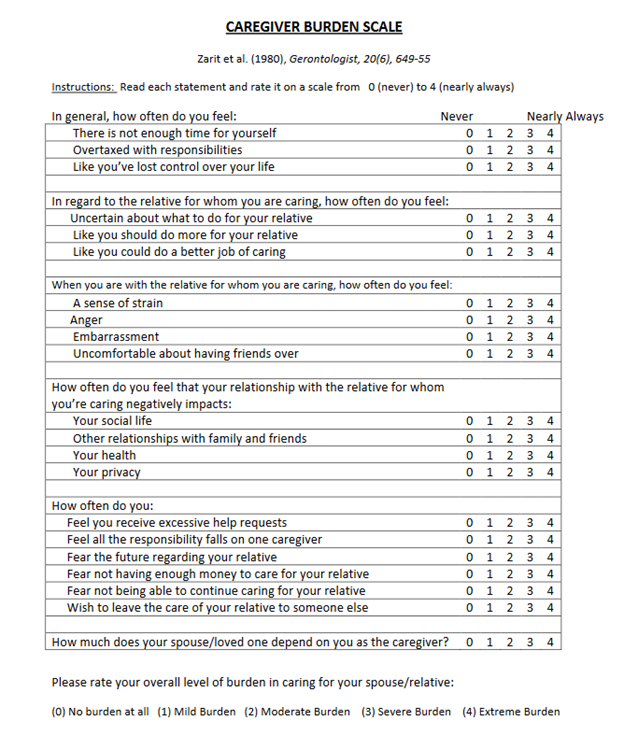
Ninety (65%) of the caregivers were women. Of the 131 patients they were caring for, 59% had PSP, 28% MSA and 13% CBS. The patients were on average about 4.5 years into their illnesses. (All three disorders have about the same average rate of progression and survival duration.) Here are the salient statistically significant results, adjusted for potential confounders as necessary:
- The average (i.e., mean) total score was 28.8 of a possible 88.
- Of the four disorders, PSP, CBS and MSA-cerebellar gave similar average scores, but scores for MSA-Parkinson were milder by a margin of about 8 points.
- Female patients regardless of diagnosis involved a greater caregiver burden than males, regardless of the caregiver gender.
- Female caregivers reported greater burden than males regardless of the patient’s gender or diagnosis.
The authors list several weaknesses of the analysis and propose a prospective study to avoid these. They include the absence of consideration of:
- the relationship between patient and caregiver
- age and any chronic illness of the caregivers
- changes in the score over time
- measures of the patient’s disability, especially falling frequency
The authors’ subjective opinion is that the patient’s cognitive and behavioral deficits are perhaps the most important determinant of the caregiver’s burden. A future study should examine this hypothesis in a formal way.
Adding these variables to the analysis would require a larger number of patient/caregiver pairs. This might be best accomplished in the context of a large treatment trial, where “secondary” and “exploratory” measures always accompany the “primary” measure of the drug’s efficacy. Alternatively, all 36 CurePSP Centers of Care could undertake such a project outside of any treatment trial, assuming adequate funding is available.
The first author of the new paper is Jessica Shurer, a medical social worker who serves as CurePSP’s Director of Clinical Affairs and Advocacy. The two senior authors are neurologists Alexander Pantelyat and Miriam Sklerov, directors of the Centers of Care at Johns Hopkins and the University of North Caroline at Chapel Hill, respectively, The three are credited with having conceptualized the study along with the second-named author, Margaret Ivancic, a medical social worker at UNC.
 PSP Blog
Caring for my husband PSP Richardson, while difficult, was manageable until the last four months of his life. He wanted to be home and I wanted him home. His rapid physical and mental deterioration, though, was shocking to me. Nothing in the past 8 years from first symptoms prepared me for his last months. The sheer collapse of him was unbearable.
Dear Ms. Pawlicki:
I’ve heard the same from many caregivers over the years and understand the stress you’re under.
You raise an important scientific issue, too: How does the Zarit Caregiver Burden score change over the course of the disease and how do the various items evolve in their relative importance? Just doing a cross-sectional study (where each caregiver is surveyed only once) gives a very limited view.
I hope you’re availing yourself of CurePSP’s services for caregivers. Support groups really help.
LG
Hi Dr. Golbe,
I recently read an article about a blood test for tau that could help predict Alzheimer’s – is there any implication for this test with PSP?
https://www.cnn.com/2024/07/28/health/alzheimer-blood-test-p-tau-217-wellness/index.html
Joey,
The test for AD is based on p-tau 217 (tau protein with a phosphate attached to amino acid number 217). That doesn’t happen in PSP any more than in the rest of the population. In PSP, there’s increased p-tau 181, but so far, spinal fluid and blood tests for that haven’t panned out as diagnostic tests.