We saw some real progress against PSP in 2025. This post and the next list my top 10 developments from the past year in approximate and very subjective descending order of importance:
AZP-2006, a drug that enhances the breakdown of abnormal tau protein by the cells’ lysosomes, was found to slow the progression of PSP by 64%. The catch is that even that impressive-sounding result did not reach statistical significance because the trial was too small, having been designed mainly to assess safety. Furthermore, its design did not exclude the possibility of random bias in the selection of the participants. But the sponsor company plans to start a much larger and better trial in the second quarter of 2026 as part of the PSP Trial Platform. My blog post on that is here.
A new subtype of PSP has been identified and named PSP-PF. It was formed from chunks of two of the previously known ten subtypes, PSP-frontal and PSP-postural instability. If confirmed by other researchers, it will probably be the third-most common subtype, and the second-most rapidly progressive. The discovery could allow the expansion of drug treatment trials, which prefer to enroll rapidly-progressing participants, to include a more people with PSP than just the ~half with PSP-Richardson syndrome. My blog post is here.
CurePSP announced its new Biomarker Accelerator Program, offering grants of up to $500,000 for major projects to identify and characterize diagnostic tests for PSP. The program will consider applications involving not only markers to distinguish PSP from other disorders, but also those predicting an individual’s course and to assess change in the disease to use as outcome measures in treatment trials and other research.
Neurofilament light chain, a protein released into the spinal fluid and blood by many kinds of damage to brain cells, accumulated more evidence of its potential as a diagnostic marker of PSP. Although NfL is the most promising fluid marker for PSP, it’s not quite ready for routine use because of as yet insufficient sensitivity, specificity and consistency across different labs. Another major outstanding issue is to what extent blood can replace spinal fluid as a test medium. However, with the publication of each small advance, more research groups and funders become interested.
I’ve been thinking about PSP subtypes a lot lately, mostly because of last week’s report of an eleventh subtype, PSP-PF, comprising elements of the PSP-PI and PSP-F types. See my recent post for more explanation. I’ve read what I can about what causes the various subtypes to prefer slightly different parts of the brain. The general thought on that right now is “tau strains.”
Think of tau as a species, like the dog, and its strains as breeds. Let’s not get into the molecular nature of the inter-strain differences or what produces them. Instead, let’s recognize that those strains could theoretically underlie the differences among the 11 PSP subtypes by introducing differences in predilections for different groups of brain cells sharing a location or function. But this week, another possibility emerged as an explanation of the subtypes’ brain-area preferences: abnormal venous circulation.
The study in Parkinsonism and Related Disordersperformed brain MRIs and routine clinical office exams on 95 people with PSP. Of those, 64 had one of the three “cortical” subtypes (PSP-speech/language, PSP-corticobasal syndrome, and PSP-frontal). The other 31 had one of the “subcortical” subtypes (PSP-Parkinsonism, PSP-progressive gait freezing, PSP-postural instability). There were also 50 healthy participants as controls.
The three groups of participants were compared with regard to the size, number and location of any “white matter hyperintensities” (WMHs), examples of which appear in the MRIs below as the irregular white dots and splotches. In mild form, they’re common in healthy, older people and more so in those with high blood pressure, diabetes and other vascular risk factors. You can see how some of them sit smack up against the black slits in the middle of the brain, the spinal-fluid-filled lateral ventricles, and some are much closer to the outer, convoluted surfaces of the brain, the cerebral cortex. (Image from Inzitari D, Pracucci G, Poggesi, et al. BMJ. 2009 Jul 6;339:b2477. doi: 10.1136/bmj.b2477
The graph below shows the current paper’s main results: (from Fu M-H, Satoh R, Ali F, et al. Parkinsonism and Related Disorders. 2025 Dec 22:143:108170. doi: 10.1016/j.parkreldis.2025.108170).
This graph’s vertical axis is a measure of the WMHs’ total volume, expressed as a percentage of total intracranial volume. The horizontal axis is the WMHs’ location expressed as average distance from the lateral ventricle. The participants with the subcortical subtypes of PSP had the greatest volume of WMHs and their average distance from the lateral ventricles was greatest. The people with the cortical subtypes ranked lower in both measures, and the control participants ranked lowest. However, after correcting for various potential confounders, the differences remained statistically significant only for the areas between 12 and 30 mm from the lateral ventricles.
How to interpret this? Let’s start with some background:
The tiny veins draining blood from the brain are divided into deep and superficial systems. Each flows into its own set of larger veins en route to the heart.
WMHs are areas of scarring. They’re largely of unknown cause, but they correlate with risk factors for stroke, which is mostly related to narrowing of arteries, not veins.
Multiple sclerosis, which produces areas of white matter inflammation and scarring more severe than those of PSP, has been linked to insufficiency of venous drainage of the brain.
Normal-pressure hydrocephalus, which is similar in many ways to PSP and even can have PSP-like changes in the brain cells, has been shown (by the same research group as the present paper) to include insufficiency in one of the deep veins.
The areas of brain yielding the graph’s statistically significant results drain into the deep venous system. They’re unrelated to brain territories supplied by any specific arteries. The authors tentatively conclude that the WMHs may be caused by insufficiency in the brain’s deep venous system. They are appropriately cautious about assigning cause-and-effect, but the obvious question raised by their results is whether narrowing of the deep veins, and not any differences in tau or its post-translational modifications, could explain some, or maybe all, of the variety of PSP subtypes.
—
The authors of this paper overlap with those of last week’s about the new PSP-PF subtype summarized in my last post. All from the Mayo Clinic in Rochester or Jacksonville, they include first author Dr. Mu-Hui Fu working under senior author Dr. Jennifer Whitwell, a veteran leader in PSP-related imaging research.
As I occasionally do, today I’ll create a blog post by combining a reader’s comment on a previous post with my reply. This comment is from Jack Phillips, Chair of the Board of Directors of CurePSP:
Larry, with the more rapidly progressing PSP-PF and its large % of PSP patients, it seems to put even more urgency on our Biomarker Acceleration Program. Do you believe the biomarker program will be able to distinguish between the different subtypes of PSP? Jack
Hi, Jack,
Happy Holidays!
First, let’s assume that further research corroborates the existence, size, and statistical validity of the new subtype called PSP-PF, which isn’t a slam dunk.
You’re right that it would be great to have an accurate way to divide everyone with PSP into a) the two fastest-progressing types (PSP-RS and PSP-PF) and b) all the others. But first, let’s see if that can be done clinically (i.e., using good old history and neuro exam). Now that many of the people with the more aggressive variations of PSP-F and PSP-PI can be grouped as PSP-PF, the remaining, slower-progressing cases of PSP-F and PSP-PI would probably be easier to distinguish from PSP-RS than they were before, so maybe clinical would work well.
As for the ability of CurePSP’s pending biomarker program to do this job better than simple clinical evaluation: The first thing that comes to mind is to image the anatomical location(s) of the most intense tau deposition and/or inflammation in the brain. Second-generation tau PET using the tracers 18F-PI-2620 or 18F-APN-1607 can already do those things to an extent. That technique would now have to be refined and tested for its ability to identify PSP-PF.
So, yes, a PET marker to diagnose PSP-PF (or maybe a PSP-PF/PSP-RS group) is a realistic goal in the next couple of years. But the multi-million-dollar expense of all those experimental PET scans together with the administrative costs would be better handled by the companies making the PET ligands than by a relatively small nonprofit like CurePSP.
As a more affordable alternative to PET, markers of neurodegeneration intensity might be able to distinguish PSP-RS/PSP-PF from the more slowly-progressing PSP types. Measures of atrophy on ordinary MRI (conditioned on symptom duration at the time of the test) might be able to do this to an extent, as might serum levels of neurofilament light chain or inflammation-related compounds.
Perhaps an index combining those two with clinical history and exam could be the ticket. (Or perhaps all those tests would only succeed in identifying the same group of patients, in which case combining them would be pointless. But that would be good to know.) Now, that’s something that the CurePSP Biomarker Initiative could afford to fund.
You’ve all heard of the ten known PSP subtypes. They’re classified into three groups by the general areas of the brain involved (i.e., cortical vs. subcortical). Here’s the list:
Cortical and subcortical (~50% of all PSP)
PSP-Richardson syndrome (PSP-RS)
Cortical (~20%)
PSP-frontal (PSP-F)PSP-speech/language (PSP-SL)
PSP-corticobasal syndrome (PSP-CBS)
Subcortical (~30%)
PSP-Parkinsonism (PSP-P)
PSP-progressive gait freezing (PSP-PGF)
PSP-postural instability (PSP-PI)
PSP-ocular motor (PSP-OM)
PSP-cerebellar (PSP-C)
PSP-primary lateral sclerosis (PSP-PLS)
(As an aside: Neurodegenerative diseases are defined mostly by their pathological (i.e., microscopical) appearance, but each disease so defined may have several possible sets of outward signs and symptoms in the living person, depending on the general locations of the pathology within the brain. We deal with this by hyphenating the names of neurodegenerative diseases, with the pathology first and the clinical picture second.)
Now, to the news: Researchers at the Institute of Science in Tokyo, the Mayo Clinic, and UC San Diego have refined the above subtype classification. First author is Dr. Daisuke Ono, senior author Dr. Dennis Dickson and eight colleagues included 588 autopsy-proven cases of PSP from the Mayo brain bank without evidence of other neurodegenerative diseases. First, they used ChatGPT’s large-language software to extract clinical data from 53,527 pages of medical records, tabulating the order of appearance and progression rate of 12 pre-specified, PSP-related symptoms in each patient. Next, they performed a statistical technique standard for this sort of thing called “cluster analysis,” coupling it with a “decision tree model.” The first revealed groups of symptoms and progression rates that occurred together more often than would be expected by chance. The second worked out a practical, step-by-step way for neurologists to assign an individual patient to a subtype.
The most important result was a new subtype combining some patients with what has been defined as PSP-F with some from PSP-PI. The analysis still found statistical justification for continuing to recognize those two familiar categories as bona fide subtypes on their own. The new subtype, called PSP-PF (the continuous red curve), has the dubious distinction of having the most rapid progression and shortest total survival of all. In the graph below, you can trace a vertical line from where the “median” line crosses the curve for each subtype to find the median survival on the horizontal axis.
The median survival of PSP-PF was 6 years, with a 25-75 interquartile span (i.e., the middle two quarters of the group) of 5-7 years. This compares to PSP-RS, with a median of 7 and a 25-75 span of 6-8. For the subjects remaining in the PSP-PI and PSP-F groups, the median survival figures were 8 and 9 years, respectively.
This re-shuffling isn’t just a statistical detail. In the total group of 588 patients, 188 (32%) had PSP-PF, while only 68 (12%) had PSP-RS. Even considering the bias of any autopsy series toward over- representation of atypical cases, it’s still remarkable that PSP-PF is far more common than the other non-RS subtypes.
All that should be accompanied by the standard scientific conservatism about adopting new findings as textbook-worthy, especially without independent confirmation. Weaknesses in this study, all of which are recognized by the authors, include the following:
When a clinical feature wasn’t mentioned in the records, the analysis treats it as if it were known to be absent.
Quantitative data such as drug dosages, blood tests results, cognitive test results, and imaging details were not considered.
If a symptom onset date was not mentioned in the records, the date of the first relevant physician visit was used as the equivalent.
Having recognized all that, we can still say that an AI-based procedure may have found a pattern in ordinary medical record data that human neurologists and researchers missed.
My title for this post tentatively calls the discovery “unwelcome” only because no one would be glad to learn that their subtype of PSP is more rapidly progressive than they thought. (I’m referring to those people with PSP-PI and PSP-F who would fall within the definition of the new PSP-PF.) But one upside is that the news that a large group of people with PSP has a rate of progression similar to that of PSP-Richardson could allow neurologists to better counsel patients and their families. Another important upside is that perhaps clinical neuroprotection trials could now enroll participants with both PSP-PF and PSP-RS instead of confining themselves to the latter. This could greatly increase the pool of eligible trial participants and shorten the time required for the recruitment and double-blind periods.
The main potential obstacle to enrolling participants with PSP-PF into trials is that the primary outcome measure, the PSP Rating Scale, has not yet been validated for that subtype. But that should be possible to accomplish by identifying people with PSP-PF in existing, longitudinal or retrospective observational cohorts using the decision rubric of Ono et al. Then, one would simply assess the ability of their existing, longitudinally administered PSP Rating Scale scores to track their symptoms over time.
So the “unwelcome” part of this won’t actually change anyone’s PSP for the worse and the upside of speeding up clinical trials would be most welcome.
We still don’t have a great diagnostic test for PSP. The best we can do is about 80%-90% sensitivity, specificity and positive predictive value. In English:
Sensitivity is the fraction of people with PSP who give a positive result on the test.
Specificity is the fraction of people without PSP who give a negative result on the test.
Positive predictive value is the fraction of people with a positive test who actually have PSP.
A single number combining these into something useful in evaluating a single individual — rather than in comparing groups — is the “area under the receiver operating curve” (AUC; see this post for an explanation). The AUC ranges from 0.50, which is no better than a coin toss, to 1.00, which is perfect accuracy. An acceptable diagnostic test typically has an AUC of at least 0.85.
Most of the studies of PSP diagnostic markers have important weaknesses such as:
The studies frequently set up artificial situations such as distinguishing PSP only from PD or normal aging rather than from the long list of other possibilities that must be considered in the real world.
The patients’ “true diagnoses” are usually defined by history and examination alone rather than by autopsy.
The patients included in the study were already known to have PSP by history and exam (or sometimes by autopsy), while the purpose of the marker would be to identify PSP in its much earlier, equivocal stages or in borderline or atypical cases.
The patients with PSP in most such studies are only those with PSP-Richardson’s syndrome, who account for only about half of all PSP in the real world.
The best type of marker so far is ordinary MRI. Recently, a group of neurologists in Athens, Greece led by first author Dr. Vasilios C. Constantinides and senior author Dr. Leonidas Stefanis evaluated the specificity of various MRI-based measurements of brain atrophy. One strength of their study was that their 441 subjects included people not only with PSP and Parkinson’s disease, but also with a long list of other conditions with which PSP is sometimes confused as well as a group of healthy age-matched controls.
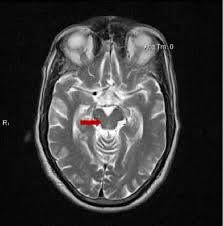
The single best MRI marker per this study was the area of the midbrain, the fat, V-shaped structure indicated below:
They found that MRI markers provided:
High diagnostic value (AUC >0.950 and/or sensitivity and specificity ∼90 %) to distinguish PSP from multiple system atrophy, Parkinson’s disease, and control groups.
Intermediate diagnostic value (AUC 0.900 to 0.950 and/or sensitivity and specificity 80 % to 90 %) to distinguish PSP from Alzheimer’s disease, frontotemporal dementia, dementia with Lewy bodies, and mild cognitive impairment (an early stage usually of AD).
Insufficient diagnostic value (AUC < 0.900 or sensitivity/specificity ∼80 %) to distinguish PSP from corticobasal degeneration, normal-pressure hydrocephalus, and primary progressive aphasia (a language abnormality that can be caused by multiple specific diseases).
Insufficient value to distinguish the non-Richardson PSP subtypes from corticobasal degeneration and primary progressive aphasia, but good performance in the other comparators.
The researchers also concluded that:
One MRI measurement isn’t best for all the possible PSP comparators.
Sometimes a combination of two or three measurements performed better than any single measurement.
One weakness of their method was the use of subjects diagnosed by standard history/exam (i.e., “clinical”) criteria, rather than by autopsy. Another is that their patients with PSP had had symptoms for an average of three years, so these were not subtle or early-stage cases. A letter to the journal’s editor from Dr. Bing Chen of Qingdao City, China further pointed out that the study of Constantinides and colleagues failed to account for the subtle effects of neurological medications on brain atrophy. As PSP and the comparator disorders may be treated with different sets of drugs, taking this factor into account might enhance or reduce the apparent diagnostic value of MRI atrophy measurements.
So, bottom line? Drs. Constantinides and colleagues have given us the first study of MRI markers in PSP to include meaningful numbers of subjects with non-Richardson subtypes. It’s also one of the few studies of any kind of PSP marker to include comparison of PSP a wide range of diagnostic “competitors” beyond just Parkinson’s and healthy aged persons. Another plus is that the test, routine MRI, is nearly universally available, relatively inexpensive, and non-invasive.
The hope is that Pharma companies or others with candidate drugs will now have fewer or lower hurdles in the way of initiating clinical trials.
In medical school, we were taught, “If you hear hoofbeats, consider horses, not zebras.” While it’s true that more common diseases are more likely in a given situation, occasionally rare things do occur. A great example is Wilson’s disease, because it’s a “zebra” that’s highly treatable, and failure to diagnose and treat it could be devastating.
Wilson’s is quite rare — a bit less than half as common as PSP. It usually starts during late childhood, but occasionally does so as late as age 55. It’s caused by a mutation in a gene related to the metabolism of copper, which accumulates in parts of the brain and in the liver to toxic effect. It causes a long and variable list of neurological symptoms and can occasionally mimic PSP to a degree. That’s why our 2024 review called “A General Neurologist’s Practical Diagnostic Algorithm for Atypical Parkinsonian Disorders” included Wilson’s among the 64 conditions (most of them zebras) to be considered in such situations.
Untreated Wilson’s disease typically leads to death from liver failure within a few years of diagnosis. But drugs that remove copper from the body or that address the problem in other ways are extremely effective and if started soon enough, can confer a normal lifespan with little or no disability. Furthermore, Wilson’s is easy to test for.
I was reminded of this by a case report appearing today in the Annals of the Indian Academy of Neurology authored by Drs. J. Saibaba, S. Gomathy, R. Sugumaran and S Narayan. Their patient’s symptoms started at age 51 with unprovoked backward falls followed by general slowing, slurred speech, tremor, weight loss, and depressed mood. (Any of that sound familiar?) His exam showed, among other things, impairment of downgaze, limb rigidity, and loss of balance. He also showed two strong clues for Wilson’s disease: a coppery-brownish ring at the edge of his corneas called a “Kaiser-Fleischer ring” and an unusual tremor of the arms called a “wing-beating tremor.”
Most neurologists test for Wilson’s in anyone with any movement disorder starting before age 55 without other obvious cause. The testing consists of a check for K-F rings, which may require a “slit lamp” exam by an ophthalmologist; a blood test for a protein called “ceruloplasmin;” and a 24-hour urine collection to check its copper content. If those are inconclusive, then a liver biopsy and/or a genetic test can be performed.
The important take-home is that if what looks like PSP starts before age 55, especially if accompanied by liver disease, Wilson’s disease should be tested for. The result could be life-saving.
As I occasionally do, I’ve selected a particularly pertinent and/or complicated reader comment to respond to as a self-contained post. “Mayod” has commented on my post, “Orphans, this could be your chance,” which touched on the statistical issues relevant to including the nine non-Richardson PSP subtypes in clinical trials. The comment essentially ask for clarification of terms as I and other medical writers use them, especially the term, “statistical power.”
Hi “Mayod”:
First, for the benefit of my other readers, I’ll point out that you are a very prominent academic expert on the philosophy and theory of statistics. That’s pretty scary, so I’ll avoid trying to match that level of sophistication and simply reply to your question at a level comprehensible to most intelligent people who have never formally studied statistics. (Full disclosure: I’ve never had a statistics course myself. I’ve just picked stuff up along the way.)
In the context of a drug trial, the “power” is the ability to exclude the null hypothesis. The null hypothesis, which we all hope will be disproved by the trial, posits that the drug works no better than placebo. At a more technical level, the study’s power is 1-β, where β is the false negative rate, or the likelihood of failing to identify a true benefit of the active drug relative to placebo. It’s also called “Type II error.” Typically, β is set at 20%, sometimes 10%. That would make the power 80% or 90%.
Another component of a trial’s power is the α, which is the greatest tolerable likelihood of falsely rejecting the null hypothesis, which is concluding that the drug works better than placebo when it really doesn’t. It’s also called the false positive rate, or Type I error and is typically set at 5%, sometimes 1%. As a drug trial designer you have to balance the α and the β, meaning that you don’t want to make the false negatives so low that you risk elevating the false positives, and you don’t want to make the false positives so low that you risk elevating the false negatives.
The other number required to determine the trial’s power is the “effect size.” In a PSP trial, that’s the detectable reduction detectable in the average rate of worsening over the duration of the trial for the active drug group relative that in the placebo group. For PSP, the effect size is typically set somewhere between 20% and 40%, though we’d all like it to turn out to be much higher than that. As an example, let’s say the placebo group and active group each start the trial with an average PSP Rating Scale score of 30. At the end of the trial, the placebo groups has progressed to an average of 40, while the active drug group has progressed to an average of 37. That’s a difference of 10 points vs 7 points, or a 30% slowing of progression (a 30% effect size).
As a brief aside: The previous paragraph’s use of the word “average,” usually means “mean” for drug trials, but there’s now a movement toward comparing not the two groups’ means, but the frequency among each group of having worsened by a pre-determined amount over the trial period. Those two frequencies and their confidence intervals are then compared. That “given amount” is the motivation behind using the “minimal clinically important difference” for that specific medical condition. The confidence interval is the span of possible results in which 95% (typically; occasionally 90%) of each group’s frequency occurs. (Nerd alert: The “95%CI” measures the variability of a frequency, just as the standard deviation measures the variability of a mean.)
Getting back to maximizing a study’s power: One way to do that is to choose an outcome measure with as little random “noise” as possible. Such noise could arise from ambiguous wording in the scoring definitions, poor rater training, inclusion of medically irrelevant items in the scoring, poor fidelity between rating definitions and the true natural history of the disease, and many other factors.
But another good way to reduce random noise in the results is simply to increase the number of patients in the study. That’s why the medical literature often expresses the “power” of a clinical trial as the number of patients (the “N”) required to minimize the noise to the point where both the α and the β are acceptable. Obviously, the lower the N, the greater the power.
“Mayod,” I hope that answers your question, and as for the rest of you, thanks for powering through this far.
Back in 2023, I posted an explanation of the ten PSP subtypes. The archetypal subtype, PSP-Richardson syndrome accounts for about half of all PSP and, in contrast to most of the other subtypes, has a rapid progression rate, a validated rating scale, and highly accurate diagnostic criteria. All of these features have led clinical trial sponsors to maximize their trials’ sensitivity and minimize their costs by restricting admission to people with PSP-Richardson. But developing better outcome measures for non-Richardson forms of PSP could change that practice.
A big step toward realizing this goal was published last week in the journal Neurology by a group at the Mayo Clinic in Rochester, MN. Led by first author Dr. Mahesh Kumar and senior authors Drs. Jennifer Whitwell and Keith Josephs, the study found that a good outcome measure for clinical neuroprotection trials in all PSP subtypes was to combine a measure of atrophy by MRI with a measure of clinical disability. This is a major advance.
The researchers performed brain MRIs at the start and end of a one-year period in 88 people with PSP and 32 age-matched controls. Of those with PSP, 50 had PSP-Richardson, 18 had “PSP-cortical” (three of the other nine subtypes) and 20 had “PSP-subcortical” (the other 6 of the subtypes). They had to lump the non-Richardson subjects using their subtypes’ general anatomical predilections because most of the subtypes were too rare to analyze on their own.
Calculating how much each of ten important PSP-involved brain regions had atrophied over the one-year interval allowed the researchers to identify which region(s) might best serve as markers of progression for each of the three groups when coupled with standard clinical measures. Those measures include such familiar instruments as the PSP Rating Scale and the Unified Parkinson’s Disability Rating Scale’s motor section as well as less familiar scales specific for cognition, gait, eye movement and speech. All the scales were administered concurrently with each of the two MRIs.
They expressed the sensitivity to one-year progression not by some abstract statistic, but by the number of patients needed in a double-blind trial to demonstrate with at least 80% certainty that patients on active drug enjoyed a 20% slowing of progression relative to the placebo group. (These specifications are typical for PSP clinical trials.) The better the measure’s performance, the fewer patients are needed.
And the award for Best Performance by an Outcome Measure in a PSP Neuroprotection Trial goes to . . . a combination of the rate of atrophy of whatever brain region shrinks fastest in the patient’s specific subtype and the PSP Rating Scale score.
The real significance of this study’s result is that using an outcome measure customized to each participant’s PSP subtype could allow trials to enroll not just people with PSP-Richardson, but also those with any of the other subtypes. That’s because the trial’s measure of success could be to compare each patient’s rate of progression during the trial to that of patients in the placebo group with the same PSP subtype.
This could double the number of people eligible to enroll in PSP trials, which means cutting the enrollment period in half, with commensurate reduction in costs for the sponsor. The hybrid measure is more sensitive to progression than the PSP Rating Scale alone, thereby reducing the number of patients required even more.
Both factors could lower the financial barrier confronting a company hoping to mount a trial for a promising PSP drug. That may be the most important bottleneck right now in the development of a treatment to prevent or slow the progression of PSP.s
That’s why this news is huge for PSP in general and for the “orphans” in particular.
If, like me, you like hearing about ideas in progress, here are the PSP-related projects at various points in my own pipeline right now:
I’ve written a long paper with statistician Ronald Thomas, PhD on clinical trial design issues in PSP that has been accepted for publication. It’s a review of previously published work but includes our original calculation of a “minimal clinically important difference (MCID)” for PSP.
What’s an MCID? It’s the smallest quantity of improvement that perceptibly changes a person’s quality of life. This can be measured in multiple ways and how to do that in PSP is the topic of another project in which I’m collaborating. Its leader is Anne-Marie Wills, MD of Massachusetts General Hospital and the Parkinson Study Group’s Atypical Parkinsonism Working Group.
I’m a sort of senior advisor – not really a collaborator – in a project led by Deepak Gupta, MD of the University of Vermont to create AI-assisted diagnostic software for the major Parkinsonian disorders, including PSP. It’s based on the current, validated, published criteria, but is a lot easier to use. It does require skill in the neurological exam, so it’s not for home use. I hope it will soon be submitted for publication.
CurePSP has undertaken a project to determine the impact of PSP, CBS, and MSA on a family’s finances. I’m working with a young staffer, Saira Mehra, on sending a detailed questionnaire to as many people with those disorders as we can. We now have enough responses to start the statistical analysis.
I’m a moderately minor collaborator in a review of swallowing abnormalities in PSP, CBD and MSA. It’s another project of the same working group and its primary author is Federico Rodriguez-Porcel, MD of the University of South Carolina. It’s been submitted, so fingers are crossed.
I’m a more minor collaborator in another review, this one of imaging and fluid biomarkers in PSP, CBD and MSA. Its primary author is Guillaume Lamotte, MD of the University of Utah. All of the authors are affiliated with the Diagnosis and Treatment Working Group of CurePSP’s Centers of Care network. It’s almost ready to submit for publication.
I’m an even more minor collaborator in an analysis of causal risk factors in PSP using medical records from 240 patients registered with the UK Biobank. It’s been submitted and its primary author is Charlie Weige Zhao, MD of Mass General. There were a couple of interesting findings, but I can’t discuss them until the paper is accepted (or maybe until it’s published, depending on the journal’s rules).
I’m advising several drug companies on how to design their PSP trials and to implement the PSP Rating Scale as the primary outcome measure. (I created the PSPRS in the mid-1990s and published it in 2007 along with statistician Pam Ohman-Strickland, PhD, of Rutgers.)
Five years ago, when I told my wife I was retiring, she actually believed me just because the paychecks stopped.
A common diagnostic problem is distinguishing PSP from normal-pressure hydrocephalus (NPH), but a new way to look at brain MRIs using artificial intelligence could have the solution. I’ll now administer the usual large dose of background information:
NPH occurs in the same age group as PSP but is much more common. Its three classic features sound a lot like PSP: frontal cognitive loss, urinary incontinence, and gait impairment. But those often don’t appear until late in the course and other issues such as general slowness, reduced vertical eye movement and tremor can precede them. Of course, those also are shared with PSP.
In NPH, the fluid-filled cavities of the brain enlarge and over-stretch the brain’s fibers to produce the symptoms. The cause of the cerebrospinal fluid (CSF) accumulation in many cases is a partial blockage of its normal absorption into the blood. In some cases, that appears to be the result of scarring from an old episode of brain infection or bleeding around the brain. Other cases, called “idiopathic NPH,” have no history of such inflammatory events and their cause remains unknown. There is also in NPH some evidence of a neurodegenerative component, as in PSP, Parkinson’s, and Alzheimer’s.
A diagnosis of NPH depends less on the clinical history and exam than on two other things: 1) a specific pattern on MRI of brain tissue loss and enlarged CSF spaces and 2) benefit after removal of some CSF. I’ll discuss those in turn:
A. MRI diagnosis. Below are MRI images from idiopathic NPH (middle row) and PSP (bottom row). The main differences between PSP and NPH are indicated by the labels on the right. PSP features widening of the spaces between the brain’s folds caused by atrophy of the brain tissue. But in NPH, the spaces toward the top of the brain are as tight as, or tighter than, normal. There are other, less reliable, MRI differences, none of them adequately sensitive or specific for NPH.
B. CSF diagnosis. The other diagnostic feature is the response to CSF drainage. It’s not just a diagnostic test; it also predicts the likely response to treatment by shunting. If someone in whom NPH is suspected has an MRI consistent with NPH and no signs of other potential causes of their symptoms, the physician will usually perform a spinal tap to remove about 30-50 ml with before-and-after videos of the gait and other actions. (The average adult has about 100-150 ml at any one time, but the daily turnover is about 500 cc, so the 30-50 ml loss is replaced after only a few hours.) Some neurologists prefer the greater diagnostic reliability provided by a more prolonged period of drainage via a soft plastic tube temporarily inserted into the lumbar CSF space (the same place where the needle of a spinal tap goes), but this can have complications.
Whichever temporary method of CSF removal is used, a good symptomatic response would prompt consideration of a tube, called a “shunt,” permanently implanted into the brain to direct flow of some CSF, usually into the abdominal cavity. Of course, implanting such a shunt into the brain can produce complications such as infection or bleeding, so we’d first like to make sure the person doesn’t have PSP, which offers no potential shunt benefit to compensate for that risk.
I should point out that PSP is far from the only disease that can mimic NPH and not respond to shunting. Among the others are the far more common PD and AD. That means that only a small minority of “NPH candidates” actually has NPH, so placing brain shunts in all the candidates would be highly inadvisable, to put it mildly. So, it’s important to make the right diagnosis.
Over the decades since 1965, when NPH was first described in the literature, the number of proposed diagnostic methods has been prodigious and none has been sufficiently accurate. But now, the cavalry may have arrived in the form of AI. A group of researchers led by Drs. Fubuki Sawa and Syoji Kobashi of the University of Hyongo in Japan has used “convolutional neural networks,” a form of deep learning, to produce a predictive model. It used the most specific and informative MRI features from 59 people with NPH who subsequently benefitted from shunting and 65 people with PSP by current, validated criteria. The resulting statistical formula produced a perfect score of 1.000 in the area under the curve (AUC) of the receiver operating characteristic (ROC). (Wikipedia has a nice little explanation of that statistic here. Basically, it’s the ability of a diagnostic test to minimize both false positives and false negatives, with 1.0 being perfect and 0.5 being equivalent to a coin toss. Its virtue is that it’s applied to an individual, not merely to the averages of two groups.)
Perhaps easier to intuit is the test’s accuracy, according to Sawa et al, of 0.983. That statistic is formally defined as the fraction of all the participants who received a correct diagnosis from the formula. Such power for a diagnostic test is nearly unheard-of in medicine, but keep in mind that the definition of NPH in this study wasn’t autopsy, but an MRI showing the typical features plus a response to CSF shunting. So that means that the input and outcome variables were partly redundant, inflating the accuracy to some extent.
The other caveat is that this technique only distinguished PSP from NPH, not from PD or anything else. But the general AI-based statistical technique should be applicable to many kinds of diagnostic situations where the two candidate diseases cause atrophy in different parts of the brain. We eagerly await those papers from Drs. Sawa and Kobashi, and we hope, others.
The take-home if you’re someone with PSP:
Should people with a diagnosis of PSP get a new MRI each year in the hope that a pattern of NPH will emerge and a shunt procedure confer improvement? Probably not, because an MRI showing the abnormalities of PSP won’t change into the abnormalities of NPH over time.
Should people with PSP get a shunting procedure just in case they actually have NPH? Definitely not, as the risk of both short- and long-term shunt complications far exceeds the likelihood of benefit.
Instead of either of these: Keep hydrated and well-nourished, avoid falls and aspiration, minimize unnecessary medications with your doctor’s advice and consent, get some exercise, maintain a social life, and join an FDA-approved clinical trial if one is available.
Also, consider getting a second diagnostic opinion from a neurologist subspecializing in movement disorders, who can scrutinize the original MRI for evidence of NPH that might have eluded the original neurologist or radiologist.
The take-home if you’re a neurologist:
At each follow-up visit or phone call, keep in mind the possibility that the diagnosis may not actually be PSP, but something much more treatable — like NPH. Then, work up or refer accordingly.