More short stuff

Three more brief items:

1

Another case of paraneoplastic PSP has been reported, making 7 in the world’s literature.  This was a 62-year old woman with ductal breast cancer whose PSP-like features evolved over only 4 months to an advanced state of disability.  The brain MRI and spinal fluid were normal.  None of the known paraneoplastic antibodies were present in her blood.  A PET scan using fluorodopa was negative, a result expected with non-degenerative forms of parkinsonism.  Treatment with steroids and other immunomodulatory agents helped dramatically, restoring an independent gait and a “good quality of life” until the breast cancer became metastatic.  This case was reported in the Annals of Indian Academy of Neurology by Dr. Ajith Cherian and colleagues. The take-home: When any neurodegenerative disease, including a PSP-like syndrome, evolves rapidly to disability over a period of months rather than years, a strong possibility is a paraneoplastic syndrome.  That’s where the immune system’s fight against a tumor produces antibodies that also attack normal components of other organs such as the brain.  Not only may the neurological symptoms improve with immunoregulatory treatment, but if those symptoms appear before the tumor has been suspected, the workup could include a thorough search for a small tumor, removal of which could be lifesaving.  (Note: The information from the PET scan could have been obtained nearly as well from a dopamine transporter scan, which is far more widely available and is covered by insurance.)

2

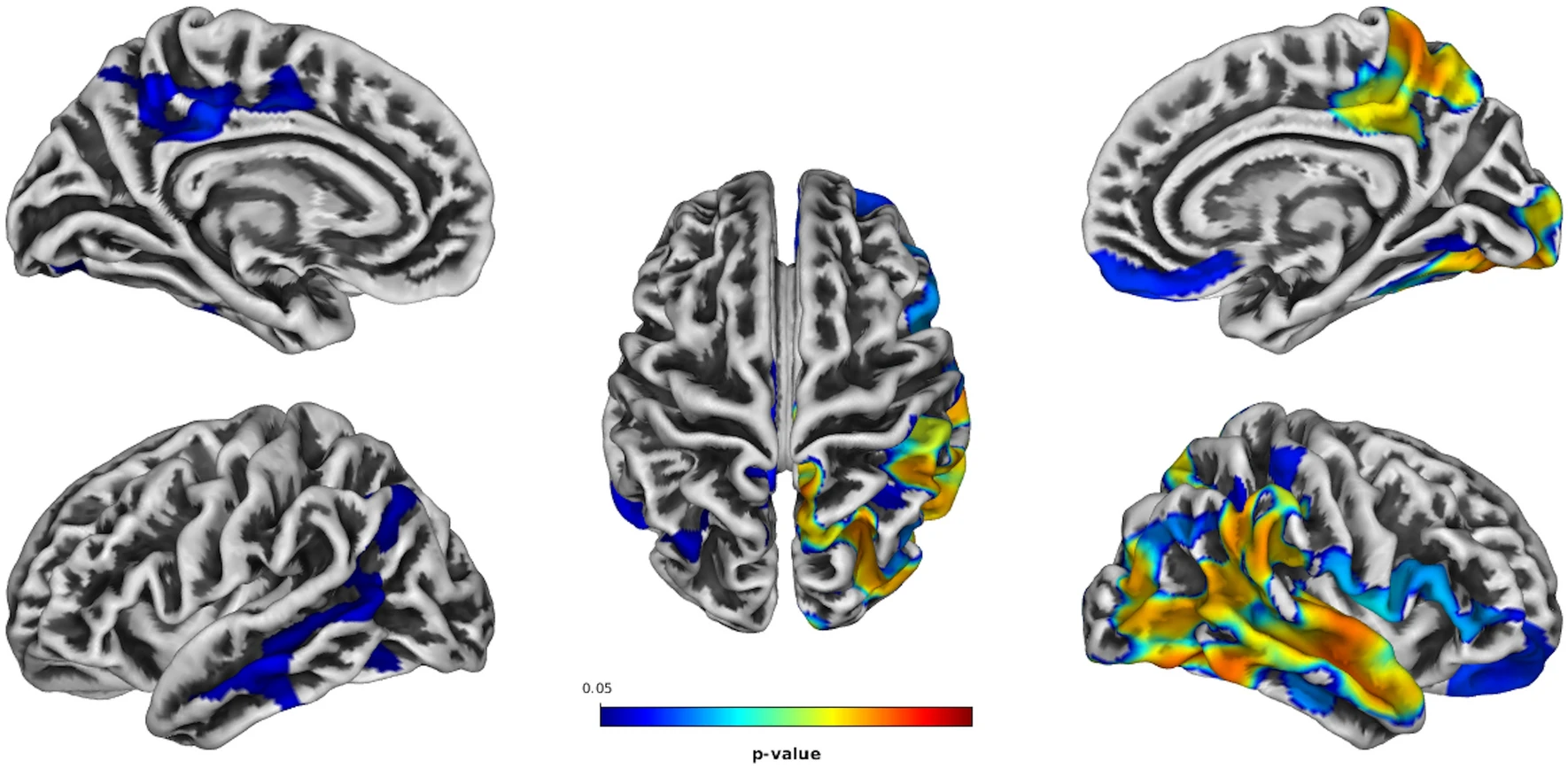
Depression occurs in about 60% of people with PSP, according to a published review.    Now, an article in Journal of Neurology reports MRI scans in 40 patients with PSP, comparing the 21 with depression to the 19 without.  The research group works at the University of Bari, in Tricase, at the tip of the heel of Italy’s boot, and was led by Dr. Daniele Urso, a well-published expert in neuroimaging of neurodegenerative disease. In patients with PSP and depression, they found more thinning of the cerebral cortex in the temporal, parietal and occipital lobes, moderately worse on the right than the left.  (In the linked image, the colored areas are those where atrophy was greater in patients with depression than in patients without. The left cerebral hemisphere is shown on the left and the right on the right. The upper two images are the medial (inner) surface and the lower two the lateral surface.) This confirms once again that depression is part of the disease process in PSP and not (or not only) a normal psychological reaction to the overall disability.  The right/left asymmetry shows that it wasn’t just that the overall PSP was more severe in the patients with depression, as the cortical atrophy of PSP is generally symmetric. 

3

A few years ago, CurePSP created a network of 25 academic centers in the US and Canada with special expertise in care of patients with PSP and CBD, calling it the “CurePSP Centers of Care.”  I’ve been one of its organizers and leaders.  Last year, we published a “best-practices” article on medical management of the disorders.  This year, we have expanded to 28 centers, including 2 in Canada.  To keep things moving and accountable, we have doubled the size of our Steering Committee to include 4 Center directors and 4 representatives of the CurePSP Board of Directors and staff.  For the first time, we’ve drafted a list of projects designed to improve clinical care and to provide clinicians of many kinds with education and awareness of PSP and CBD (and for some centers, MSA as well).  Also for the first time, CurePSP is providing the Centers some modest financial support for expenses related to delivering first-rate clinical care. I’ll let you know how it’s going. 

. . . borne back ceaselessly into the past

A perennial question for researchers studying neurodegenerative disease is how long before the onset of symptoms the cause of the disease (whatever THAT may be) starts to act on the individual.  This is important for several reasons: 

  • Epidemiological efforts to identify an external cause of a disease such as (in the case of PSP) toxins, infections or trauma could sure use some clue as to how far in advance of the individual’s symptom onset to focus the search.
  • Trials of drugs to slow the progression of PSP would like to initiate treatment as early in the disease course as possible, so identifying patients before they display symptoms would be great.
  • If we ever find a vaccine or some other way to prevent the underlying disease process from starting in the first place, we’d need to know the age by which it should be administered.

Now the very productive Cambridge Centre for Frontotemporal Dementia and Related Disorders at University of Cambridge, led by behavioral neurologist James Rowe, has shed some light on that question.  The PSP study’s first author was Duncan Street, a clinical research fellow working under Prof. Rowe. They have mined the database of the UK Biobank, a non-profit organization operating what’s called a prospective, cohort risk factor study. A famous U.S. study of this type, but just for cardiovascular disease, is the Framingham Heart Study, which started in 1948 and is the source of most our present knowledge of risk factors for hypertension, heart attack and stroke.

The UK Biobank project enrolled 502,504 randomly selected, healthy people between 2006 and 2010, when their average age was 57.  At baseline, they received a raft of neurological and many other tests and were then monitored for the development of diseases of any type.

By the end of 2020, 176 people in the cohort had developed PSP diagnosable by standard clinical criteria.  The researchers found several subtle ways in which the average baseline scores among those 176 differed from the average baseline scores of the group who did not develop PSP or Parkinson’s.  (All of these differences were statistically significant, which means each has less than a 5% chance of being a random fluke.)   

  • Those developing PSP were heavier, on average, by 7.9 pounds though the PSP group had a slightly lower proportion of men (60% vs 62%).
  • Their reaction time was slower by 7.6% and their right-hand grip strength was weaker by 5.2%.
  • They did 15.4% less well in a test of fluid intelligence and 13.7% less well in a test of digit recall. 

The fluid intelligence test posed 13 questions requiring logical reasoning over a 2-minute span and the digit recall score was the longest string of digits that could be repeated immediately, in the same order. 

The researchers also compared the 176 people developing PSP to a group of 2,526 developing Parkinson’s.  Here, as you’d expect, there were fewer differences, the only one being a 10.5% lower performance in the PSP group’s fluid intelligence score.   

The database did not include the year of onset of PSP symptoms, but it did have the year of initial PSP diagnosis. That allowed the average time from the baseline evaluations to that point to be calculated at 7.8 years.  Other research has found a delay from symptom onset to diagnosis to average around 3 years. So, the take-home from this research article is that abnormalities hinting at PSP can be detected, if one looks for them, at an average of about 5 years (7.8 minus 3, rounded off) before symptoms appear. That, in turn, means that the underlying disease process must start some time before that, though we don’t yet know how long before.  The average symptom onset age of PSP is about 63, so any screening test for PSP should be given no later than the mid-50s.  But would giving the test in the early 50s or late 40s — the better to institute treatment early — be too soon to detect many cases of PSP?  We don’t know.  Once we settle on a test or a battery of tests that works in early-stage symptomatic PSP – an “early trait biomarker” – we can try it out in a pre-symptomatic cohort of people in their 40s and 50s who score below a certain cutoff on a screening battery.

One final thought:  Back in 1996, I published a paper showing for the first time that people with PSP had completed slightly fewer years of formal education than matched control individuals without PSP.  That has been confirmed by multiple subsequent studies, but the reason for it is unknown.  Here are three possibilities:

  • Does the disease start subtly in the first couple of decades of life and reduce one’s ability to do schoolwork? 
  • Or is it that people less inclined to stay in school for whatever social or economic reasons develop fewer synapses in their brains, which makes any subsequent neurodegenerative process more likely to produce symptoms and to come to medical attention? 
  • Or is it that people with less education are more likely subsequently to live or work in areas with toxins that contribute to the cause of PSP?

If the first explanation (early-life onset) is correct, then administering a screening test battery at any point in adult life might be able to detect early stages of PSP, providing opportunity for disease prevention to be instituted even earlier.

A welcome word from Australia

Here’s some nice news.  The Phase 2, double-blind trial of sodium selenate that I mentioned in my December 19 post as pending has just started recruiting patients.  That orally-administered drug may slow the progression of PSP and other tauopathies.  Unfortunately, at this point, it’s taking place only at six sites in Australia.

The trial is described in an article from late 2021 in the open-access journal BMJ Open. The first author is Lucy Vivash, a research fellow at Monash University in Melbourne.  Terence J. O’Brien, MD, the neurology chief at that prestigious institution, is the senior (i.e., last-named) author.  Australia does not require its trials to be listed in www.clinicaltrials.gov, and it isn’t.  But it is listed in an equivalent database for Australia and New Zealand trials.

The mechanism of action of sodium selenate against PSP is to activate an enzyme called protein phosphatase 2.  Like any phosphatase, it removes phosphate groups from the proteins to which they have become attached.  Our bodies normally use phosphates as a way to regulate the activity of enzymes, but under some disease conditions, phosphates are attached to excess or in the wrong spots.  In PSP, there is excellent evidence that inappropriate phosphorylation of tau encourages it to fold into a toxic form.  In the words of the researchers:

“Protein phosphatase 2 (PP2A) is the major tau phosphatase in the brain accounting for more than 70% of brain phosphatase activity, and thus stimulation of its activity presents a compelling strategy for reducing hyperphosphorylated tau. PP2A is colocalised [in the same locations within the same brain cells] with tau, and in many neurodegenerative diseases, reduced PP2A activity is observed alongside reductions in tau dephosphorylation.”

The year-long trial will include 70 patients with PSP-Richardson syndrome, half of whom will receive placebo.  This trial is unusual in that the primary outcome measure will not be a clinical evaluation of patients’ neurological performance and subject reports of symptoms such as the PSP Rating Scale (PSPRS).  Rather, the primary outcome will be a slowing of the rate of brain atrophy as measured by before-and-after MRI scans.  This has been shown to correlate better with the passage of time than the PSPRS or any other clinical measure of PSP progression.  However, it’s not clear if it actually correlates as well with daily functioning.  True, traditional measures are included as secondary outcome measures, but no drug developer wants to rest their case for drug approval on a secondary measure when the designated primary measure failed to show benefit.  

I suspect, but don’t know, that the MRI measure was chosen as the primary outcome measure because its greater sensitivity to change over time permitted enrolling only 70 patients (to be able to detect a 50% reduction in progression rate), as opposed to the 102 patients required by the next-most-sensitive measure, the PSPRS. Each additional patient increases the cost of the trial, and this one is financed by a grant from the Australian government rather than by any drug company. So financial constraints may have been more of an issue than usual in the study design.

So, let’s wish Dr. Vivash and her colleagues and patients every success in this trial and let’s hope that the pandemic allows it to proceed smoothly.

A welcome word from Scotland

I just learned that since 2014 there’s been a medical publication called Journal of Patient Experience.  It’s on-line and open-access.  They’ve just published an article entitled “Progressive Supranuclear Palsy: The Other Side of the Fence” by Beatrice Sofaer-Bennett PhD, an accomplished academic nurse with a faculty position at the University of Edinburgh.  Most of her work has concerned the care of people with chronic pain. 

Now, as you’ve surmised, Professor Sofaer-Bennett has been diagnosed with PSP and has described her own thoughts and feelings in a way that’s moving without being maudlin and informative without being technical.  Her experience of receiving multiple other diagnoses before PSP will be familiar to most patients and their families.  She makes a welcome and eloquent plea for better education of physicians about the disease.  Perhaps her most helpful points describe how she handles the issue of her prognosis.

The article includes a couple of minor mis-statements of neurological fact, so don’t use this as a reference source.  Also, I must tell you that her sudden sweating episodes and constant shortness of breath are very unusual in PSP.  They are more common in people with MSA, which can be difficult to distinguish from PSP diagnostically.  I mention these points only to avoid having anyone with PSP think that they can expect these things to happen to them, or if they do occur, to neglect having those symptoms specifically evaluated, thinking they’re just “normal” for PSP.  Both can be symptoms of non-neurological, highly treatable conditions. But I haven’t evaluated her myself, so I’ll not criticize her neurologist’s diagnosis from afar. 

So, Professor Sofaer-Bennett, thank you for sharing your thoughts and suggestions.  Those of us working to improve the quality and accessibility of care for people with PSP appreciate your help and wish you the best in your journey.

Proteomics hits paydirt

If you know anything about PSP at its molecular level, you know that the tau protein in the neurofibrillary tangles is almost entirely of the “4-repeat” or 4R variety.  The other kind is “3-repeat” or 3R.  Normal adult human brain has equal amounts of 3R and 4R.  So do the tangles of Alzheimer’s disease.  But the tangles of Pick’s disease are 3R. 

The thing that’s repeating is the section of the protein that binds it to microtubules, the brain cells’ internal skeleton and monorail system for transporting chemicals along axons.  The gene encoding tau, called the “microtubule-associated protein tau” (MAPT) gene, has four sections, called exons, each encoding one microtubule-binding repeat.  MAPT has 16 exons and the four in question are exons 9, 10, 11 and 12.  4R tau includes the repeat encoded by exon 10 and 3R tau doesn’t.

There’s pretty good evidence that in PSP, the extreme imbalance of 3R and 4R tau is a major factor in making the tau toxic to brain cells.  But why can’t the brain cells in someone with PSP make enough 3R tau?  In other words, what prevents the brain cells in PSP from excluding the repeat from exon 10 half of the time, as normal brain cells do?

In the latest issue of the journal RNA Biology, a group mostly from McMaster University in Hamilton, Ontario, Canada report at least part of the answer.  They have found that the protein called “heterogeneous nuclear ribonuclear protein C” (hnRNPC) prevents the normal process from happening by binding to messenger RNA.  hsRNPC has been known for years in relation to certain types of cancer, but its role in the brain or in neurodegenerative disease was not previously well studied.  To accomplish this work, the team developed a new technique called “RNA antisense purification by mass spectroscopy” (RAP-MS).  They also found, critically, that in PSP brain, the level of hnRNPC is abnormally elevated, an important confirmatory observation.  (Why is it elevated?  I can’t wait for the next installment in this story!)

The authors point out that hnRNPC can now be considered a target for drugs to slow or halt the progression of PSP.  Pharmaceutical companies, take note.

The senior author of the study and lab head at McMaster was Yu Lu, PhD, a specialist in proteomics.  His grad student Sansi Xing was first author.  The team included others from McMaster, the University of Iowa in Iowa City and Mount Sinai in New York. 

Faulty brakes

After reading my last post, you may be wondering if it’s just a coincidence that lesions in the cerebellum mimic many of the disinhibited behavioral features of PSP.  It’s no coincidence, and here’s why.

The motor role of the cerebellum in effect acts as a “brake” on the actions of the cerebral motor cortex and basal ganglia.  The “ataxic” gait of cerebellar disease is characterized by unchecked lateral movement of the center of gravity.  Once the proprioceptive (joint position sense) and visual functions perceive that one is reeling to one side, a voluntary check and corrective action occur.  But that correction, similarly, goes too far, producing a reeling in the other direction.  This is the familiar gait of the drunk, as alcohol is an acute cerebellar toxin. 

The same goes for other cerebellar motor deficits.  The uncoordinated hand movements consist of overshooting a goal followed by a correction that itself overshoots, and the process repeats, producing a kind of tremor or wavering.  The speech, besides its slurring, is degraded by an unintended, rapid grouping of syllables followed by a long pause. Try it — if you want to mimic drunkenness.  The eyes exhibit a slow, involuntary movement of a few degrees to one side followed by a rapid correction.  This is called “nystagmus” and can produce a constant jittering of the visual scene that may be described by the patient as “double vision.”

The behavioral aspects of cerebellar dysfunction are analogous.  Just as they cause a loss of inhibition of an ongoing motor action, so do they cause a loss of inhibition on behavior, with inappropriate or repetitive comments, compulsive thoughts and incontinent laughter or crying.

So, yes, it makes sense.

In through the back door?

One of my retirement activities is giving an occasional lecture to the neurology residents in my old department at Rutgers Robert Wood Johnson Medical School.  In March, my topic will be the anatomy of the cerebellum.  I’ve never lectured specifically on that before, so I’ve been updating my knowledge and preparing slides.  That led me to something very interesting. 

It turns out that one or more discrete lesions, typically small strokes, of the posterior half of the cerebellum (hence the anatomical connection) can produce behavioral and cognitive abnormalities.  Mind you, the cerebellum has classically been considered only a center of motor control.  But in 1997, Dr. Jeremy Schmahmann, a neurologist at Harvard, and his psychologist colleague Dr. Janet Sherman described what they called the “cerebellar cognitive affective syndrome.” 

This is a mouthful, and “Schmahmann-Sherman syndrome” would have been shorter but more of a tongue-twister.  So the world, as usual, decided to recognize the contribution of the man over that of the woman, and the condition is usually called “Schmahmann’s syndrome.”  In protest, I’ll call it CCAS. 

From: Stoodley CJ, MacMore JP, Makris N, Sherman JC, Schmahmann JD. Location of lesion determines motor vs. cognitive consequences in patients with cerebellar stroke. NeuroImage Clin. 2016;12:765–75.
The Roman numerals are areas of the cerebellum. X, y and z are the three axes of space and the numerical values are the distance of the image plane from a standard reference plane for that axis. Each color is arbitrarily chosen and represents one patient’s stroke(s).

It’s not clear why CCAS arises from disruption of only the back half of the cerebellum, as both halves have pretty much the same kind of circuitry, as far as we know.  The features of CCAS include loss of:

  • executive functions (difficulty with shifting tasks or multitasking, problem solving, planning, organizing, and sequencing)
  • some aspects of affect (disinhibition of speech or behavior, making inappropriate jokes, behaving childishly, inability to suppress laughter or crying, being obsessive or compulsive) 
  • some language functions (loss of fluency of speech, grammatical rule-breaking)
  • some visuospatial skills (inability to copy or understand pictures or to distinguish two objects presented at the same time)

Ring a bell (especially the first two)?  Sound something like PSP? 

We’ve known since its original 1964 description of PSP by Steele, Richardson and Olszewski that the cerebellum, specifically in an important part called the dentate nucleus (because its layers are in a saw-tooth pattern), is a site of tau deposits and cell damage.  But the balance problems and dizziness produced by dentate damage may be swamped by the symptoms from the degeneration in the cerebrum, specifically the basal ganglia.  So, the symptoms of PSP have never been considered to arise importantly from the cerebellum damage.

But now, thanks to Drs. Schmahmann and Sherman, we know that cerebellar problems can cause cognitive and behavioral problems, and that they look like those of PSP.  True, the well-known loss of function in the frontal lobes can explain those symptoms as well.  But here’s the rub:  Cerebellar symptoms in PSP might be amenable to treatment by transcranial magnetic stimulation (TMS).

TMS involves the painless, nearly harmless (as far as we know) application of magnetic fields to the scalp.  It’s an emerging field for a wide variety of neurological problems and has been FDA-approved for depression and migraine.  The European Union has approved it for several other conditions as well, including Alzheimer’s, Parkinson’s, autism, bipolar disorder, epilepsy, chronic pain and PTSD. Adverse effects are very rare, with the most common being fainting.  Some others are seizures, pain, confusion, hearing loss and hyperactivity.  Caution must be exercised in the presence of pacemakers or other implanted or worn devices.  The procedure is typically repeated once or twice a month for six to 12 months.  Unfortunately, Medicare and commercial insurance do not yet cover it, and the cost is several thousand dollars for a course.

In PSP, seven studies of TMS have been published, involving a total of only 47 patients.  Two of the seven were single cases reports.  Three of the seven, involving 32 patients, stimulated over the cerebellum. They all reported modest improvement in motor symptoms, and two studied reported speech improvements.  None found side effects, at least over short-term follow-up.  Unfortunately, none of the three studies evaluated cognition or behavior in detail.

A closely related technique is transcranial direct current stimulation. Its advantage over magnetic stimulation is that it can reach more deeply into the brain, but with more side effects. It has not been studied as well in PSP as TMS. My November 8, 2021 post was about one such study. I’ll return to TDCS in another post.

So we have work to do.  The frequency of the magnetic impulses, their strength, temporal pattern and precise location could make big differences in the outcome, so this will not be simple.  But if careful study shows that the benefit amounts to even a modest improvement in quality of life for those with PSP, and if Medicare eventually decides to pay for it, let’s get busy.

My idea of art

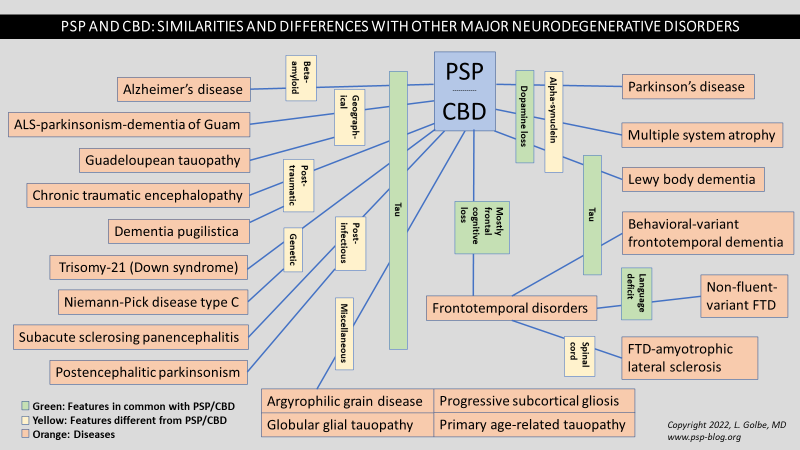
Here’s something I’ve been working on sporadically for months. It’s a diagram providing a quick-and-easy guide to the major neurodegenerative diseases from the standpoint of PSP and CBD. It’s designed to show laypersons that while PSP and CBD are rare, they can provide researchers important insights into the more frequent diseases. It’s kind of like how an advertisement for a retail business shows how centrally located it is through careful centering of the map.

The diagram’s overall concept should be self-explanatory, though most people will have to hit Wikipedia to learn what many of these specific diseases are. At the lower left is a key showing which colors are diseases and which are commonalities and differences (with respect to PSP/CBD).

Don’t interpret the relative positions of the diseases to mean that one disease is a variant or subtype of the other. The lines only indicate similarity, not necessarily classification. The area where classification is justified, but only incidentally, is that “frontotemporal disorders” is an umbrella term for all of the diseases to which that label is connected, including PSP and CBD.

Also, please be aware that the “Genetic” label means “single genetic causation.” In the case of trisomy 21, it’s a whole chromosome and for NPC, it’s a mutation in one gene acting via a recessive mechanism. Many of these disorders have more subtle contributions to their causation from multiple variant genes in the same individual, each mutation contributing a slight degree of risk.

PSP treatment trials recruiting now or soon

As promised, I will now start trying to keep you updated on actively recruiting clinical trials in PSP.  Keep in mind a few things before using my list:  

  • In compiling my list, I rely heavily on www.clinicaltrials.gov.  Trials in the US are required to list themselves there, but some take longer than others to comply.  Trials overseas may or not be required to have a listing on clinicaltrials.gov, depending on the country.  My list also includes trials I’ve heard about through the grapevine that are not (yet) listed.
  • In Phase 1 and sometimes in Phase 2, the trials do not typically allow patients completing the protocol to continue receiving the drug, no matter how well they were doing on it.  Later Phase 2 and Phase 3 trials often do allow this, but they do not commit to it in advance.  Typically, if the trial shows the drug to be ineffective (or unsafe) overall, the drug company will discontinue its program for that drug and stop producing it.  That means that even the few patients who might have been doing well on it will not continue to have access to it.
  • In theory, exceptions to that rule could exist for drugs that are being tested in both PSP and another disease such as Alzheimer’s.  If the PSP trial shows lack of efficacy but acceptable safety, the company will continue to manufacture the drug pending the outcome of the other trial and may make it available to those who completed the PSP trial.
  • For trials of neuroprotective treatment, patients may not know if they are benefitting.  (Definitions: “Neuroprotective” drugs are intended to slow the progression of the abnormal brain process in the long term, as opposed to helping the symptoms experienced by the patient in the short term.  For example, for infections, antibiotics are protective, while painkillers are symptomatic.)  To know if an individual in a neuroprotective trial has had slowing of their rate of worsening over the 12 months on the drug, their rate of worsening over at least a few months before the trial would have to have been quantitatively assessed using the same method that the trial used.  We almost never have that data, so trials work by comparing the average result from a group receiving the drug to the average from a group receiving a placebo.
  • Do not expect a neuroprotective drug to improve your symptoms.  At best, it could prevent worsening, and more likely would only slow the rate of worsening.  The trials are typically designed to detect a slowing of the rate of worsening of 30% or 40%. 
  • Bottom line: Participating in a clinical trial, especially one in Phase 1 or 2, requires some level of altruism.
  • For more information on these trials, go to www.clinicaltrials.gov and enter the drug’s name or ID number shown in the first column.

Here’s the current list to the best of my knowledge.  The ones at the bottom labeled as “may start” are awaiting funding in most cases.

Drug /
clinicaltrials.gov ID
SponsorPhaseMechanismLocation(s)Comments
TPN-101

NCT04993768
Transposon2aReduces tau productionBoca Raton, FL Farmington Hills, MI30 patients on drug, 10 on placebo
RT001 (di-deuterated linoleic acid ester)

NCT04937530
Retrotope2aReduces lipid peroxidation, enhancing mitochondrial activityUniversity of Munich (Germany)Non-controlled study showed very slow PSP progression over 2 years.
NIO-752

NCT04539041
Novartis1Anti-sense oligonucleotide; reduces tau productionRochester, MN; Nashville, TN; Montreal; 3 in Germany; 1 in UKRequires 4 injections into spinal space over 3 months.
AZP2006

NCT04008355
AlzProtect1Reduces tau production3 sites in France~24 patients on drug, ~12 on placebo
May start recruiting in the next year:
ASN120290Asceneuron1Reduces tau misfolding and aggregation by inhibiting O-GlcNAcase?Press release info only
MP201Mitochon1Mitochondrial decoupler?Early in planning per press release
Tolfenamic acidNeuroTau2NSAID that reduces tau productionCleveland Clinic, Las Vegas + others? 
Sodium selenateGov’t of Australia2Enhances dephosphoryl-ation of tau by protein phosphatase 2Multiple, in Australia 

It’s about time

I’ve been writing about PSP for patients and families for 30 years, and I realized long ago that what people most want to hear about isn’t my scientific musings about a new diagnostic technique or etiologic theory. They want to know about treatment, especially about clinical trials they might join.


For most of those three decades, there was little to report on that front. But in the past five to eight years, that has changed. Fortunately, clinicaltrials.gov has stepped into the breach starting with the FDA’s 2007 requirement that pharmaceutical companies list their trials on that public bulletin board.


But clinicaltrials.gov has its drawbacks for patients and families seeking a treatment trial. Searching its database on “progressive supranuclear palsy” returns a long list of projects that are mostly either observational, geographically unrealistic, fully recruited, terminated, listed but nowhere near initiation of recruitment, or on hold because of the pandemic. Yes, careful scrutiny can eliminate those, but that takes some insight into clinical research that most people lack.

I haven’t been a complete slacker on this matter. I wrote a 2018 book entitled, A Clinician’s Guide to Progressive Supranuclear Palsy, but that was frozen in time. I led the July 2021 writing, with 36 expert co-authors, of a consensus statement entitled, Best practices in the clinical management of progressive supranuclear palsy and corticobasal syndrome: a consensus statement of the CurePSP Centers of Care. It focused on available, non-specific, symptomatic management, with only vague predictions about what actual disease-specific, neuro-protective or preventive treatments might be on the horizon.


That’s why this blog will henceforth try to keep you all current on clinical trials in PSP and CBD. I’ll do this in concert with CurePSP, which will soon add such a page to its website, which the CurePSP staff and I will update as needed. I’ll get back to you on this soon.