I’m happy to report that the National Plan to End Parkinson’s Act was signed into law by President Biden this week. It covers not only Parkinson’s disease itself, but also “all other neurodegenerative Parkinsonisms, including multiple system atrophy, corticobasal degeneration, progressive supranuclear palsy, and Parkinson’s-related dementia.”
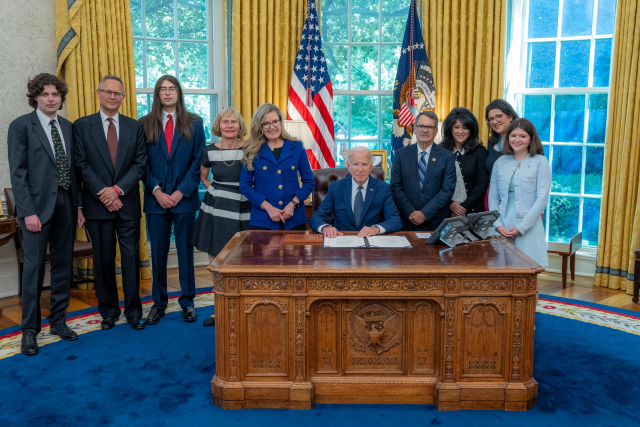
The bill is named after two people: Dr. Emmanuel Bilirakis, who died with PD last year and was the brother of the act’s original sponsor, Rep. Gus Bilirakis, Republican of Florida; and Rep. Jennifer Wexton, Democrat of Virginia, who announced in September 2023 that she has PSP. Both representatives have been critical proponents of the act throughout the legislative process. Here’s the President signing the act on July 2, 2024, seated between Rep. Wexton and Rep. Bilirakis.
Here’s a copy of the act. It requires the Department of Health and Human Services to develop and periodically update a coordinated Federal plan to find the causes and cures of the Parkinsonisms and to make recommendation for future Federal support of those efforts. The act requires the DHHS to appoint an Advisory Council of at least 23 members from multiple stakeholders to meet at least quarterly. It also requires the DHHS to organize an annual research conference on its efforts in this area. Both conferences are to be open to the public. Although the act itself provides no funding — not even for the conferences it requires — the Advisory Council and DHHS are tasked with generating recommendations for future Federal funding.
I’m not sure that this is a step forward for PD, where there’s already excellent public awareness, plenty of research conferences, and robust, ongoing programs in the academic, lay-led non-profit, philanthropic, and pharmaceutical sectors. I don’t know that “coordination” by a Federal agency is going to improve on the current system, which is driven by the inherently powerful, albeit messy, force of our capitalist system and by the collective voices of the 1 million Americans with PD.
But for PSP and the other atypical Parkinsonisms, it’s a different story. With only about 5,000 to 10,000 diagnosed affected people in the US and no major celebrity as its champion, PSP could benefit greatly from the awareness this act could bring. That could help turn the attention of all of those existing PD-interested players toward the atypicals.
And another thing: For years — no, decades — I’ve felt frustration over how promising preliminary findings in PSP often can’t gain traction because of personalities, scientific “fashion,” funding issues or other immediate practicalities. A potentially longer-term view of the Advisory Council could help change that, but only if the group avoids the traditional pressures hampering progress for the atypical Parkinsonisms up to this point. The potential, however, is definitely there.
 PSP Blog