The current diagnostic criteria for PSP were published in 2017. Unlike the previous standard set of PSP criteria from 1986, this one defined not only “possible PSP” and “probable PSP,” but also a new, lower level of certainty called “suggestive of PSP.” That applied to people with PSP features insufficient to satisfy the “possible” criteria. It was designed to maximize sensitivity at the likely cost of specificity. Both the 1986 and 2017 sets of criteria defined “definite PSP” as requiring autopsy confirmation.
For PSP-Richardson syndrome, the most common of the 10 PSP subtypes, the critical difference between “suggestive of” and “possible” relates to eye movements. The former has no restriction or slowing of eye movement, but does have either square-wave jerks (rapid, irregular, low-amplitude, horizontal jerks of the eyes when staring straight ahead, separated by very brief pauses) or difficulty opening the eyes (also called “blepharospasm”). Both “suggestive of” and “possible” PSP-Richardson also require at least a bit of balance loss.
The PSP research group in Barcelona, one of the world’s leading such projects, maintains a longitudinal registry and observational study. Like most longitudinal studies, it gathers detailed information about the participants at the time of enrollment and periodically thereafter, seeking ways to use one to predict the other — diagnostic and prognostic markers.
The group’s latest project was headed by Celia Painous, MD PhD, a post-doc working under senior author Yaroslau Compta, MD PhD. It enrolled 131 participants with PSP, 12 with Parkinson’s disease and 18 healthy people as controls. Of those with PSP, 23 had “suggestive of” criteria for one of the PSP subtypes (mostly PSP-Parkinsonism) and 108 met “possible” or “probable” criteria (mostly PSP-Richardson syndrome).
The testing included not only the standard history and physical exam for PSP but also a blood test for neurofilament light chain (NfL) and several tests in spinal fluid: alpha-synuclein seed amplification assay (asyn-SAA), neurofilament light chain (NfL), total tau (t-tau), tau with a phosphate at amino acid 181 (p-tau), and beta amyloid (Aβ42). All of these have been proposed as diagnostic markers for PSP or other tauopathies.
The testing also included something unusual for this type of project – a precise test of eye movement termed “video-oculography.” The participant sits comfortably at a desk, resting chin and forehead against rigid supports, as at the optometrist’s office. They perform visual tasks shown on a computer screen while a video camera records the movements. The images below are from a technical article on the device. If you read it, keep in mind that it was written by the manufacturer’s employees as a marketing tool.

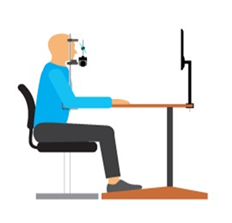
The visual tasks used a bright dot in the middle of the screen as a starting point and other dim dots that could light up. For most of the tests, the person was instructed to look as quickly as possible from the starting point to other dots as they lit up in turn. The device measured delays in starting the movement, speed, undershoot, and overshoot. The procedure also required the participant to perform “anti-saccades,” where they’re told to move their eyes not to the dot that just lit up, but to a different dot that remains dim, situated in exactly the opposite direction from the starting point. This can be performed in any of the four directions of gaze. It tests the ability to follow instructions and to resist one’s natural inclinations, both of which are impaired early in PSP and other disorders of the frontal lobes.
Sure enough, compared with the subjects with PD and the controls, the group with “suggestive of” PSP at the first visit showed more errors than the PD or healthy control groups in the anti-saccade task in the vertical directions, with greater delay in responding and slower movement. It’s true that the duration of the “suggestive” PSP symptom(s) in that group was four years. Still, the fact that only very minimal signs of PSP were present shows that the disease was in a very mild stage. We can therefore hope that a harmless, painless, inexpensive, sensitive test for abnormalities on the anti-saccade task could provide a very early marker for PSP.
Before long, we may see such a test added to research protocols seeking people with PSP before clear, overt symptoms develop. That would be very useful in studies of genetic or environmental risk factors, where groups with and without the risk factor are compared with regard to the incidence of PSP. It’s likely that for work with PSP, video-oculography could be combined with other markers to provide fewer false positives.
 PSP Blog