I’m happy to report that the National Plan to End Parkinson’s Act was signed into law by President Biden this week. It covers not only Parkinson’s disease itself, but also “all other neurodegenerative Parkinsonisms, including multiple system atrophy, corticobasal degeneration, progressive supranuclear palsy, and Parkinson’s-related dementia.”
The bill is named after two people: Dr. Emmanuel Bilirakis, who died with PD last year and was the brother of the act’s original sponsor, Rep. Gus Bilirakis, Republican of Florida; and Rep. Jennifer Wexton, Democrat of Virginia, who announced in September 2023 that she has PSP. Both representatives have been critical proponents of the act throughout the legislative process. Here’s the President signing the act on July 2, 2024, seated between Rep. Wexton and Rep. Bilirakis.
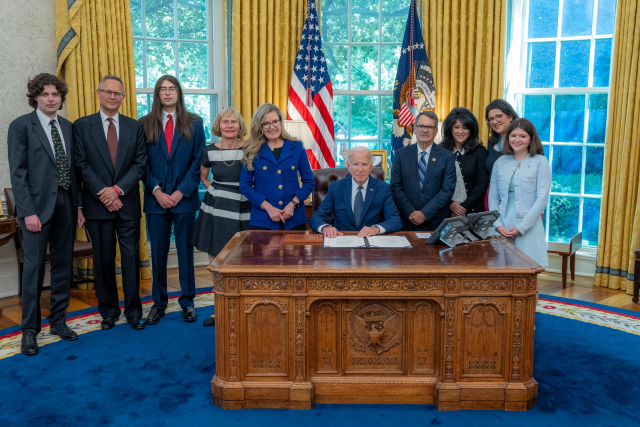
Here’s a copy of the act. It requires the Department of Health and Human Services to develop and periodically update a coordinated Federal plan to find the causes and cures of the Parkinsonisms and to make recommendation for future Federal support of those efforts. The act requires the DHHS to appoint an Advisory Council of at least 23 members from multiple stakeholders to meet at least quarterly. It also requires the DHHS to organize an annual research conference on its efforts in this area. Both conferences are to be open to the public. Although the act itself provides no funding — not even for the conferences it requires — the Advisory Council and DHHS are tasked with generating recommendations for future Federal funding.
I’m not sure that this is a step forward for PD, where there’s already excellent public awareness, plenty of research conferences, and robust, ongoing programs in the academic, lay-led non-profit, philanthropic, and pharmaceutical sectors. I don’t know that “coordination” by a Federal agency is going to improve on the current system, which is driven by the inherently powerful, albeit messy, force of our capitalist system and by the collective voices of the 1 million Americans with PD.
But for PSP and the other atypical Parkinsonisms, it’s a different story. With only about 5,000 to 10,000 diagnosed affected people in the US and no major celebrity as its champion, PSP could benefit greatly from the awareness this act could bring. That could help turn the attention of all of those existing PD-interested players toward the atypicals.
And another thing: For years — no, decades — I’ve felt frustration over how promising preliminary findings in PSP often can’t gain traction because of personalities, scientific “fashion,” funding issues or other immediate practicalities. A potentially longer-term view of the Advisory Council could help change that, but only if the group avoids the traditional pressures hampering progress for the atypical Parkinsonisms up to this point. The potential, however, is definitely there.
 PSP Blog
How can we find out about the DHHS research conference once it is established?
Hi, Michele: I assume it will be posted at https://www.hhs.gov/ohrp/news/events/index.html
LG
To be standing next to the President is a great tribute to Jennifer Wexton’s commitment and courage to increase awareness of PSP.
Yes — she has brought valuable public awareness to PSP, at the personal cost of some loss of medical privacy. But she’s clearly gratified to be able to use her position to make the world a better place.
I understand your frustration with the lack of attention Parkinsonisms have gotten in the past and still today, despite recommendations from the MJFF and Advisory Councils to include them in decisions made by government authorities. A case in point is the Veteran Administration’s decision in 2017 denying disability and compensation for Parkinsonisms presumed caused by the contaminated water at Camp Lejeune containing TCE, PCE, Benzine, and vinyl chloride chemicals. The VA does accept Parkinson’s Disease as presumptive for Camp Lejeune and those veterans are granted disability. Parkinsonisms claims are denied based on lack of research and not enough numbers of people with atypicals, although these veterans (and families who lived on base) were all drinking, bathing, cooking, and cleaning with the same water as those with PD.
The Governor from Florida and governors of other states are signing off on creating Progressive Supranuclear Palsy Policy Committees. It is SB 186, known as “Justo R. Cortes Progressive Supranuclear Palsy Act” headed by the states’ Surgeon Generals. I have volunteered to serve on Florida’s PSP and Other Neurodegenerative Diseases Policy Committee as a wife and caregiver for my husband who has advanced PSP. I am awaiting further word on whether I will be chosen to serve. The Committee is tasked to develop policy recommendations relating to disease awareness, early detection/diagnosis, care, and treatment of PSP and other neurodegenerative diseases.
Dear Ms. Mullamphy:
I’m sorry, but the argument that PSP and PD should have the same set of causative risk factors because they’re both Parkinsonisms is actually pretty weak when you think about it at the level of the molecules and brain cells.
Yes, both diseases cause “Parkinsonism” because one of the many areas of the brain that they each affect is the one controlling the fluidity of motion (the substantia nigra). Most of the other involved brain areas differ between them. Besides, PD has multiple risk factors that have not been found in PSP by studies large enough to do so. The one consistent risk factor for PSP, lesser educational attainment, does not exist for PD. (In fact, the opposite, greater educational attainment, is a risk factor for PD.) The list of genetic risk factors is also quite different.
These differences are not surprising, as PD starts in neurons of the intestines and features aggregation of alpha-synuclein protein called Lewy bodies, while PSP starts in the astrocytes of the brain and features aggregation of tau protein called neurofibrillary tangles. So, there just isn’t enough fundamentally in common between PD and PSP to assume that anything that’s true about one of them applies to the other.
Dr. Golbe: The veterans who served their country and were stationed at Camp Lejeune’s toxic water era have developed cancers, ALS, MS, PD, etc. Because no one knows the cause of these afflictions, the fact that TCE, PCE, Benzine and vinyl chloride are known toxic chemicals that presumably could cause neurodegenerative diseases and cancers, the VA allowed PD as a ‘presumptive condition’ due to its numbers, not to the science that identified the differences or the cause. No one can say what triggers PD, ALS, MS, and no one can say what triggers atypicals. My argument is not the difference in the diseases under the Parkinson umbrella; the fact is, no one knows how they all started, but injested toxicity can certainly be a presumed cause and toxicity can manifest as Parkinson-like symptoms due to an individual’s vulnerability, while others may not be affected at all.
In an article by the MJFF dated 6/17/2024 titled “Your Environment Influences Parkinson’s Risk and Progression: What Can You Do?” cites a concern about trichlorethylene (TCE) and heavy metals in water. TCE has been banned in other countries, and through efforts by the MJFF, the EPA has announced a proposal to ban nearly all uses of TCE within one year, which will hopefully occur before the end of 2024. The MJFF and Advisory Council did support Parkinsonism as presumptive. Unfortunately, the VA did not include them due to lack of research and the small numbers of afflicted people.
Dear G:
You make a reasonable point (if I may paraphrase): “To compensate veterans for illnesses developing long after a service-related toxin exposure, we don’t need biological or statistical association of the toxin with the specific illnesses. We know that the exposure occurred, and we know that the causes of these diseases are unknown. Therefore, unless there’s clear evidence showing no causal connection, we should give veterans the benefit of the doubt.”
Here’s the only flaw I see in the argument: Our meager current knowledge of the causes of most diseases leaves room for toxins as contributing factors, even if the primary cause is known to be something else. Therefore, it’s hard to see a limit to the compensation entitlement overall. In other words, how much money can the country afford to compensate ill veterans whose conditions pass only that low cause-and-effect bar? The cost only for Camp Lejeune veterans with PSP is a tiny number, but the cost for all veterans with all diseases of unknown cause who have been exposed to toxins anywhere during their time in service would be a very large number. So, that’s a question for policymakers and voters.
We should also ask if the same cause-and-effect bar applies to non-military liability claims. Suppose a random civilian develops a disease of unknown cause and a toxic site nearby has chemicals known to cause some diseases, but not necessarily the one that person has. Is the polluter liable for civil claims using the same benefit-of-the-doubt reasoning that we agree the Camp Lejeune veterans should be able to use against the US Government? Again, a question for policymakers and voters.
LG