GV-1001: unclear news is good news

In July 2023, I posted a guardedly optimistic report on the launch of a small, Phase 2a trial in South Korea of the drug GV-1001, with the generic name “tertomotide.”  Three weeks ago (sorry for my delayed vigilance on your behalf), the company released some of the results.  The headline was that the drug failed to show benefit in slowing the rate of progression on the PSP Rating Scale.  Nevertheless, the company, GemVax, said they remained optimistic and would proceed with plans for a Phase 3 trial in North America and elsewhere.

Here’s the deal in a bit more detail.  I say “a bit” because it’s not as much detail as I’d want to see.  The trial was only 6 months long and the plan was for only 25 patients in each of the three groups: higher dose, lower dose and placebo.  That’s too brief and too small to demonstrate a realistic degree of slowing of progression.  The best longitudinal analysis of PSP to date calculated that to demonstrate a 30% slowing in a 12-month trial would require 86 patients per group.  Shorter trials and more modest slowing would require even more patients than that.  But early-phase trials like this are mostly about safety, not efficacy.

The results for the low-dose and placebo groups appears below, just for the PSP-Richardson patients: 
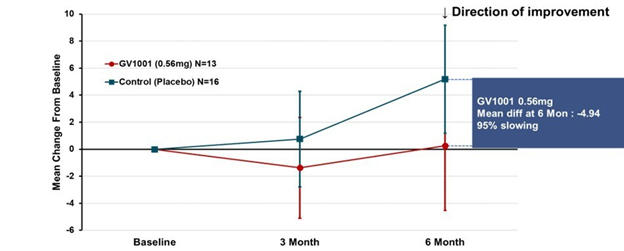
The vertical axis is the average improvement (downward) or worsening (upward) in the total PSP Rating Scale relative to the patient’s own baseline score.  (On the PSPRS, 0 is the best and 100 the worst possible score, and the average patient accepted into a drug trial has a score in the mid-30s.)  At 3 months, neither group showed much change.  But at 6 months, the placebo group had deteriorated by 4 points but the active drug group had remained close to its baseline.  So, that looks like a benefit, but the wide standard deviation (the vertical “whiskers” at 3 and 6 months) were too large to support statistical significance (i.e., to rule out the possibility of a fluke result).  Hence the negative headline, but you can see why the drug company felt encouraged by the result.

A more complicated but statistically more valid way to look at the same results appears below. This graph applies to both PSP-Richardson and PSP-Parkinson patients, hence the larger Ns:
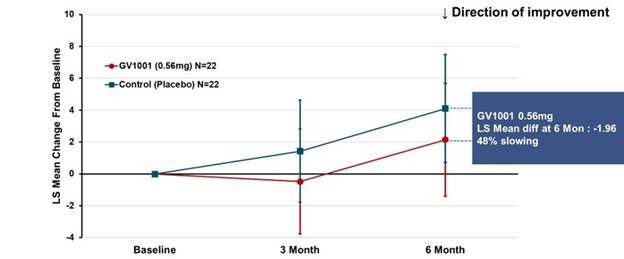
This time the vertical axis is “least square mean change from baseline.”  That uses a statistical technique called “mixed-model repeated measures” to compensate for statistical noise in the results.  The basic shapes of the active drug and placebo curves look similar to the raw score graph.  But now, the two lines have the same slope between 3 and 6 months, suggesting that their rates of progression over that period were the same.  The interval from baseline to 3 months did have different slopes, favoring active drug.  So, this could mean one of 3 things:

  1. There’s a neuroprotective effect (i.e., a slowing of the progression rate) that lasts only 3 months, at which point the two groups proceed to progress at the same rate;
  2. There’s a symptomatic improvement by the 3-month point that persists to the 6-month point, but no protective effect at any point; or
  3. The trial’s small size, wide standard deviations, paucity of evaluations and short duration make it impossible to draw any conclusions about symptomatic or neuroprotective efficacy.

I’ll vote for Option 3.

The data for the high-dose group, which received twice the lower dose, is not presented in the company’s press release.  However, the high-dose group was included in the poster at the Neuro2024 conference (CurePSP’s annual international scientific meeting) in Toronto in October.  It did not show the possible benefit that the low-dose group showed.  So, that’s a little discouraging, but it’s not unheard-of in pharmacology for a higher dosage regimen to do something extra via a different chemical mechanism that counteracts some of the benefit of a lower dosage. So, that doesn’t worry me much.

    Now, the issue is just how safe and tolerable the drug was.  The press release only says, “The safety profile of GV1001 in the Phase 2a PSP Clinical Trial was consistent with prior safety data. GV1001 was generally well-tolerated with no serious adverse events related to the drug reported.” I’ve seen the actual numbers, and the press release is right. All of the adverse events, and there were very few, were things common in this age group or complications of PSP itself.

    So, that’s probably more information than you wanted about GV-1001, or maybe it’s a lot less than you’d have liked. (I’m in the latter category.)  Bottom line is that the results were good enough to justify a Phase 3 trial, which is slated to start in 2025, and that’s really good news.

    Note: The text in italics explaining the two graphs and detailing the drug side effects are corrections or additions to my originally posted version. I thank Roger Moon, Chief Scientific Officer of GemVax, for supplying this information after he saw the original post. These changes do not alter my conclusions.
    Medicine cabinet research

    On November 3 of this year I posted on some work with a zebrafish model of tauopathy showing that a class of drug called carbonic anhydrase inhibitors could slow disease progression. Those drugs are commonly prescribed for glaucoma and other conditions. One insightful commenter has asked if it might be possible to use an existing patient database to search for a correlation between CAIs and PSP risk.

    There has been one such attempt, but it included too few patients to answer this question. Earlier this year, Jay Iyer and colleagues (including me) at multiple institutions used a database of 305 patients with PSP observed over a 12-month period to look for any relationship between concomitant drug use and rate of progression on the PSP Rating Scale. It found that benzodiazepines were associated with more rapid progression. Here’s the paper. The table’s “F value,” as the caption indicates, measures the “interaction between change in PSPRS scores and time.” That’s a sophisticated version of the rate of progression.

    But CAIs are too rarely prescribed to show up in that type of analysis. In fact, the statistics considered only those drugs used by at least 10% of the patients, as lower frequencies would not have produced statistically significant results.

    This approach, seeking a relationship between the risk factor (medication use) and an outcome (disease severity) is only one way to approach this problem. Another is to compare people with PSP to people without it with regard to the risk factor. Another is to compare people with the risk factor to people without it with regard to the frequency of the disease. For a disease as rare as PSP and a risk factor as rare as CAIs, one would need a huge database, like those maintained by national health care systems. Unfortunately, no such analysis of PSP and CAI use has been attempted to date, but in theory, it can be done despite PSP’s misdiagnosis rate in the general population outside of dedicated movement disorder centers.

    A new game in town

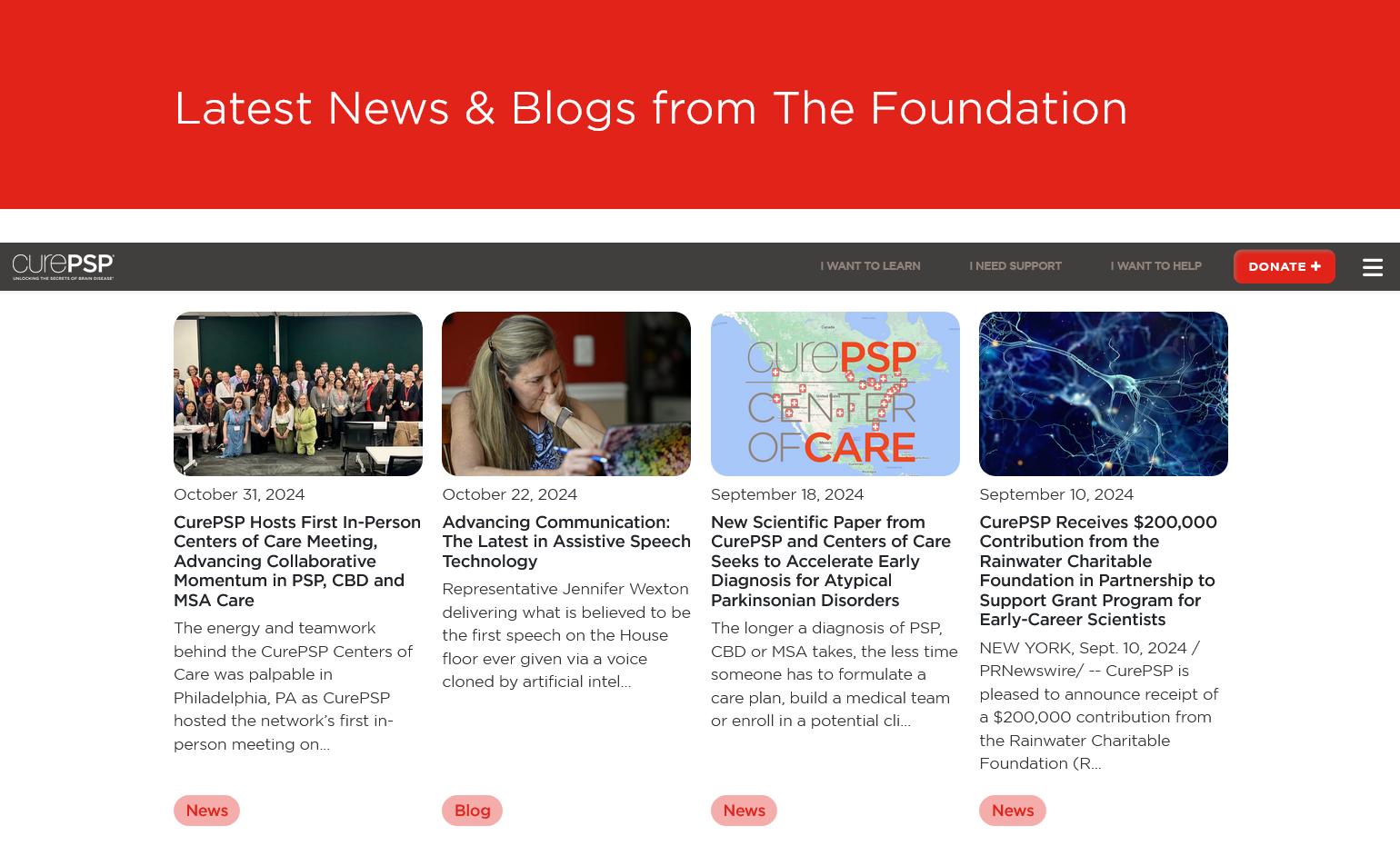
    I want to draw your attention to a new PSP-related blog, started by CurePSP on October 22. In keeping with CurePSP’s overall mission, the blog concerns not only PSP, but also corticobasal syndrome (CBS) and multiple system atrophy (MSA), which can be difficult to distinguish from PSP, especially in early stages. 

    The one post so far is an excellent discussion of speech-assistive devices and voice banking by CurePSP staffers Courtney Malberg and Oscar Sullivan.  Although I’m CurePSP’s Chief Clinical Officer, I’ve provided no advice nor content for the blog to date and haven’t been asked to. That’s the way it should be — I’ve got my own blog, completely independent of CurePSP.

    The single blog post so far is mixed in with news items related to CurePSP’s activities.  Each item is labeled “News” or “Blog” (in the small pink ovals at the bottom).  Of course, both should be of interest to the same readers.   

    Here’s a screen shot of the page. The first blog post is the second from the left.

    So, why zebrafish?

    In response to a commenter’s question on how zebrafish became an experimental model: Zebrafish have been systematically used in research since the 1950s, starting with studies of the causes of birth defects. The original reasons for choosing that species were that it takes only four days from fertilization to hatching and that the eggs develop outside the mother’s body. The latter makes it easy to expose the developing embryos to experimental toxins by simply adding them to the water. Even after only a week post-hatching, young zebrafish half a centimeter long display most of the physiological and behavioral features of adults 6-8 times that size. Juvenile zebrafish are transparent, allowing many experimental outcomes to be easily observed without harming the animal or further interfering in its function. Besides, they’re easy to clone as a genetically uniform colony and react to toxins in ways very similar to mammals. Much of the earliest research in developing zebrafish as a genetic model was performed in the 1960s to 80s by George Streisinger, a Holocaust survivor working at the University of Oregon. Here’s a great biosketch.

    More fishy news

    My post from two weeks ago, entitled, “A big little fish,” was about zebrafish as an experimental model for PSP.  This creature, once the normal human tau gene has been added to its genome, is uniquely suited for efficiently screening long lists of drugs as treatment for tauopathies.  I specifically cited a publication screening 147 currently available drugs modulating the attachment of phosphate groups or other regulators of tau production. It yielded two reasonable candidates for further research in other animal models or in people with PSP.

    This week, there’s another important finding in zebrafish, except that it concerns not tau production, but tau disposal.

    A research group at the University of Cambridge led by Drs. Ana Lopez, Angeleen Fleming and David Rubinsztein used zebrafish with the normal human tau gene to screen 1,437 compounds for use against tauopathies.  All had been either FDA-approved for medical use or found in clinical trials to be safe, even if ineffective for whatever they were being tested for. 

    Next, they tested those 1,437 for the ability to improve the survival of a set of cells in the fishes’ eyes (the rods) that normally produce the tau protein.  Of the 71 passing that test, the researchers chose the 16 that seemed easiest to study further.  Of those, the most effective at rescuing cells from degenerating was the drug methocarbamol, which is available by prescription for muscle spasms under the brand name “Robaxin.”  One of the several actions of methocarbamol unrelated to muscle relaxation is inhibition of an enzyme called carbonic anhydrase, which regulates the acid-base balance of cells. 

    Drugs that specifically inhibit carbonic anhydrase are available for use in glaucoma and in a variety of neurological disorders.  Three of the most popular anhydrase inhibitors are acetazolamide (brand name Diamox), methazolamide (Neptazane) and dorzolamide (Trusopt). To determine if carbonic anhydrase inhibition explains the benefit of methocarbamol in the zebrafish, the researchers gave those three drugs to a different colony of zebrafish with a human tau gene, but in this case the human gene carried a mutation called P301L, which causes a rare, hereditary, PSP-like illness. 

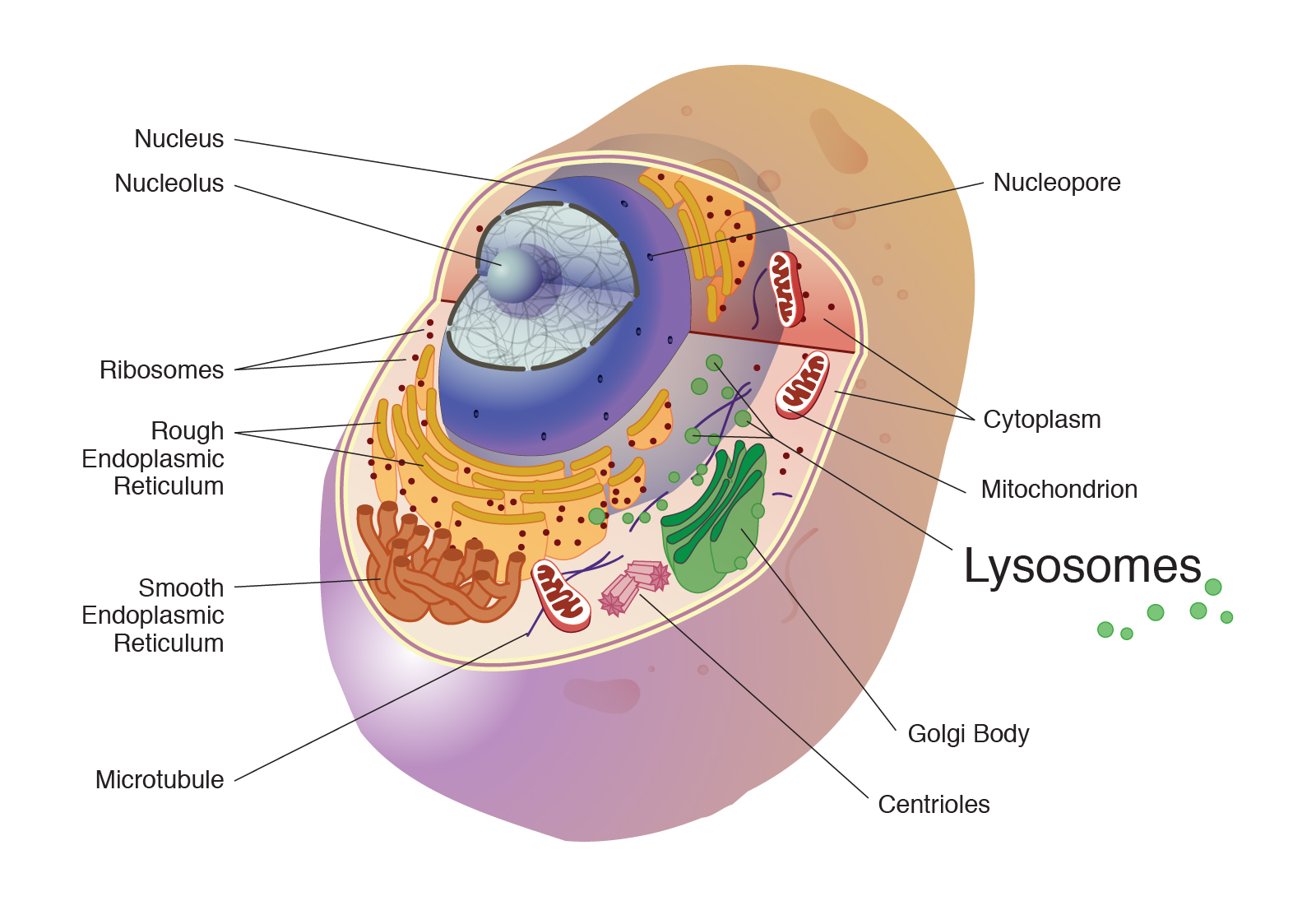
    To the Cambridge team’s delight and ours, all three carbonic anhydrase inhibitors provided major protection against the damage caused by that tau gene mutation.  A further set of experiments showed that the mechanism of protection was that the drugs work by improving the export of tau from the cells by the lysosomes.  Those are organelles that perform part of our cells’ complicated garbage disposal mechanism.

    I’ll let the researchers’ own words describe the overall results:

    Together, our results suggest that CA [carbonic anhydrase] inhibition ultimately regulates lysosomal acidification and cellular distribution, promoting lysosomal exocytosis and tau secretion. This mechanism lowers tau levels within neurons, which, in turn, have lower levels of hyperphosphorylated and aggregated toxic tau forms, accounting for an improvement in phenotypic, neuronal loss and behavioral defects in vivo in zebrafish and mouse models. This raises the possibility of rapid repurposing of CA inhibitors for tauopathies, as our studies were performed in mice at human-like plasma concentrations. Furthermore, our data suggest that stimulation of unconventional secretion may also be a potent therapeutic approach for other neurodegenerative diseases caused by toxic, aggregate-prone intracellular proteins.

    So, the “elevator explanation” is that carbonic anhydrase inhibitors make the fluid in lysosomes more acidic, enhancing their ability to load up on abnormal tau protein and dump it out of the brain cell.

    This finding could lead to repurposing existing, off-patent carbonic anhydrase inhibitor drugs not only for PSP but potentially also for the many other neurodegenerative diseases that rely on the lysosomes to dispose of abnormal, misfolded proteins.  Let’s hope that other animal models confirm this and that a clinical trial follows. 

    All the carbonic anhydrase inhibitors available are off patent, which means that their manufacturers would not be interested in investing the many millions of dollars needed to test them for a new use.  But drug companies have been known to reformulate old drugs into longer-acting or better-absorbed versions, or to make inconsequential but patentable tweaks to old drugs’ chemical structure. Or maybe a deep-pocketed, non-commercial funder such as the NIH could fund a clinical trial of an existing carbonic anhydrase inhibitor. 

    So, that’s what should happen . . . and here’s what should not happen: For you to doctor-shop until you find one willing to prescribe a carbonic anhydrase inhibitor.  For one thing, those drugs come with a long list of possible side effects and drug interactions. For another, it would be difficult to know if it’s working to slow the rate progression in you as an individual.  If you go on a potentially neuroprotective drug and develop some moderate side effect, the decision to continue or discontinue the drug would depend on its benefit in you specifically, not on its effect in zebrafish or even in other people with PSP averaged together. That’s why drug trials observe each participant for a whole year and involve hundreds of participants randomized to experimental drug or placebo.  We need faster and cheaper ways to do such trials and a lot of work is addressing that problem right now. 

    Meanwhile, don’t give up hope — or give in to the temptation of unproven, unmeasurable treatment.