Four reasons to hope

It’s high time I updated you on currently – or imminently – recruiting PSP clinical trials.

Here are the four in chronological order. All these are for “neuroprotection,” meaning slowing of the underlying disease process. They don’t attempt to improve the existing symptoms, however. That’s called “symptomatic” treatment and I’ll get around to that soon.
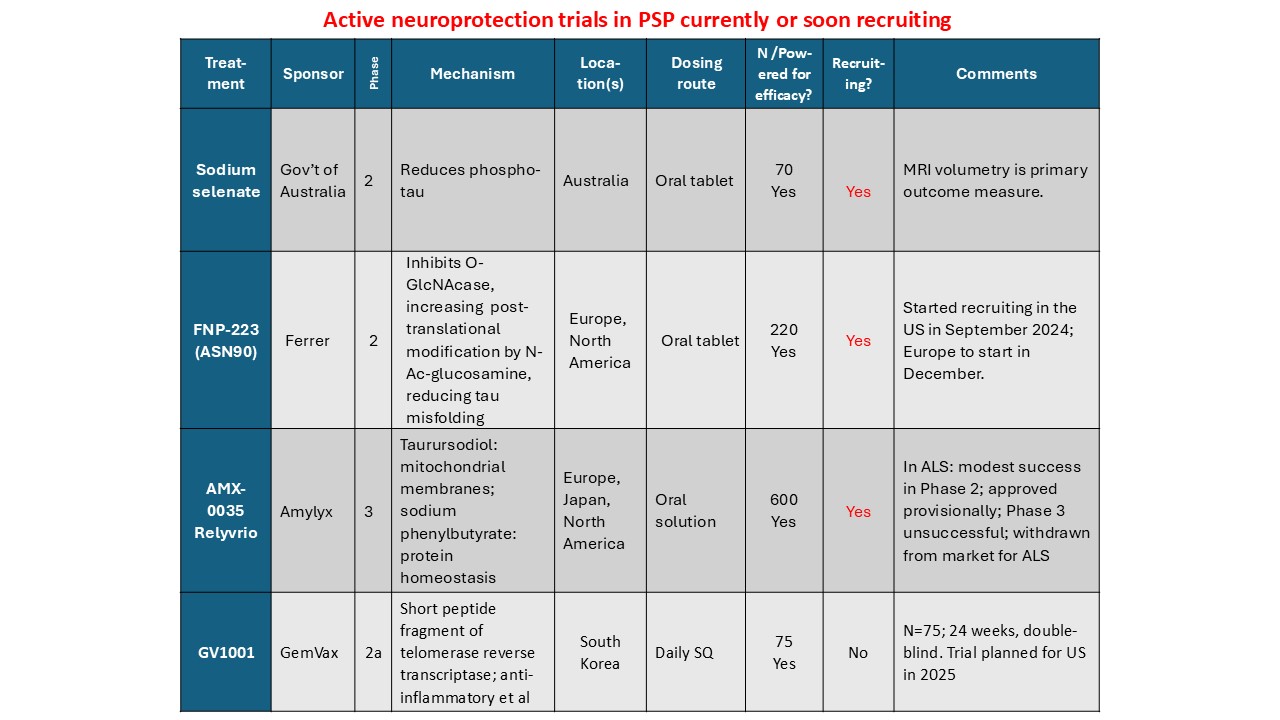
More details:

Sodium selenate provides supplemental selenium, which is critical for the function of 25 human enzymes with a wide range of functions. Two are relevant to PSP: glutathione peroxidase 4 and protein phosphatase 2A. The first regulates one type of programmed cell death and the second removes phosphate groups abnormally attached to the tau protein. The trial is happening only in Australia. See here for details, including contact information.

FNP-223 inhibits an enzyme called 0-GlcNAcase (pronounced “oh-GLIK-nuh-kaze”), which removes an unusual sugar molecule from its attachment to tau. The sugar is called N-acetyl-glucosamine and it prevents abnormal tau from attaching at the same spots on the tau molecule. It’s an oral tablet and the trial, which has just started, will be in both Europe and North America. Click here for details and contact info.

AMX-0035 is a mixture of two drugs in an oral solution. Both are currently marketed for conditions unrelated to neurodegeneration. The PSP trial has started in North America and will do so in Europe and probably Japan in the next few months. One of the two drugs, called sodium phenylbutyrate (marked as Buphenyl), addresses the brain cells’ management of abnormal proteins. The other, taurursodeoxycholic acid, marketed as TUDCA, helps maintain the mitochondria. Click here for details and contact info.

Finally, GV-1001 is an enzyme with anti-inflammatory action in the brain. But it’s not like a steroid or non-steroidal anti-inflammatory drug. It acts by an mechanism that the drug company is keeping close to its chest and has something to do with DNA transcription into proteins. The drug has to be injected subcutaneously every day, like insulin. A small trial is in progress in South Korea and in you live there, here’s enrollment info. There are plans to start a trial in the US in 2025, but that could depend on the current trial’s outcome.

Soon, I’ll post something on neuroprotection trials in which the double-blind recruitment is over but the results are pending. After that will be symptomatic trials.

With all these trials in progress, CurePSP’s “Hope Matters” tagline is truer than ever.

A welcome word from Australia

Here’s some nice news.  The Phase 2, double-blind trial of sodium selenate that I mentioned in my December 19 post as pending has just started recruiting patients.  That orally-administered drug may slow the progression of PSP and other tauopathies.  Unfortunately, at this point, it’s taking place only at six sites in Australia.

The trial is described in an article from late 2021 in the open-access journal BMJ Open. The first author is Lucy Vivash, a research fellow at Monash University in Melbourne.  Terence J. O’Brien, MD, the neurology chief at that prestigious institution, is the senior (i.e., last-named) author.  Australia does not require its trials to be listed in www.clinicaltrials.gov, and it isn’t.  But it is listed in an equivalent database for Australia and New Zealand trials.

The mechanism of action of sodium selenate against PSP is to activate an enzyme called protein phosphatase 2.  Like any phosphatase, it removes phosphate groups from the proteins to which they have become attached.  Our bodies normally use phosphates as a way to regulate the activity of enzymes, but under some disease conditions, phosphates are attached to excess or in the wrong spots.  In PSP, there is excellent evidence that inappropriate phosphorylation of tau encourages it to fold into a toxic form.  In the words of the researchers:

“Protein phosphatase 2 (PP2A) is the major tau phosphatase in the brain accounting for more than 70% of brain phosphatase activity, and thus stimulation of its activity presents a compelling strategy for reducing hyperphosphorylated tau. PP2A is colocalised [in the same locations within the same brain cells] with tau, and in many neurodegenerative diseases, reduced PP2A activity is observed alongside reductions in tau dephosphorylation.”

The year-long trial will include 70 patients with PSP-Richardson syndrome, half of whom will receive placebo.  This trial is unusual in that the primary outcome measure will not be a clinical evaluation of patients’ neurological performance and subject reports of symptoms such as the PSP Rating Scale (PSPRS).  Rather, the primary outcome will be a slowing of the rate of brain atrophy as measured by before-and-after MRI scans.  This has been shown to correlate better with the passage of time than the PSPRS or any other clinical measure of PSP progression.  However, it’s not clear if it actually correlates as well with daily functioning.  True, traditional measures are included as secondary outcome measures, but no drug developer wants to rest their case for drug approval on a secondary measure when the designated primary measure failed to show benefit.  

I suspect, but don’t know, that the MRI measure was chosen as the primary outcome measure because its greater sensitivity to change over time permitted enrolling only 70 patients (to be able to detect a 50% reduction in progression rate), as opposed to the 102 patients required by the next-most-sensitive measure, the PSPRS. Each additional patient increases the cost of the trial, and this one is financed by a grant from the Australian government rather than by any drug company. So financial constraints may have been more of an issue than usual in the study design.

So, let’s wish Dr. Vivash and her colleagues and patients every success in this trial and let’s hope that the pandemic allows it to proceed smoothly.