An encouraging drug trial, but caveat emptor

A bit over two years ago, my posts from December 19, 2021 and January 22, 2022 reported that the drug censavudine (TPN-101) was entering a Phase 2a clinical trial. Now it’s over and the results were encouraging.  I choose that word carefully, and here’s why:

The drug company sponsor, Transposon Therapeutics, presented the results at a conference in Lisbon a couple of weeks ago and I’ve only now had the opportunity to see the numbers. The trial was small (42 patients, of whom 10 were on placebo) and brief (a bit less than 6 months for the double-blind phase), with an open-label extension of the same duration.  This study design is typical of Phase 2a trials in neurodegenerative diseases, which are designed to study safety and tolerability because their small size and short duration can’t detect clinically meaningful benefits.

The company’s press release says, “Participants treated with TPN-101 for the entire 48-week trial duration showed a stabilization of their clinical symptoms as measured by the PSP Rating Scale (PSPRS) between weeks 24 and 48. In contrast, participants who had been on placebo from weeks 1 to 24 continued to show a worsening of the PSPRS between weeks 24 and 48, suggesting a delay of clinical benefit onset of at least 24 weeks after start of drug treatment, and lagging behind the early effects on biomarkers seen in weeks 1 to 24.”

Here’s an image from the poster presented at the conference. (Sorry about the blurriness – it’s a screen shot.)
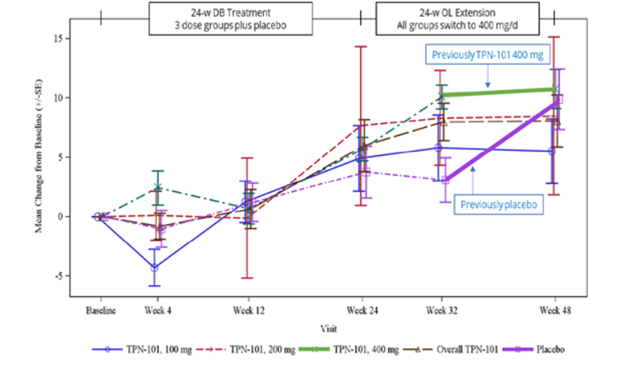
The vertical axis shows the number of points, positive or negative, by which the PSP Rating Scale changed from baseline.  (Up is worse. The typical progression of PSP is 10 or 11 points per year.) The purple lines, both dashed and solid, are the patients assigned to placebo for the first 24 weeks and the other colors are the groups on the three different dosages of censavudine (100 mg, 200 mg and 400 mg per day).  The brown dashed line is the aggregate of the three.  The vertical line segments with hashmarks show the scores’ standard errors, a measure of variation among the patients. (See my P.S. at the end of this post.)

Note that by the end of the 24-week double-blind phase, all the results are more-or-less superimposed, meaning that the patients on active drug did no better than those on placebo.  That’s normally considered a negative outcome in terms of neuroprotection, but of course this trial was too small to reveal a neuroprotective effect of realistic magnitude.  After the placebo patients started receiving active censavudine at Week 24, they continued approximately along the same progressive path with the usual random wiggles (dashed and thick purple lines), ending at about 10 points worse than baseline at Week 48.  This also would ordinarily be interpreted as an absence of benefit. 

Now, here’s where things get tricky:  After Week 32, which was eight weeks into the open-label phase, the patients on censavudine since baseline seemed to stabilize – that’s the flattening of the thick green line.  In other words, their rate of progression from Week 32 to Week 48 was much less steep – a point or two rather than the expected three or four points.  So, looking at the small magnitude of progression just from Week 32 to Week 48, Transposon suggested that censavudine may have a delayed benefit that became evident only after 32 weeks of treatment.  In this view, the placebo group, having started censavudine at Week 24, hadn’t had enough time by Week 48 for the benefit to express itself. 

Here’s the problem with that reasoning:  Looking at just two visits (Weeks 32 and 48) doesn’t provide enough statistical power to conclude anything, especially with so few patients (30 patients on censavudine from the start) and only 16 weeks to work with.  Furthermore, it’s easy to see that the censavudine and placebo groups, with some random wiggling, both follow the same line not only from baseline to Week 24, but also from baseline to Week 48 and from Week 24 to Week 48. 

The PSPRS results were not statistically significant, of course, and Transposon didn’t claim they were.  However, their presentation’s conclusions did say, “Clinical improvements emerge with longer treatment.”  I say, “There’s insufficient evidence for that.”

The trial included spinal fluid sampling at baseline, Week 24 and Week 48.  They tested for several things, including interleukin (IL)-6, which correlates with brain inflammation, and neurofilament light chain (NfL), which correlates with loss of brain tissue in PSP.  Here are the IL-6 results:
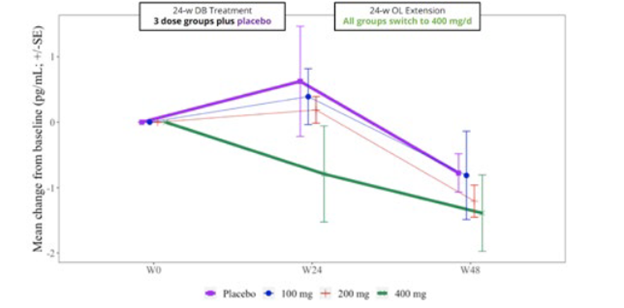
From baseline (“W0”) to Week 24, IL-6 for the group on the highest dosage of censavudine declined and continued to do so for the next 24 weeks of the same dosage.  But for the groups on placebo and lower dosages of censavudine during the first 24 weeks, the IL-6 levels rose and then, after switching to censavudine (at the highest dosage), their IL-6 declined to become indistinguishable from that of the group on high-dosage censavudine from the start.

This looks very good, though I’m not sure why the placebo patients were able to “make up for lost time” so nicely.  In any case, the result was not statistically significant, but at least it’s encouraging.  

Now, let’s consider the NfL results, as shown in the graph below.  In the group on 400 mg throughout, the level showed no change over the whole 48 weeks.  By Week 24, the patients on placebo worsened to an extent predicted by previous research and then seemed to improve, or at least to stabilize, after starting to receive censavudine 400 mg.  This result, like that of the IL-6, was not statistically significant, however.  The 100 mg and 200 mg groups, upon switching to 400 mg at Week 24, seemed to accelerate in their degenerative course, a puzzling result.  In any case, none of these observations reach statistical significance.
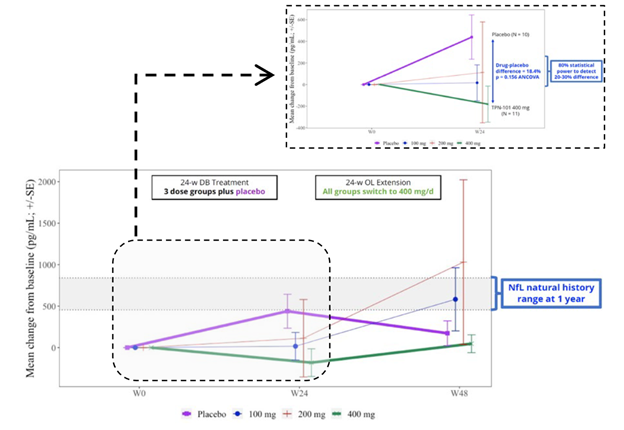
Despite the lack of statistical significance for the IL-6 and NfL results, Transposon’s bottom-line conclusions read, “Reductions in NfL and IL-6 support the potential for a positive effect on neuroinflammation and neurodegeneration.”  Technically speaking, that nuanced statement is appropriate, as they do “support the potential,” but the very large titles for the two graphs above were the very non-nuanced “TPN-101 Reduces Neuroinflammation” and “TPN-101 Reduces Neurodegeneration.”  I didn’t include them in my two screen shots because I didn’t want to perpetuate those very misleading declarations.

My bottom line: Censavudine (TPN-101) is acceptably safe over two years’ observation.  This trial was too small and its double-blind phase too brief for any statement as to efficacy in slowing PSP’s progression.  A large trial able to demonstrate whatever efficacy may exist is well justified and I look forward to it.

My other bottom line: Transposon’s presentation of its study’s efficacy results is misleading at best.

P.S. for the statistically interested:  This presentation used standard errors (SE) rather than standard deviations (SD).  SD is appropriate when two groups such as a placebo group and an active drug group are being compared.  But for tracking the course over time of a single group, SE is appropriate.  This presentation includes both kinds of observations, so I can’t fault their choice of SE.  But you should keep in mind that the SE is a smaller number than the SD:  SE is the SD divided by the square root of the N.  So, in this trial, the N of each dosage group and the placebo group was about 10, and the square root of 10 is about 3, so the height of the error bars in each graph is only about a third of what most of us are used to looking at.  That creates a false impression of a meaningful separation between the placebo and censavudine results.

It’s awards season

A caregiver has asked me, as CurePSP’s Chief Clinical Officer, to list the most important clinical research advances in PSP of 2023. Happy to oblige. Here are my top five in no particular order. 

  • The FDA approved a combination of two drugs called taurursodiol and sodium phenylbutyrate with the brand name “Relyvrio” for use in amyotrophic lateral sclerosis (ALS; Lou Gehrig disease).  A trial in PSP has already started to recruit patients.  The drugs address an issue in the mitochondria shared by the two diseases in different sets of neurons.
  • Tau PET ligand APN-1607 received go-ahead from the FDA to proceed to a pivotal Phase 3 trial.  Such a trial began recruitment in December in the US and will involve multiple other countries as well.  The compound would allow a diagnosis of PSP in early or equivocal cases by being taken up by the abnormal tau protein in the brain and imaged.
  • A drug called TPN-101 was found to be safe and well-tolerated in a Phase 1 trial of 30 patients with PSP.  The drug counters inflammation in the brain by reducing the transcription of ancient viral DNA in our genome.  Next is a small trial for efficacy.
  • A simple, remote, gait-monitoring system with only three sensors proved able to distinguish the gaits of PSP and PD.  Further testing for its ability to document progression or improvement will follow.
  • PET imaging of frontal lobe synapses showed good correlation with the PSP Rating Scale and with the results of cognitive testing.  This is different from typical PET in neurodegenerative disease, which images glucose utilization or protein aggregates.  The work suggests that synaptic imaging could be a good diagnostic marker in the earliest, pre-symptomatic stages of PSP.

But the most important piece of news is that several drug companies are planning to start clinical treatment trials in the next year or two. I’ll report on all that as it happens.

Putting the cat back into the bag

Here’s a nice piece of news.

My periodic updates on active PSP neuroprotection treatment trials have mentioned a drug called TPN-101.  That’s an oral drug that inhibits an enzyme called reverse transcriptase.  If that term sounds familiar, it’s because that’s one of the mechanisms of anti-HIV drugs. 

Transposon Therapeutics issued a press release yesterday announcing that a 24-week, Phase 2 trial of TPN-101 in 30 patients showed a reduction of spinal fluid levels of neurofilament light chain (NfL) by 18.4% compared with the 10 patients on placebo.  NfL is a normal protein in brain cells that leaks out into the spinal fluid during active brain degeneration.  TPN-101 also reduced spinal fluid levels of interleukin-6 (IL-6) by 51.6%.  IL-6 is a component of the immune response in the brain that correlates with inflammation, part of the neurodegenerative process in PSP.  There were no important side effects. 

A study of only 30 patients is far too small to show any outward neuroprotective effect that might exist.  This trial was designed to look for chemical evidence of engagement with the “target” cells and proteins in the brain and also to detect major side effects. 

The findings will be presented as a poster at the 18th International Conference on Alzheimer’s and Parkinson’s Diseases in Lisbon in March 2024.

If you’d like to know how this drug works, put on your nerd hat and hang on:  Our genomes are riddled with short stretches of DNA called “transposable nucleotide elements” inserted there by a viruses infecting ancestors hundreds of millions of years ago.  But we have ways to prevent this viral DNA from being translated into proteins.  One protective mechanism, called “chromatin packing,” uses a variety of proteins to surround our DNA strands like insulation on a copper wire, preventing our protein-making machinery from gaining access.  The chromatin, however, does have to grant access to allow normal protein manufacture, and as we age, the chromatin starts to grant too much access.  The old viral DNA can now be encoded into RNA, which our immune system promptly recognizes as foreign.  The result is an inflammatory immune response that, via a variety of pathways, encourages the tau protein to misfold and aggregate.  Those, of course, are the hallmarks of PSP and a couple of dozen other “tauopathies.”  TPN-101 inhibits an enzyme called “LINE1 reverse transcriptase,” which is necessary for the transcription of the transposable nucleotide elements into RNA but is not involved on normal cell processes. In other words, the drug puts that cat back into its bag.

I hope and assume that the next step will be a larger study attempting to show clinical benefit in slowing progression of PSP.  This typically takes months to organize, months more to recruit all the patients, 12 months for the last-recruited patient to complete the double-blind phase, and another few months to analyze.  That totals about 3 years, but at least things are moving in the right direction.

A new drug out of the gates

My post on December 19 mentioned that an early-phase trial of a drug called TPN-101 in PSP was about to start recruiting participants at two sites – one in Florida and one in Michigan.  I just learned that recruitment has begun and there are now five sites.  They’re in Boca Raton, Florida; Gainesville, Florida; Farmington Hills, Michigan; Las Vegas, Nevada; and Englewood, Colorado.  Contact information is available here.

The drug, whose new generic name is “censavudine,” is an inhibitor of the enzyme reverse transcriptase.  As you’d guess, it was originally developed for the treatment of AIDS.  The mechanism of action against PSP is via reducing levels of hyperphosphorylated tau.  It’s administered as an oral tablet.  This trial is designed to test safety.  With only 40 participants and less than six months of placebo-controlled treatment (followed by the same period of open-label observation), it isn’t large/long enough to assess benefit unless the magnitude of that benefit is improbably huge.

Figure that it will take six months to fully recruit, which means that the last patient will finish in mid-2023.  So I’d expect results in late 2023.  Let’s hope that this is safe and well-tolerated and that a Phase 2b or Phase 3 trial of hundreds of patients at dozens of sites will start soon thereafter.

Short stuff

Most of my posts are long — maybe too long. The charitable explanation is that I can’t resist my instincts as a professor to explain stuff so my learners can understand it. The less charitable explanation is that I’m just a windbag. So here are a bunch of very brief items of news, ideas and opinion about PSP and CBD in the style of Twitter. In fact, I’ll even limit my character count to 280, including spaces. Here goes.


A group in Bologna did skin biopsies to look for a phosphorylated form of α-synuclein in PD, PSP or CBD, and controls – 26 subjects in each group. They found it in all 26 with PD, in no controls, and in 24 with PSP/CBD. (The other two had PD-like features.) Now: how about MSA?

You’ve noticed that CurePSP’s publicity materials call PSP, CBD and MSA “prime of life” diseases because those conditions’ usual decades, the 50s, 60s and 70s, are when life can otherwise be lived to the fullest. Do you agree? Let me know.


A group called the PSP Research Roundtable was formed in 2017 to help speed the process of testing promising drugs. It’s run by CurePSP and has membership from academia, the FDA, the NIH, drug companies, biotech, philanthropy and patient advocacy groups.


Transposon Therapeutics has started a Phase 2 trial of TPN-101 in PSP at private clinical trial sites in Boca Raton, FL and Farmington Hills, MI. Like many available HIV drugs, TPN-101 inhibits the enzyme reverse transcriptase, but otherwise, details are sparse.

About the mechanism of action of TPN-101: I can tell you that another reverse transcriptase inhibitor routinely used for HIV called efavirenz (trade names Sustiva and Stocrin) reduces tau aggregation. CurePSP is currently supporting a study of it in a mouse tauopathy model in The Netherlands.

Enough for now. No windbag, I.