Four reasons to hope

It’s high time I updated you on currently – or imminently – recruiting PSP clinical trials.

Here are the four in chronological order. All these are for “neuroprotection,” meaning slowing of the underlying disease process. They don’t attempt to improve the existing symptoms, however. That’s called “symptomatic” treatment and I’ll get around to that soon.
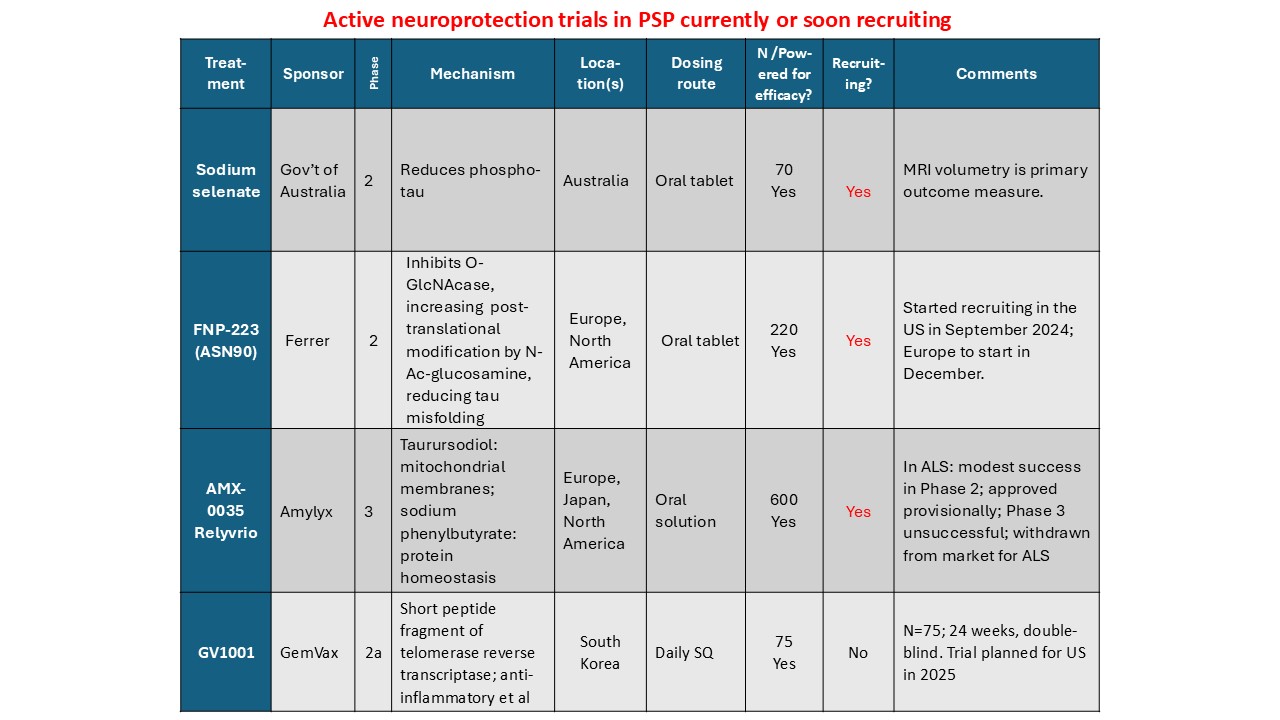
More details:

Sodium selenate provides supplemental selenium, which is critical for the function of 25 human enzymes with a wide range of functions. Two are relevant to PSP: glutathione peroxidase 4 and protein phosphatase 2A. The first regulates one type of programmed cell death and the second removes phosphate groups abnormally attached to the tau protein. The trial is happening only in Australia. See here for details, including contact information.

FNP-223 inhibits an enzyme called 0-GlcNAcase (pronounced “oh-GLIK-nuh-kaze”), which removes an unusual sugar molecule from its attachment to tau. The sugar is called N-acetyl-glucosamine and it prevents abnormal tau from attaching at the same spots on the tau molecule. It’s an oral tablet and the trial, which has just started, will be in both Europe and North America. Click here for details and contact info.

AMX-0035 is a mixture of two drugs in an oral solution. Both are currently marketed for conditions unrelated to neurodegeneration. The PSP trial has started in North America and will do so in Europe and probably Japan in the next few months. One of the two drugs, called sodium phenylbutyrate (marked as Buphenyl), addresses the brain cells’ management of abnormal proteins. The other, taurursodeoxycholic acid, marketed as TUDCA, helps maintain the mitochondria. Click here for details and contact info.

Finally, GV-1001 is an enzyme with anti-inflammatory action in the brain. But it’s not like a steroid or non-steroidal anti-inflammatory drug. It acts by an mechanism that the drug company is keeping close to its chest and has something to do with DNA transcription into proteins. The drug has to be injected subcutaneously every day, like insulin. A small trial is in progress in South Korea and in you live there, here’s enrollment info. There are plans to start a trial in the US in 2025, but that could depend on the current trial’s outcome.

Soon, I’ll post something on neuroprotection trials in which the double-blind recruitment is over but the results are pending. After that will be symptomatic trials.

With all these trials in progress, CurePSP’s “Hope Matters” tagline is truer than ever.

PSP treatment trials recruiting now or soon

As promised, I will now start trying to keep you updated on actively recruiting clinical trials in PSP.  Keep in mind a few things before using my list:  

  • In compiling my list, I rely heavily on www.clinicaltrials.gov.  Trials in the US are required to list themselves there, but some take longer than others to comply.  Trials overseas may or not be required to have a listing on clinicaltrials.gov, depending on the country.  My list also includes trials I’ve heard about through the grapevine that are not (yet) listed.
  • In Phase 1 and sometimes in Phase 2, the trials do not typically allow patients completing the protocol to continue receiving the drug, no matter how well they were doing on it.  Later Phase 2 and Phase 3 trials often do allow this, but they do not commit to it in advance.  Typically, if the trial shows the drug to be ineffective (or unsafe) overall, the drug company will discontinue its program for that drug and stop producing it.  That means that even the few patients who might have been doing well on it will not continue to have access to it.
  • In theory, exceptions to that rule could exist for drugs that are being tested in both PSP and another disease such as Alzheimer’s.  If the PSP trial shows lack of efficacy but acceptable safety, the company will continue to manufacture the drug pending the outcome of the other trial and may make it available to those who completed the PSP trial.
  • For trials of neuroprotective treatment, patients may not know if they are benefitting.  (Definitions: “Neuroprotective” drugs are intended to slow the progression of the abnormal brain process in the long term, as opposed to helping the symptoms experienced by the patient in the short term.  For example, for infections, antibiotics are protective, while painkillers are symptomatic.)  To know if an individual in a neuroprotective trial has had slowing of their rate of worsening over the 12 months on the drug, their rate of worsening over at least a few months before the trial would have to have been quantitatively assessed using the same method that the trial used.  We almost never have that data, so trials work by comparing the average result from a group receiving the drug to the average from a group receiving a placebo.
  • Do not expect a neuroprotective drug to improve your symptoms.  At best, it could prevent worsening, and more likely would only slow the rate of worsening.  The trials are typically designed to detect a slowing of the rate of worsening of 30% or 40%. 
  • Bottom line: Participating in a clinical trial, especially one in Phase 1 or 2, requires some level of altruism.
  • For more information on these trials, go to www.clinicaltrials.gov and enter the drug’s name or ID number shown in the first column.

Here’s the current list to the best of my knowledge.  The ones at the bottom labeled as “may start” are awaiting funding in most cases.

Drug /
clinicaltrials.gov ID
SponsorPhaseMechanismLocation(s)Comments
TPN-101

NCT04993768
Transposon2aReduces tau productionBoca Raton, FL Farmington Hills, MI30 patients on drug, 10 on placebo
RT001 (di-deuterated linoleic acid ester)

NCT04937530
Retrotope2aReduces lipid peroxidation, enhancing mitochondrial activityUniversity of Munich (Germany)Non-controlled study showed very slow PSP progression over 2 years.
NIO-752

NCT04539041
Novartis1Anti-sense oligonucleotide; reduces tau productionRochester, MN; Nashville, TN; Montreal; 3 in Germany; 1 in UKRequires 4 injections into spinal space over 3 months.
AZP2006

NCT04008355
AlzProtect1Reduces tau production3 sites in France~24 patients on drug, ~12 on placebo
May start recruiting in the next year:
ASN120290Asceneuron1Reduces tau misfolding and aggregation by inhibiting O-GlcNAcase?Press release info only
MP201Mitochon1Mitochondrial decoupler?Early in planning per press release
Tolfenamic acidNeuroTau2NSAID that reduces tau productionCleveland Clinic, Las Vegas + others? 
Sodium selenateGov’t of Australia2Enhances dephosphoryl-ation of tau by protein phosphatase 2Multiple, in Australia