I’m at the annual meeting of the Movement Disorders Society, now officially the International Parkinson and Movement Disorders Society (why the redundancy?). I just gave a lecture on the treatment of PSP, MSA and CBD. My bad – I didn’t get the PowerPoint file to the organizers in time for it to be included as a hard copy in the handout, so here it is: Treatment of PSP and CBD – L Golbe You can download it even if you didn’t attend the conference. You’re welcome.
Category Archives: Uncategorized
A new drug target from an epidemiologic observation
I think what jolted me out of my multi-month posting torpor is next week’s annual meeting of the Movement Disorders Society. I’ve been preparing a lecture on the treatment of PSP, CBD and MSA, and that got my juices flowing.
Speaking of treatment, an interesting paper that appeared in Plos One during my writer’s block came out of Günter Höglinger’s lab in Munich. Julius Bruch was first author. It builds on the observation that people with Guadeloupean tauopathy are far more likely than local controls to have consumed the fruits sweetsop and soursop, which contain annonacin, a mitochondrial Complex I inhibitor. Subsequent work with annonacin has suggested that it can cause a tauopathy in rats.
The new paper found that annonacin upregulates the production of 4R tau, the predominant form in PSP and some other tauopathies, by favoring the inclusion of the exon 10 peptide product into the finished tau molecule. Further experiments described in the same paper showed that annonacin upregulates the splicing factor SRSF2, which is one of a handful of factors known to regulate splicing of exon 10. So they used silencing RNA to knock down SRSF2. The result was a dramatic reduction in 4R tau.
They then took the next step and analyzed human PSP brain tissue for SRSF2, finding it markedly elevated compared to controls with no neurological disease.
To examine the possibility that the elevation of 4R tau and SRSF2 by annonacin was the result of mitochondrial Complex I inhibition rather than of nonspecific cellular stress or nutrient deprivation, they treated neuronal cultures with MPP+, a well-studied Complex I inhibitor, but not with 6-hydroxydopamine, a toxin that works independent of Complex I, or with nonspecific nutritional deprivation.
So it looks like a drug that inhibits SRSF2 could correct the abnormal 4R/3R ratio in PSP and potentially prevent cell loss. But a lot of work remains to determine how important this particular pathway is in causing the cell loss. The highly variable 4R/3R concentration across different brain areas in PSP and the existence of tauopathies with normal or low 4R/3R ratios show that the story isn’t so simple. But with the recent explosion of interest from drug companies in PSP as a route to Alzheimer’s disease, any new approach could attract interest, and this one deserves a place on the list. I don’t know if any existing or approved drugs inhibit SRSF2, but that could be a good job for a lab that’s tooled up for high-throughput screening.
Not your father’s PSP
As it turns out, PSP comes in many clinical flavors. Back in the 80s I remember some patients whose illness looked like Parkinson’s until I realized that they weren’t responding to my levodopa prescriptions, at which point I repeated a careful ocular motor exam and found square wave jerks and slow downward saccades. I also remember one member of my first series of 41 patients with PSP from 1988 with severe gait apraxia and freezing as his most disabling feature.
Then, in 2005, David Williams and colleagues, mentored by Andrew Lees at Queen Square, published what is probably the most important clinical paper on PSP in the half-century since Steele, Richardson and Olszewski. That work delineated and named PSP-Richardson syndrome (PSP-RS ) and PSP-parkinsonism (PSP-P). This wasn’t just a new way to slice a clinical spectrum sharing the same basic pathology; the two variants actually had statistical differences by cluster analysis. This suggests that they differ at the pathoanatomic level. They even differed in the ratio of 4R/3R tau. (It turns out that the predilection of PSP’s tangles for 4R tau is driven by RS.)
Since then, a cornucopia of low-frequency clinical variants meeting pathoanatomic criteria for PSP has been described. In approximate descending order of prevalence after RS and PSP-P are corticobasal syndrome, postural Instability, pure akinesia with gait freezing, frontotemporal dementia, ocular motor predominance, progressive non-fluent aphasia, semantic dementia, and a cerebellar variant.
The clinicopathologic studies are only starting to appear, but it’s likely that they will all turn out to emphasize different cells, nuclei and brain regions. We will also probably see some subtle molecular differences among them (presaged by the 4R/3R difference between RS and PSP-P).
That sounds like different diseases to me. Different diseases shouldn’t be combined in treatment trials, genetic analyses or descriptive studies. What a mess.
Or is it? Maybe we don’t need to find causes and cures for each PSP variant individually. As they’re all tau aggregation disorders, maybe they will all yield to the same prevention. Maybe the mechanism of prion-like spread, by now pretty much a textbook verity, will apply not only to all of the “pure tauopathies” (and it’s not yet clear that all of the PSP variants are in fact pure tauopathies) but to all of the protein-aggregation-based neurodegenerative disorders. If it does, then poisoning that process could be the grand unified answer to Alzheimer’s, Parkinson’s, ALS, and PSP in all its malign variety.
The Gathering
Now’s the time to arrange your October schedule around CurePSP‘s annual International Scientific Symposium. The proceedings will be dawn to dusk on Saturday, October 18, 2014 in Baltimore at Johns Hopkins’ Mt. Washington Conference Center. As usual, I’m privileged to be its scientific director and master of ceremonies.
As always for this shindig, the technical level will be very high, with scientists talking to scientists. No lay-language summaries. There’s always time for everyone to contribute ad libitum during the ample discussion periods. A lot of the meeting’s material is unpublished and it’s a great place to form new ideas and collaborations.
The agenda has two categories of speakers: recent CurePSP grantees presenting the results of their funded work completed within the past year; and internationally-known authorities describing the state of the art in their own areas. This year, the grantees are Diana Apetauerova, Nilufer Ertekin-Taner, Stuart Feinstein, Pau Pastor, Michael Wolfe and Benjamin Wolozin . The invited speakers are Adam Boxer, Günter Höglinger, Virginia Lee and John Trojanowski. As always, Dennis Dickson will update the group on the operations of CurePSP’s brain bank, which he directs, and on the projects of his arising from that collection. There will also be a few posters, with brief, live presentations by those PIs.
But perhaps the star attraction will be Jerry Schellenberg presenting the preliminary results of his much-anticipated whole-exome sequencing project in PSP. We have reserved a large chunk of the schedule for his talk and for talks by a number of experts in the most promising genes identified by the WES.
Registration is free! (but required) If you’re a student (medical or grad or other), fellow (clinical or research) or resident (neurology or other), CurePSP offers travel scholarships Breakfast and lunch will be provided to all registrants. I’ll post the exact schedule as soon as I can, but you can assume that the first speaker will start at about 7:45 AM and that we’ll all head for the nearest bar at about 5:00.
Poster submissions are welcome. Please submit them by September 5 to abantum@curepsp.org with a copy to me (golbe@rutgers.edu). I’ll have a decision for you by Sept. 10.
For more information, go to http://www.psp.org/research/researchers/symposium.html
Is PSP a disease?
The neurodegenerative diseases are starting to merge. The most obvious level of commonality lies at the cellular level of pathogenesis, where each disease is now hypothesized to include protein misfolding, templating, intercellular spread and damage by oligomers. Within the tauopathies, there is major overlap among “diseases,” as shown in this superb diagram from David Williams and Andrew Lees (Lancet 2009).
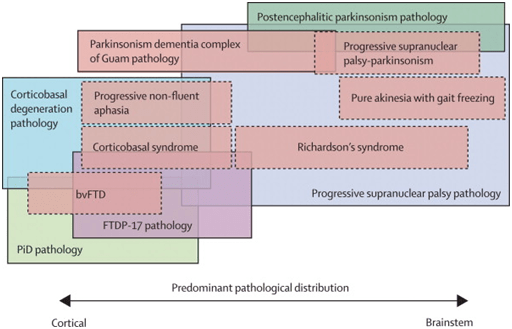
The blue, green and purple areas are pathological syndromes and the reddish ones are clinical syndromes. Note that all of the patients with Richardson’s syndrome and PSP-parkinsonism have classic PSP pathology, but the reverse is not true. Corticobasal syndrome is only about half explained by corticobasal degeneration pathology (though the diagram suggests about 85%), most of the rest being PSP and frontotemporal dementia pathology. Similar shortfalls in clinicopathological correlation underlying our traditional definition of a “disease” plague the rest of the tauopathy diagram. A similar diagram can be made for the α-synucleinopathies.
How to explain this to our patients? Our students? Ourselves? I like to think of neurodegenerative diseases as a set of spectrums. As there are only a limited number of neural systems available to damage, inevitably some parts of some of the spectrums will overlap in their anatomical, therefore clinical, phenotypes. This idea may seem unsatisfying to our traditional, neat system of clinicopathological pigeonholes. It’s not as easy to digest as, for example, the “autism spectrum,” where we don’t yet have the messy variable of pathological correlates to contend with. But this state of neo-nosologic confusion is only temporary. Before too long, we will have a long list of genomic, epigenetic, toxic, proteomic variants along with just plain stochastic events that in combination produce neurodegenerative disease. We will then have an understanding of such diseases that is more sophisticated and rational than the current combination of microscopical, biochemical and clinical abnormalities. These insights will render our present concept of “a disease” obsolete and make it much easier to devise prevention for most of these conditions.
Two pieces of good news: antibodies and TPI-287
To help that last, depressing post on CSF diagnostic tests go down, here are two spoonfuls of sugar.
The first is that the tiny biotech startup iPierian, Inc. has been bought by the giant Bristol-Myers Squibb. iPierian, like at least a half-dozen other companies and several academic labs, is developing an antibody against tau. Their first disease target is PSP. The mere fact that BMS is interested indicates that some smart people think this idea has legs, and the R&D resources that big pharma can bring to bear are a great shot in the arm for the tauopathies. Of course, the Holy Grail from the commercial standpoint is an Alzheimer’s treatment, but if a PSP treatment is spun off as a preliminary or corollary product, excellent.
Antibodies can’t gain access to the intracellular space in the brain. The scientific idea underlying the antibody development is that misfolded, aggregated tau molecules are vulnerable to antibody attack during their foray through the intercellular space en route from neuron A to neuron B. It’s like the cute green sea turtle hatchlings getting picked off by gulls during their awkward sprint across the beach. The notion of tau secretion by neurons is critical to the new templating hypothesis of spread of misfolded and aggregated proteins in neurodegenerative disease. (The idea has also been called “prion-like” but I’m with those who feel that this creates misplaced fear that all neurodegenerative diseases are transmissible and their sufferers are to be shunned.)
Now, let’s just hope that the stuff is tolerated, both by patients and by BMS’s business strategy.
Another purveyor of anti-tau antibodies, C2N, is in a more advanced stage of the pipeline with its own product. A Phase I trial is due to start within a year. More on that in coming weeks.
The other nice piece of news is that a trial of a microtubule-stabilizing drug in PSP and CBD has received IRB approval and will begin soon. Designated TPI-287, the intravenously infused compound is a member of the taxane family that has been successful as antineoplastic agents. It’s only in Phase Ib at this point and confined to a handful of centers, mostly in California. Details should be up on clinicaltrials.gov soon, but here they are now:
• Study director: Adam Boxer, MD, PhD
• Sponsor: UCSF (Funder: CBD Solutions, Tau Consortium)
• Recruiting?: Yes
• Official study title: A Phase I, Randomized, Double-Blind, Placebo-Controlled, Sequential Cohort, Dose-Ranging Study of the Safety, Tolerability, Pharmacokinetics, Pharmacodynamics, and Preliminary Efficacy of TPI-287 in Patients with Primary Four Repeat Tauopathies: Corticobasal Syndrome or Progressive Supranuclear Palsy
• ClinicalTrials.gov identifier: not yet available
• Conditions studied: Corticobasal Syndrome (CBS) and Progressive Supranuclear Palsy (PSP)
• Intervention Drugs: TPI-287 or placebo control is administered as an intravenous infusion, once every 3 weeks for 9 weeks during the double-blind dose-finding phase (for a total of 4 infusions). There are 3 infusions in the optional open-label phase; total of 7 infusions in both phases.
• Phase: Phase Ib
• Purpose: Tau is a microtubule-associated protein, and abnormal tau function has been proposed to play a role in the development and progression of primary four repeat tauopathies, CBS and PSP. TPI-287 is a stabilizer of microtubule dynamics, and the stabilization of microtubules is hypothesized to compensate for the loss of tau function in primary four repeat tauopathies. The purpose of this study is to determine the safety and tolerability of intravenous (IV) infusions of TPI-287 in patients with four repeat tauopathies (4RT), CBS or PSP.
• Duration of participation: Approximately 4 months, 7 months with open label extension
• Inclusion criteria: Subjects must be between 50 and 85 years of age (inclusive) and be able to walk 5 steps with minimal assistance (stabilization of one arm or use of cane/walker). Subjects must also have a Mini Mental State Examination (MMSE) score of 14 through 30 at the screening visit. Subjects must be willing and able to have brain MRIs as well as two lumbar punctures performed. Subjects must have a reliable caregiver who has at least 5 hours of contact with them per week and is willing to accompany the subject to study visits.
• Exclusion criteria: Subjects must not have any medical condition other than CBS or PSP that could account for cognitive deficits (such as Alzheimer’s disease, active seizure disorder, stroke or vascular dementia). Subjects must not have a prominent and sustained response to levodopa therapy. Subjects must not have a history of significant cardiovascular, hematologic, renal, or hepatic disease, significant peripheral neuropathy, major psychiatric illness or untreated depression. Subjects must not have previous exposure to microtubule inhibitors, must not have participated in another interventional clinical trial within 3 months of screening, and must not have been treated with another investigational drug within 30 days of screening.
PSP markers in CSF? Not yet
As a PSP-ologist, it takes a lot to discourage me, but the excellent review of CSF markers in the diagnosis of PSP did it. Nadia Magdalinou, Andrew Lees and Henrik Zetterberg of University College London, writing in the JNNP, point out that no CSF measure has been consistently or reproducibly found to differentiate PSP from all of the relevant competing diagnostic considerations.
An excellent study cited in the review found low levels of CSF α-synuclein in Parkinson’s, DLB and MSA relative to PSP and other brain disorders. A value less than 1.6 pg/μl had good (91%) positive predictive value for any synucleinopathy but higher concentrations had poor (20%) negative predictive value. So that measure is of some small value.
Neurofilament light chain in CSF is elevated in PSP, MSA and CBD, according to another study, with an area under the ROC curve of 0.93. This has been confirmed by others since. This is useful in distinguishing PSP from PD, but when your patient has a poor levodopa response and downgaze problems, PD isn’t really the issue; PSP, MSA and CBD are.
One study of neurofilament heavy chain found that it can differentiate PSP from CBD but not from MSA. That study was published in 2006 and we’re still awaiting confirmation.
You’d think that tau would be the object of intense scrutiny in the differential diagnosis of PSP by CSF, but there’s been relatively little on that. One good study found that the ratio of phospho-tau to total tau is lower in PSP and MSA than in PD. The other studies of phospho-tau in PSP have been negative.
So the winner so far for PSP, limping across the finish line, seems to be neurofilament light chain. It’s not available commercially as far as I can tell; nor should it be, without further study.
Adding to this discouraging picture is the fact that most or all of the studies of CSF markers in PSP have sampled patients in a stage of PSP that allowed clinical diagnosis. By that time, the CSF picture may be more diagnostic than in the earlier stages, when a state marker would be most useful. In other words, the studies were retrospective rather than prospective.
For now, I’m putting my money on imaging.
A road map to a cure, or maybe a grant
For as long as I’ve directed the research grants program at CurePSP, I’ve been a champion of the investigator-initiated approach. Let the experts decide what’s scientifically ripe and feasible for them, I say. I’ve seen too many RFAs produce opportunistic applications that are a stretch for an investigator both intellectually and practically.
But I thought it was best to compromise that principle by creating this “Road Map to a Cure.” It presents a general approach to developing neuroprotective treatment for PSP that builds on recent advances and hot ideas, interacts with the private sector, and is feasible with present technology. Perhaps best of all, its definitions are flexible enough to accommodate a wide variety of investigator-initiated ideas.
In developing the Road Map, I collaborated with Yvette Bordelon, a movement disorders specialist at UCLA and Chair of the Research Committee of CurePSP’s Board of Directors; and Jeff Friedman, a pediatrician/biochemist at Friedman Bioventures and Scripps and a member of CurePSP’s Board.
As you can see, the Road Map chooses three general hypotheses: a genetic etiologic component, a prion-like (the preferred term is “templating”) mechanism, and a problem with protein folding and management. It also identifies two broad categories of experimental tools that need improvement: animal (or cellular) models and human biomarkers. The Road Map then seeks to develop treatments based on one or more of the three hypotheses and using one or both of the two tools. Then comes the familiar the cascade of treatment development, from target identification to in-vitro or cellular screens to more complex model organisms to early-phase humans trials to late-phase trials.
Of course, some treatments may be ready for testing in animals or humans right now without the preliminary steps, and that would be great. Will CurePSP triage out any applications lying outside of this development model? Not at all. The Road Map is formulated more as a general guide and we recognize that there are other paths.
We also recognize that the Road Map ignores important things like symptomatic or surgical treatments, studies of exogenous risk factors, descriptive and nosologic studies and, perhaps most important, completely new and risky ideas.
The Road Map, as you’ve guessed, is designed partly as a fundraising tool that allows potential donors to understand how scientists would spend their money. The donors deserve to know that and are quite capable of understanding it if we scientists just take the trouble to explain it to them.
Now for something you can use today: the PSPRS
I’m in awe of the scientific creativity and astuteness of the researchers whose work I feature in this blog. My own original work is more modest — but has its uses. In fact, hardly a week goes by without a publication of a research project using the PSP Rating Scale. This post is a shameless attempt to evangelize for it. Click here to download the PSPRS form.
Since my statistician colleague Pam Ohman-Strickland and I published it in 2007, the PSPRS has gradually become the standard way to quantify overall symptomatology and disability in clinical research in PSP. It is equally useful in routine clinical care and requires only 10 minutes to perform. It’s not copyrighted.
Yes, the Unified Parkinsonism Disability Rating Scale, the standard scale for PD, has been validated in PSP, but has nothing about frontal behavioral signs, eye movements, sleep and some other things that are important in PSP. The PSPRS has a nice, round 100 possible points divided into six sections and 28 items. Rather than attempting to rate every possible feature of PSP with equal emphasis, the items’ relative importance in the PSPRS mirrors that in the most common form of PSP itself. This design feature results in the PSPRS progressing about 11 points per year regardless of the magnitude of the score or disease duration. The score is useful as a prognostic indicator and I’m presently working on refining that.
The PSPRS requires some skill in the neurological exam, so cannot be applied by patients or caregivers. But they can bring it to the attention of their neurologists. Click here for the original paper in Brain that explains the details of how to administer the PSPRS.
Like everyone, I’m hoping for a more objective, reproducible test to quantify the state of neural degeneration in PSP – maybe something with spinal fluid or MRI. But until then, the PSPRS is the best we’ve got and it’s dirt cheap.
DNA methylation for the rest of us
Silly me. I thought I could write some posts in technical language and others on different topics in plain English. But I find that I just don’t have the heart to leave my non-technical readers in the dark about exciting research findings, even if the payoff for patients is years away. So here’s a brief, non-technical translation of my last post on DNA methylation.
A paper in a prestigious journal this week reports that the DNA of people with PSP has an unusual pattern of small chemical markings in a few areas, including the area that includes the gene that makes tau protein.
Time out for some basics:
DNA is the chemical that bears the genetic code. It’s like a language with an alphabet of only four letters. Each word has three letters and there are 20 available words. The “letters” are A, C, G and T, which are abbreviations for the four chemical components that make up the DNA strand. Each three-letter “word” specifies an amino acid. A string of amino acids that the cell produces according that that instruction (like a sentence, to continue our analogy) is called a protein. All of the chemical processes and structures of the body rely on proteins of many different varieties that are determined mostly by the order of their amino acids.
Tau is the protein that forms the abnormal blobs in brain cells in PSP, called “neurofibrillary tangles.” Its normal function is to help maintain the internal skeleton of the brain cells, which doubles as monorail system to transport nutrients to where they’re needed.
These chemical markings, called “methyl groups,” are very simple – each is just one carbon atom with three hydrogen atoms on it. It’s been known for many years that such “methylation” of the amino acids in DNA is one way to regulate the coding of the DNA into proteins. In PSP, the tau protein is abnormal in several ways, and abnormal methylation of the tau protein’s gene, it’s now been discovered, could be the reason.
We already know that the gene that encodes the tau protein is abnormal in other ways. But those are actual genetic mutations – alterations in the DNA code itself. The new research article concludes that the mutation in the order of bases in the DNA causes the abnormal methylation, which then causes the damage of PSP.
We’ve also long known that methylation can be influenced by the chemical environment of the cell, examples being certain toxins or nutritional deficiencies. So this new finding suggests that we should look more closely at those sorts of things as possible causes of PSP. It also suggests that drugs that affect methylation could potentially stop or slow progression of the disease.
As you’d imagine, this opens the door to a whole new area of research in PSP. These are exciting times!
 PSP Blog