“A little duloxetine to loosen my tongue”

The drug duloxetine, marketed under the brand name Cymbalta, was originally developed for depression or anxiety but is now prescribed mostly for pain management.  An article from neurologists in Russia and Malaysia now reports that three people with PSP who were receiving duloxetine for their mood issues experienced important, unexpected improvement in their speech. 

The article’s first author is Dr. Oybek Turgunkhujaev of the Semeynaya Clinic in Moscow and its senior author is Dr. Shen-Yang Lin of Universiti Malaya in Kuala Lumpur.  Unfortunately, the journal, Movement Disorders Clinical Practice, is not open-access and because it’s only a brief article, there is no abstract in PubMed for me to link to.

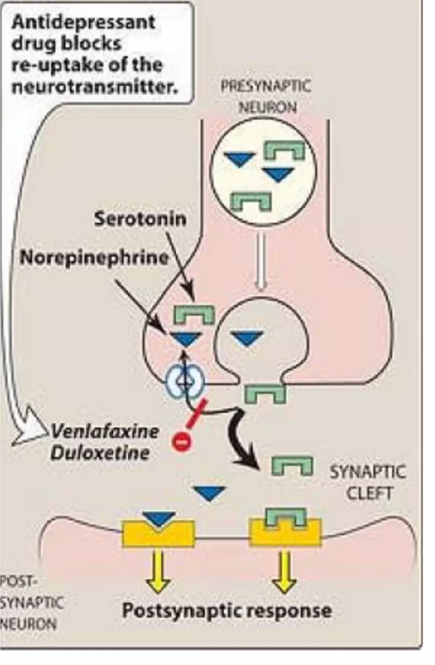
The mechanism of action duloxetine is to enhance the action of the neurotransmitters serotonin and norepinephrine by blocking the brain cell’s ability to re-absorb those molecules from the synapse.  That’s a standard way for brain neurons to regulate and sharpen its signals to other neurons.  That process is called “reuptake” and you’ve probably heard of the SSRIs or selective serotonin reuptake inhibitors. Duloxetine works on norepinephrine as well as serotonin, so it’s an SNRI.   Other SNRIs in common use include venlafaxine (Effexor) and desvenlafaxine (Pristiq). The figure below shows the mechanism of action of duloxetine and venlafaxine. 

Nerd alert: This mostly takes place in the pons, specifically the locus ceruleus (for norepinephrine), raphe nuclei (for serotonin), but to a lesser extent in prefrontal cortex of the cerebrum (both norepinephrine and serotonin).

The journal article is accompanied by before-and-after videos of two of the three patients.  They all had difficulties not only with slurring, but also with difficulties initiating speech and stuttering.  The delay to onset of the drug’s benefit is described only as “within weeks.”  All three patients also experienced an improvement in their mood, which could have been a direct effect of the drug on the natural reaction to their improved ability to speak.

The authors do a good job of describing how the drug’s known mechanism of action might address the parts of the brain that when impaired, are known to cause those symptoms.  But they also recognize that the general alerting and energizing effect of duloxetine could explain the result as well.  Placebo effect seems unlikely, as the durations of benefit were too long: “> 3 months,” “15 months until death” and “>5 months.” 

Bottom line: This is encouraging and I hope further reports of duloxetine in PSP from other centers are forthcoming. BUT . . . and MEANWHILE . . .

Physicians considering prescribing duloxetine off-label for speech problems in PSP should be aware that it can have important side effects and drug/dietary interactions.  I can’t get into those here, but they are described in detail in the 31-page FDA-approved package insert and its one-page summary. Needless to say, there has been no formal trial of duloxetine in PSP, so that population could have different/additional/worse side effects relative to the mostly younger people in the depression and pain trials on which the package insert was based. 

Sing, o muse!

You’ll recall from my 7/4/24 post that Rep. Jennifer Wexton of Virginia announced last year that she has PSP.  Below is a new press release from her office.  My point relates to its final paragraph.


Wexton Marks Disability Pride Month on House Floor Using New AI Voice Model

Washington, July 25, 2024

Washington, DC — Today, Congresswoman Jennifer Wexton (D-VA) delivered a speech on the floor of the House of Representatives to recognize Disability Pride Month, celebrated each July. Wexton utilized her new AI voice model for the first time on the House floor to share how she has fought throughout her career for disability rights and accessibility issues, and how that has now become a personal fight for her since her Progressive Supranuclear Palsy (PSP) diagnosis last year.

“I hope that when people see me continuing to do all I can to keep living my life and doing this job I love as best I can, they understand and appreciate the courage, resilience, and spirit that so many Americans of differing abilities demonstrate each and every day. I hope I can be a voice — even an AI voice — for Americans facing accessibility challenges and other disabilities, because too often people only see us for that disability. And in truth we are so much more,” said Wexton.

The AI voice model was created through ElevenLabs, a software company that specializes in developing natural-sounding speech synthesis software using deep learning. The model was generated consensually using a collection of previous public speeches from Rep. Wexton provided by her team. Any additional questions about the ElevenLabs technology can be directed to press@elevenlabs.io.


More than the nominal topic of Disability Pride Month, the text mentions that she used an AI-based speech aid to deliver a speech on the floor of the House.  It used audio recordings of her public speeches before PSP’s dysarthria set in to train the AI software to translate a written text into speech in her own voice, not the electronic, synthetic voice we all recognize as “computer speech.”  This is important because the distinctive timbre of one’s speech provides an important emotional identifier. 

This technique, relying as it does on a prepared, written text, is not suitable for ordinary two-way conversations unless you can type extremely fast. Few people with PSP can do that, even with the help of word-completion software.  Besides, hardly anyone has a collection of old audio clips on which to “train” the AI software that Rep. Wexton used.  An audio bank deliberately created for this purpose in an early stage of illness is one potential solution.

I wanted to review the latest on this topic, mostly to help me advise CurePSP about what sort of programs or research it might support going forward.  So, I consulted my newest muse, ChatGPT.  Here’s what it had to say about voice banking and other solutions for severe dysarthria:


You can bank your own voice for future use in a speech generation app in case you become disabled. Voice banking involves recording a variety of phrases and sentences while your voice is still healthy. These recordings can later be used to create a synthetic version of your voice, allowing speech generation apps to produce speech that sounds like you.

Here are the general steps to bank your voice:

    Choose a Voice Banking Service: Select a service that offers voice banking. Some popular options include VocaliD, Acapela, and ModelTalker.

    Record Phrases: Follow the service’s instructions to record a set of phrases and sentences. The more you record, the better the quality of the synthesized voice.

    Submit Recordings: Upload your recordings to the voice banking service.

    Voice Synthesis: The service will process your recordings and create a synthetic version of your voice.

    Integration with Speech Generation App: Once your synthetic voice is ready, it can be integrated into a speech generation app. This allows you to communicate using your own voice even if you lose the ability to speak naturally.

Voice banking is a proactive step that can significantly improve the quality of life for individuals facing conditions that may affect their ability to speak.

Alternatives to voice banking?

If voice banking is not a suitable option for you, there are several alternatives that can help with communication if you become disabled. Here are a few options:

1. Voice Cloning

Voice cloning uses advanced AI to create a synthetic version of your voice with fewer recordings. Services like Respeecher and Descript can create high-quality voice models from a limited amount of audio data.

2. Text-to-Speech (TTS) with Customization

Text-to-speech technology can be customized with different voices, accents, and tones. Some TTS systems allow you to adjust parameters to make the voice sound closer to your own. Popular TTS engines include:

    Amazon Polly

    Google Text-to-Speech

    Microsoft Azure Speech Service

3. Pre-Recorded Messages

You can record common phrases and sentences that you might need. These recordings can be played back as needed. Devices like the GoTalk series or AAC (Augmentative and Alternative Communication) devices often support this feature.

4. Alternative and Augmentative Communication (AAC) Devices

AAC devices and apps provide various ways to communicate through symbols, text, and synthetic speech. Examples include:

    Tobii Dynavox

    Proloquo2Go

    TouchChat

5. Predictive Text Apps

Predictive text apps can assist in quicker communication by predicting the words and phrases you are likely to use. These apps learn from your typing habits to offer more accurate suggestions. Notable apps include:

    SwiftKey

    Gboard

6. Communication Boards and Books

Low-tech options such as communication boards or books with pictures, symbols, or letters can be very effective, especially in environments where technology might not be available.

7. Eye-Tracking Technology

For individuals with severe physical disabilities, eye-tracking technology allows communication through eye movements. Devices like the Tobii Eye Tracker can be used to control computers and AAC software.

8. Sign Language and Gestures

If you retain some physical ability, learning sign language or using a system of personalized gestures can be an effective way to communicate.

Each of these alternatives offers different advantages depending on your specific needs and circumstances. Exploring these options can help you find the most effective means of communication in the event of disability.


Now back to human me. 

It goes without saying that these solutions have to be tailored to the individual – no easy task considering that the disease itself worsens with time.  Another complication is that many of the techniques require manual dexterity or eye movement control beyond the abilities of many people with PSP.  (It also goes without saying that anything from ChatGPT can be incomplete or even wrong.)

Medicare pays most of the cost of some of these things if there’s a doctor’s prescription. Discuss with a speech pathologist, which you should be doing anyway for general PSP-related speech and swallowing issues.

If you consider me your PSP muse, whose mine? Now I know.
Khao pad, arancini, and corn dogs

Here’s installment 3 in my series on research posters at the Movement Disorders Society conference in Copenhagen in August.  The first 2 posts covered treatment and non-imaging diagnostic testing, respectively.  The topic now is clinical features.  Don’t forget – these have not yet been submitted for publication in most cases.   All I have to work with are the abstracts, typically of about 400 words.  I don’t even have the full posters, much manuscripts.  I found 7 that I expect to survive the peer review process at respectable journals.  The first 4 are here.  Give me a couple of days for the last 3.  As before, my own editorial comments appear in italics.

The prevalence and characteristics of REM sleep behavior disorder in progressive supranuclear palsy patients.

A.P.H. Phoumindr, J.S.R. Srignean, R.B.H. Bhidayasiri (Bangkok, Thailand)

The set of symptoms called “rapid eye movement behavioral disorder” (RBD) occurs in 95% of people with Parkinson’s disease (PD) and in virtually everyone with dementia with Lewy bodies (DLB).  In RBD, one acts out dreams in the form of limb twitches; talking or shouting; sleepwalking; or even violent movement that can endanger the bedpartner.  In the morning, the patient recalls none of it.  For both PD and DLB, RBD can start years before the movement problem and is considered a major “pre-motor” predictive factor for those diseases.  It was originally thought to be rare in PSP, but more recent research has shown that it occurs in something like 30-40% of patients.  In this poster, neurologists in Bangkok, Thailand found that 10 (53%) of their 19 patients with PSP had experienced RBD.  The survey was performed after 6 years of PSP, on average.  

It’s hard to draw conclusions from the statistics because of the small size of the group, but the take-home is that a Thai population corroborates the general observation that RBD can occur in PSP.  Neurologists hearing of fragments of RBD in people with PSP should bear in mind the possibility of RBD because precautions against injury can be instituted and effective medication, usually melatonin or clonazepam, at bedtime can be started.  If the clinical symptoms seem diagnostically equivocal, a formal sleep study would tell the tale.

Impulse control disorder related to dopaminergic therapy in progressive supranuclear palsy

T. Thammongkolchai, P. Termsarasab (Bangkok, Thailand)

Two other neurologists from Thailand report one patient with PSP who experienced impulse control disorder, in his case pathological gambling and ice cream consumption, after starting pramipexole, a dopamine agonist medication.  This effect is well-known in Parkinson’s, where that drug class often provides good benefit, but this case shows that it can also happen in PSP, where dopamine agonists give little to no benefit.

This is another reason not to use the dopamine agonists in PSP without some special reason.  Whatever benefit they do provide is exceeded by the benefit of levodopa, which has far fewer side effects in PSP.  For a list of dopamine agonist drugs in clinical use world-wide, click here.

An acoustic-perceptual analysis of speech in clinical PSP phenotypes

G. Di Rauso, F. Cavallieri, A. Gessani, D. Fontanesi, S. Coniglio, V. Fioravanti, S. Contardi, E. Menozzi, S. Meletti, F. Antonelli, V. Rispoli, F. Valzania, C. Budriesi (Modena, Italy)This is a detailed, careful and very technical comparison of speech disturbances between 25 people with PSP-Richardson’s syndrome (PSP-RS) and 16 with PSP-Parkinsonism (PSP-P).  The researchers evaluated both the speech produced and the ability to understand speech.  They found no differences between the two subtypes and conclude that the formal diagnostic criteria for PSP-RS and PSP-P were justified in not attempting to use the type of speech disturbance to distinguish between them.

This finding makes sense because the main features of PSP dysarthria, spasticity (an explosive or rubber-band-like quality) and ataxia (a drunken-type, irregular pattern) are not part of the features distinguishing PSP-RS from PSP-P in other parts of the nervous system.  The finding is helpful in that it dissuades neurologists from trying to differentiate PSP-RS from PSP-P by their motor or perceptual speech abnormalities.  This is a fine example of a “negative” trial that is nevertheless important and useful.

Progression of the clinical features of progressive supranuclear palsy-Richardson syndrome in early and advanced stages

T. Xie, C. Liao, L. Golbe (Chicago, USA)

This project demonstrates that difficulty swallowing solids and liquids progressed faster late in the course of PSP, while all the other items in the PSP Rating Scale progressed at a uniform pace throughout the disease course.  The analysis was original in benchmarking each patient’s course not by calendar years, but by progression milestones of their own time downgaze palsy – a central feature of PSP.  It’s also unique in tabulating patients’ exam results from onset to within a few months of death, on average. 

Full disclosure: Yes, “L. Golbe” is yours truly.  Tao Xie (pronounced “she”) is a prominent neurologist at the University of Chicago with whom I’ve worked before and Chuanhong Liao is a biostatistician there.  Dr. Xie gets all the credit for the creative scientific thinking and the study design.  My most important contribution was a database of 462 patients I saw from 1994 to 2020 and evaluated with the PSP Rating Scale at each visit. The results can be used to counsel patients in symptomatic management.  They may also serve as “historical control” data in the long-term, open-label phase of neuroprotective treatment trials in which the double-blind phase lasts only 12 months and occurred much earlier in the course.  We have submitted a paper for publication. 

Speech therapy in PSP?

The Lee Silverman Voice Training (LSVT) “Loud” program is a popular method used by speech/language clinicians to improve vocal volume and clarity in people with Parkinson’s disease.  I’ve never been all that enthusiastic about it because there is no literature demonstrating superiority to traditional forms of speech therapy for PD.  For another thing, I’m a little suspicious of its proprietary financial model, where a clinician pays anywhere from $300 (for a student) to $990 (for a professional) for a two-day course that yields a certificate permitting them to advertise that they offer LSVT.   The courses and certificates are available only from LSVT Global, Inc.

Potential evils of capitalism aside, it’s good to see someone finally trying to help the dysarthria of PSP.  Our heroes are a group in Rome headed by the well-regarded movement disorders authority Fabrizio Stocchi, MD PhD.  The paper‘s first author is Patrizio Sale, MD PhD. a neuro-rehabilitation specialist.  The work appeared in the European Journal of Physical and Rehabilitation Medicine.

The study compared the benefit of LSVT Loud in 16 patients with PSP to the same four-week course of treatment in 23 patients with PD.  Both groups did improve in most of the measures applied.  Probably the most positive result was in the reading task, where the maximum volume for the patients with PSP improved from an average of 82.5 dB to an average of 87.5 dB. Somewhat more modest benefits accrued for nonverbal phonation and for non-reading speech.

Unfortunately, there were no control patients receiving sham treatment, traditional treatment or no treatment.  We don’t know if the improvement will long persist, but the literature suggests that it does so in PD.  Equally important is that the study did not evaluate articulation — only volume.  Furthermore, the study was quite small, inviting flukey results.  Clearly, more work is needed, but for now, I’ll try sending some of my patients with PSP and hypophonia (low vocal volume) for LSVT.  I’ll let you know what happens.