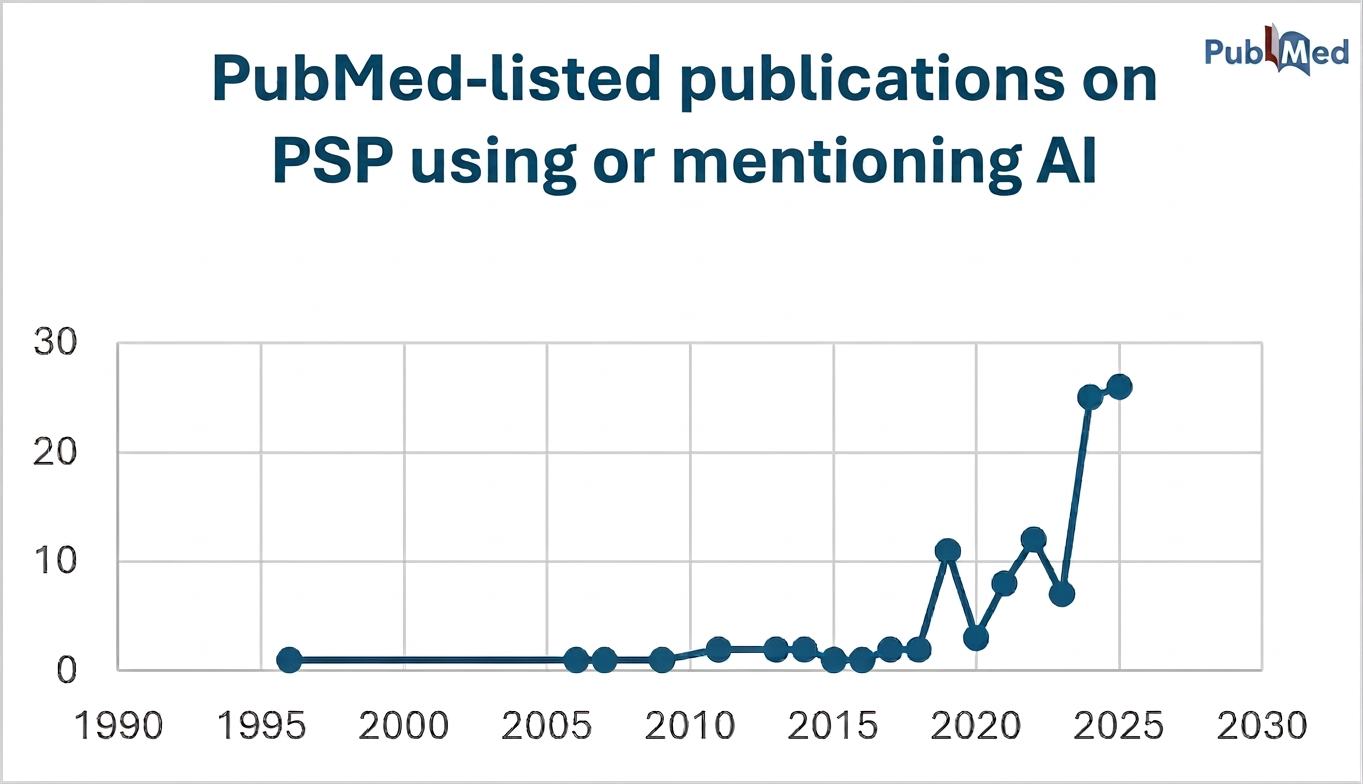
My last post, from 9/14/26, was about how AI is starting to be used for PSP care and research. Thank you to Kristophe Diaz, PhD, CurePSP’s CEO, for sending a comment with a nice piece of news about a new source of PSP research grants with an AI emphasis:
The Rainwater Charitable Foundation (RCF) is a private philanthropy with a long record of generous support of PSP research. It has just announced a new grant program called the Learning Research Network.
It would provide $1 million per project. In the RCF’s own words:
“The LRN is RCF’s evolving approach to creating a more connected, reusable, and AI-enabled scientific research environment. Its goal is to make it easier for researchers and, increasingly, AI-enabled tools to build upon data, methods, analyses, software, workflows, and knowledge generated across different projects and laboratories. Rather than a single database, software platform, or AI model, the LRN is envisioned as an ecosystem of interoperable scientific resources and capabilities that can work together to accelerate discovery.”
The funded project(s) would be traditional biologically-based inquiries, usually taking place in labs, but “will combine scientific significance with a credible AI-enabled and collaborative strategy.” That strategy would incorporate the “FAIR” principles.
Here’s an explanation of “FAIR.” I got this from Gemini (an AI search engine) and edited it to fit this blog’s style.
FAIR stands for “findable, accessible, interoperable, and reusable.” These are principles for managing and sharing digital information and tools such as raw patient datasets, genome sequences, or trained AI-based statistical programs. The FAIR principle makes the on-line data easier for both humans and automated AI systems to use and to understand.
- Findable:Data and AI models must have unique, persistent identifiers (like DOIs*) and rich metadata** so researchers and algorithms can locate them in online databases.
- * Digital Object Identifier (DOI) is a unique, permanent string of numbers, letters, and symbols used to reliably identify an article, book, or data set online.
- ** Metadata is “data about data.” For example, names of a publisher, journal, volume and page numbers, author’s contact information, or a website where information about a digital, on-line dataset can be found. A traditional example is the masthead of a printed newspaper showing the names of the editors and the address of the publisher.
- Accessible: Once found, users and authorized software must know how to retrieve the data or model using secure, standardized, and open communication protocols.
- Interoperable: Information must use standard file formats, common vocabularies, and structured metadata. This allows different biomedical databases and AI programs to merge, compare, and analyze data together seamlessly.
- Reusable: Assets must be well-documented with clear usage licenses and detailed background information (provenance) so others can safely retrain, audit, or apply the AI models in new studies.
In other words, the research results, and especially the raw data behind them and the AI programs used to obtain the data, should be made available to other researchers in a standardized way that can be easily accessed by AI programs.
Until now, when a researcher posted their raw data on line for the use of other researchers, it has often been very time-consuming and inconvenient for the second researcher to find and use it alongside their own data. But data produced with the help of the RCF’s new grant program would avoid those problems.
So, thanks, Rainwater Charitable Foundation, for all you’re doing and have done for PSP research!