For once

Some excellent news for you today.  The orally administered drug AZP-2006 has shown early signs of slowing the progression of PSP. (Yes, you heard right!)

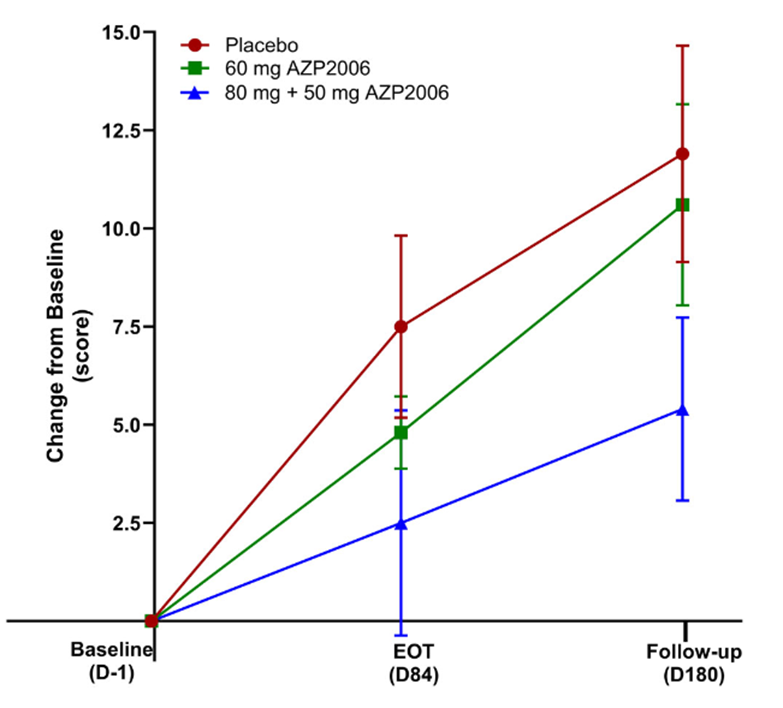
My blog post from May 9 of this year brought news that a small, open-label, Phase 1 study of AZP-2006 seemed to have slowed the progression of PSP by 31 percent.  Now, the drug has completed a small, double-blind, Phase 2a trial with even better results: In the 11 patients receiving 60 mg per day, the worsening in the PSP Rating Scale score over the 3 months of the double-blind phase was a third slower than in the placebo group (identical to the result of the uncontrolled Phase 1) and in the 13 patients receiving a loading dose of 80 mg on the first day and then 50 mg per day, the apparent worsening was two-thirds slower.  

It’s important for you to understand, and the authors repeatedly emphasize, that these results were not statistically significant, meaning that they could be the result of a random fluke.  There were also some minor differences among the three patient groups (placebo, 60 mg, and 80 mg then 50 mg) at the study’s baseline that theoretically could have explained the results.  A larger, Phase 2b study could confirm the result while having the statistical power needed to compensate for any “baseline bias” among the treatment groups. 

The trial included a 3-month open-label extension. That’s where the participants on placebo for the first 3 months were offered the opportunity to convert to the active drug at 60 mg per day, while those initially on the active drug could opt to continue it.  Over months 4, 5 and 6, the rate of decline of the formerly-placebo group slowed down noticeably.  The other important result is that the drug showed itself to be safe and well-tolerated over the entire 6 months.

The publication’s first author is Jean-Christophe Corvol, MD, PhD, a very well-regarded, senior neurologist I know at the legendary Hôpital Pitié-Salpêtrière in Paris.  The senior (i.e., last-named) author is Luc Defebvre, MD, PhD, at Lille University. Six of the other 16 authors are staff researchers at the sponsoring drug company, AlzProtect, of Lille, France.

In this graph, the vertical axis is the worsening in terms of the 100-point PSP Rating Scale.  EOT is end of the double-blind part of the trial at Day 84.  Thereafter, all participants received active AZP-2006.  Note that both active-drug groups progressed more slowly than the placebo group over the first 3 months; and on active drug, the participants formerly on placebo may have slowed their progression rate. The vertical line segments represent standard deviations of the mean. (From:  Corvol JC, Obadia MA, Moreau C, et al. AZP2006 in progressive supranuclear palsy: outcomes from a Phase 2a multicenter, randomized trial, and open-label extension on safety, biomarkers, and disease progression. Movement  Disorders. 2025 Sep 27. doi: 10.1002/mds.70049. PMID: 41014124)
So, when will the Phase 2b study start?  My May 5, 2025 post reported on the “PSP Platform,” (PSPP) an NIH-supported collaboration among dozens of U.S. academic centers to perform Phase 2b trials on up to three drugs simultaneously using one placebo group.  One of the first three drugs, in fact, is AZP-2006.  Last I knew, the PSPP was expected to start late this year, but it’s now almost October and I’ve heard nothing further other than that some details remained to be ironed out with the FDA. That trial would take about 6-12 months to recruit and then another 12 months for the last patient to finish, then at least a couple of months to analyze the data. 

So, how does AZP-2006 work?  I’ll plagiarize my own May 9 blog post, along with its “Nerd Alert!” warning that this gets technical:

The main mechanism of action of AZP-2006 is at the lysosomes, one of the cell’s garbage disposal mechanisms, where it acts specifically at the lysosome’s prosaposin and progranulin pathways. Prosaposin is the metabolic precursor (a “parent molecule” cleaved by enzymes to produce the active molecule) of the saposins, a group of proteins required for the normal breakdown of various types of lipids that are worn out or over-produced or defective from the start. Progranulin is the precursor, as you’d guess, of granulin, which, like saposin, is involved in function of the lysosomes. But progranulin addresses disposal of proteins, not lipids. In mouse experiments, the drug also enhances the production of progranulin, mitigates the abnormal inflammatory activity in tauopathy, reduces tau aggregation, and stimulates the growth or maintenance brain cell connections.

Bottom line: This very small, Phase 2a trial was designed to show safety, not efficacy, and its slowing of PSP progression did not nearly achieve statistical significance nor exclude potential sources of random bias.  But the magnitude of the (apparent) effect make this excellent news for those with PSP, present and future.

Proof of principle and cause for hope

The gene therapy company uniQure announced today that its has succeeded in slowing the rate of progression of early-stage Huntington’s disease (HD) by 75 percent.  Although the specific treatment would not work for PSP, the general principle successful in HD could be relevant to all neurodegenerative diseases.

The new research is not yet peer-reviewed nor published.  In writing this post, I used information from the company’s press release,  a news article from the BBC, and Old Reliable, ClinicalTrials.gov.

Unlike PSP, HD is a purely genetic disease.  It works on an autosomal dominant mechanism with full penetrance, which means that anyone inheriting one copy of the disease-causing version of the relevant gene from either parent will develop the disease.  The gene’s technical name is IT15 and it encodes a protein called huntingtin or HTT (notice the “-in” ending indicating a protein).  The gene defect is extra copies of a span of the three nucleotides C, A, and G. This “CAG repeat expansion” directs the cell’s protein factories (the ribosomes) to build into the HTT protein an excessively long string of the amino acid glutamine.  The normal span is 7 to 35 CAG repeats, but in people with HD, one of the person’s IT15 genes has at least 36 repeats. In people with HD, the normal version of the IT15 gene continues to make normal HTT, which means that half of their HTT is normal and half isn’t. The new treatment suppresses the brain’s production of the abnormal half.

Here’s how the trial worked: The researchers started with a kind of virus routinely used in research called AAV, which readily enters brain cells but by itself causes no harm.  They made short stretches of DNA designed to encode a type of micro-RNA corresponding to the abnormal HTT protein.  They inserted that DNA into the viruses and dubbed the result, “AMT-130.” In a 12-18-hour neurosurgical procedure, they injected the AMT-130 viruses into the caudate and putamen, the parts of the brain where HD does its main damage. The viruses released their DNA into the brain cells, which started transcribing it into RNA.  In this case the RNA was actually a “microRNA” designed to bind and disable the cells’ own abnormal RNA that would have gone on to be translated into abnormal HTT protein.   

In that way, the researchers hoped to reduce the cells’ production of abnormal HTT protein.

The trial included 29 people with HD at four study sites (Two in Warsaw, Poland and one each in London, UK and Cardiff, Wales.) Seventeen of the participants received a high dose of the virus, 12 received a low dose and all were observed for 3 years.  They were examined using the standard Unified Huntington’s Rating Scale (UHRS) and other measures of neurological function as well as spinal fluid sampling to measure levels of proteins associated with neurodegeneration.  As a control group, the trial used records of people with HD from an unrelated study of the natural history of the disease called “Enroll-HD.”

The result in the high-dose group was far better than anyone dreamed of. 

The “primary outcome measure,” the rate of worsening in the UHRS, was only 25 percent of that of similar patients from the control group.  Subsidiary measures of clinical efficacy gave similar or even better results.  Levels of neurofilament light chain (NfL), a protein released into the spinal fluid by degenerating brain cells, actually declined, while increasing in the control population. 

The low-dose group gave much less impressive results, which in a way is good because it suggests that the improvement was actually from the treatment rather than from some statistical fluke.

So, is this relevant to PSP?  Yes and no.

It’s relevant to PSP because:

  1. PSP and HD are both neurodegenerative diseases with an abnormally aggregating protein playing a critical but incompletely understood role in the loss of brain cells: tau for PSP, huntingtin (HTT) for HD.
  2. The anti-sense oligonucleotide treatment presently under development in PSP, NIO-752, works by the same principle as the AMT-130 virus.  But it’s injected into the spinal fluid and engages the tau messenger RNA directly, whereas AMT-130 releases DNA, which encodes RNA acting as the equivalent of an anti-sense oligonucleotide.

It’s not so relevant to PSP because:

  1. The tau protein aggregating in PSP is not defective from a genetic standpoint.  Yes, it’s misbehaving, but as far as we know, PSP has no common, specific, mutated form of the tau gene that could make its RNA susceptible to a targeted attack like that provided by AMT-130.  Rather, the misbehavior of tau in PSP is caused by other abnormalities in the brain cells resulting from the cumulative effect of multiple mild genetic mutations, probably along with some sort of toxic environmental exposure. 
  2. The ASO under development for PSP simply reduces the production of normal tau, and since tau has essential functions in the healthy brain, we would not want to completely eliminate its production as AMT-130 could potentially do for HTT in HD.  This means that any benefit provided by the ASO in PSP would have to be moderate at best.
  3. The damage in early HD (the stage recruited by this trial) is almost entirely in the caudate and putamen, the targets of the injections.  But in PSP, by the time a patient is diagnosed, the damage has involved many more than just two areas on each side of the brain.  This would make injecting all the involved areas extremely difficult.

Despite these reservations, the news is good for PSP because like the monoclonal anti-beta-amyloid antibodies for Alzheimer’s disease, AMT-130 sets a precedent for slowing the course of a neurodegenerative disease by attacking an aggregating protein.  But unlike the AD results, the patients receiving AMT-130 for HD suffered only mild side effects and enjoyed a dramatic benefit.

Even if this technique can’t help PSP because its tau is not genetically defective, other proteins are likely to be mutated in at least a few people with PSP.  We do know of 22 genes with some sort of genetically-related defect, but we don’t know if any are encoded into defective proteins like the HD mutation is. 

But we can hope that before too long, there will be diagnostic markers to detect PSP before it spreads beyond two or three small brain areas; and the results of genetic testing in a lone individual with PSP will allow their neurologist to order up a cocktail of injectable gene therapies to fit their own combination of mild gene mutations.  We can dream.

I’ve spent my summer in futility

If you’ve been disappointed with the long intervals between my posts over the past few months (and I hope you are), there’s a reason.  I’ve been using much of my discretionary sitting-at-the-computer time writing a long review article on clinical trial design in PSP.

The editor of the journal Alzheimer’s and Dementia: Translational Research and Clinical Interventions invited me to write something on PSP for a special issue on a trial outcome measure called “minimum clinically important difference.”  The MCID is the smallest change in an existing, validated, accepted clinical rating scale that can be perceived by the patient as making a difference to their everyday level of disability or quality of life.  An alternative definition I’ve seen is the smallest difference that would prompt the clinician to recommend a change in treatment. The MCID has never to my knowledge been used in PSP trials, though for over a decade it has served at least as a secondary measure in trials in other conditions, including Parkinson’s disease. 

The most widely accepted outcome measure for PSP clinical trials is still the original, 28-item version of the PSP Rating Scale, which uses a point scale of 0 (best) to 100 (worst). But the original PSPRS been criticized, most prominently by the FDA, as too dependent on the neurological examination, with insufficient attention to the patient’s daily life. The European Union’s equivalent of the FDA, the European Medicines Agency (EMA), still prefers the original PSPRS. (Disclosure: I developed the PSPRS and receive a share of its licensing fees from Rutgers University, the scale’s official owner.)

I collaborated in this writing project with Ronald G. Thomas, PhD, a biostatistician at UC San Diego.  We calculated an MCID for PSP using data from the placebo groups of five published, 12-month double-blind clinical trials.  I won’t get into more details lest I plagiarize myself or invite scoops, as the manuscript was submitted only a couple of weeks ago and has not yet cleared peer review.  But I can tell you that the MCID is only a small part of our paper, which discusses many aspects of PSP trial design with an eye toward allowing trials to enroll participants faster and to become smaller, cheaper, shorter, and easier for the patient and caregiver.

Aside from obvious the patient/caregiver consideration, why is all this so important?  Because we need to lower the bar for small pharma or biotech companies to try their new drugs in PSP. One obstacle is the cost – fewer patients and shorter trial durations are simply cheaper.  Another is that during a trial, the clock is ticking on the drug’s patent protection.

A very interesting outcome of the calculations Dr. Thomas performed for our paper (again, provisional pending peer review) relates to the number of participants required for a PSP “futility trial.”  That kind of trial typically uses controls from previously published sources, thereby reducing recruitment time and costs.  It is designed to determine relatively cheaply if a drug should be abandoned or it’s worth testing in a formal, expensive, traditional trial meeting government requirements for potential approval.  A small company whose futility trial “rules out futility” (to use the formal, statistical term for success in this context) could find it easy to license or sell that drug to a larger company or to attract venture capital for a large trial of its own.

Dr. Thomas found that a futility trial needs only 100 participants on the active drug, assuming it uses placebo data from 200 people from previous trials, and has 80% power to detect a 35% slowing of progression with a statistical significance of .05. That’s not really huge news, as futility trials have been performed in PSP before, albeit using different statistical parameters than these. 

The take-home is that the unsuccessful double-blind PSP trials of the past have provided a valuable resource in the form of their placebo groups’ data, which can allow futility trials and permit many other improvement to our current clinical trial designs in PSP. That could make the clinical trial pipeline easier, faster, cheaper and less of an obstacle to small, start-up pharma companies.

Let’s pick up and dust off

Some not-so-good news, I’m afraid: ORION trial has been discontinued for lack of benefit.

A combination of two oral drugs collectively called AMX0035 has been in a double-blind trial since late 2023. One component, sodium phenylbutyrate (brand name Buphenyl), helps brain cells get rid of misfolded, worn out or defective proteins, including tau. The other, taurursodeoxycholic acid (brain name TUDCA), stabilizes dysfunctional mitochondria. Both drugs are known to be safe in non-PSP populations, as they have long been approved and marketed for other conditions.

A few days ago, with about half of the ORION subjects having completed their 12-month double-blind observation, the sponsoring company performed an interim analysis. Their statisticians, under strict secrecy rules, “peeked” at the active drug vs. placebo assignments, comparing the groups on their degree of worsening on the PSP Rating Scale since the first visit. They found no difference, which means that allowing the remaining patients to complete their double-blind observation could never show a statistically significant improvement for the trial as a whole. Nor was there any slowing of progression on any of the secondary efficacy measures such as brain atrophy on MRI. Fortunately for the study participants, the frequency and severity of adverse effects were very low in both the active drug and placebo groups.

Where does PSP go from here, trial-wise?  Lots of places:

  • The trial of FNP-223, an oral drug that reduces abnormal phosphorylation and misfolding of tau, is nearly complete.
  • A trial of NIO-752, an anti-sense oligonucleotide injected into the spinal fluid that reduces the manufacture of tau, will start in a few months.
  • The PSP Platform Trial, which has teed up two two drugs and expects a third soon, should start later this year if changes in its NIH funding don’t stand in the way. Those are an active anti-tau vaccine called AADvac1 and AZP-2006, an oral drug that reduces inflammation and helps brain cells dispose of garbage. They will be tested separately, but using a common control group.
  • The trial of GV-1001, a subcutaneous injection that works at the RNA level to reduce brain inflammation, will probably start in 2026 or late 2025 if all goes well.  

Two drugs a bit further behind in the pipeline, based on my reading of the tea leaves, are:

  • bepranemab, an anti-tau monoclonal antibody for intravenous infusion and
  • an oral reverse transcriptase inhibitor called censavudine, where the results of the Phase I trial are sparsely reported to date.

That makes five new drugs to start trials within the next year or so — plus another one or two slightly later.

I liked the ORION trial’s idea to give two drugs simultaneously to address two different parts of PSP’s pathogenesis. Many PSP experts feel that at least that many drugs will be needed to do much to slow the progression of this complex disease. That’s what has proven necessary for things like AIDS, severe hypertension and many kinds of cancer. Those are only a few examples of multi-pronged attacks turning life-threatening, progressive diseases into chronic, manageable, non-disabling conditions.

I’m bullish on the same kind of thing happening to PSP.