Helping AI to come get PSP

My last post, from 9/14/26, was about how AI is starting to be used for PSP care and research.  Thank you to Kristophe Diaz, PhD, CurePSP’s CEO, for sending a comment with a nice piece of news about a new source of PSP research grants with an AI emphasis:

The Rainwater Charitable Foundation (RCF) is a private philanthropy with a long record of generous support of PSP research. It has just announced a new grant program called the Learning Research Network.

It would provide $1 million per project.  In the RCF’s own words:

“The LRN is RCF’s evolving approach to creating a more connected, reusable, and AI-enabled scientific research environment. Its goal is to make it easier for researchers and, increasingly, AI-enabled tools to build upon data, methods, analyses, software, workflows, and knowledge generated across different projects and laboratories. Rather than a single database, software platform, or AI model, the LRN is envisioned as an ecosystem of interoperable scientific resources and capabilities that can work together to accelerate discovery.”

The funded project(s) would be traditional biologically-based inquiries, usually taking place in labs, but “will combine scientific significance with a credible AI-enabled and collaborative strategy.”  That strategy would incorporate the “FAIR” principles.

Here’s an explanation of “FAIR.”  I got this from Gemini (an AI search engine) and edited it to fit this blog’s style. 

FAIR stands for “findable, accessible, interoperable, and reusable.” These are principles for managing and sharing digital information and tools such as raw patient datasets, genome sequences, or trained AI-based statistical programs.  The FAIR principle makes the on-line data easier for both humans and automated AI systems to use and to understand.

  • Findable:Data and AI models must have unique, persistent identifiers (like DOIs*) and rich metadata** so researchers and algorithms can locate them in online databases.
    • * Digital Object Identifier (DOI) is a unique, permanent string of numbers, letters, and symbols used to reliably identify an article, book, or data set online. 
    • ** Metadata is “data about data.”  For example, names of a publisher, journal, volume and page numbers, author’s contact information, or a website where information about a digital, on-line dataset can be found.  A traditional example is the masthead of a printed newspaper showing the names of the editors and the address of the publisher.
  • Accessible: Once found, users and authorized software must know how to retrieve the data or model using secure, standardized, and open communication protocols.
  • Interoperable: Information must use standard file formats, common vocabularies, and structured metadata. This allows different biomedical databases and AI programs to merge, compare, and analyze data together seamlessly.
  • Reusable: Assets must be well-documented with clear usage licenses and detailed background information (provenance) so others can safely retrain, audit, or apply the AI models in new studies.

In other words, the research results, and especially the raw data behind them and the AI programs used to obtain the data, should be made available to other researchers in a standardized way that can be easily accessed by AI programs. 

Until now, when a researcher posted their raw data on line for the use of other researchers, it has often been very time-consuming and inconvenient for the second researcher to find and use it alongside their own data.  But data produced with the help of the RCF’s new grant program would avoid those problems.

So, thanks, Rainwater Charitable Foundation, for all you’re doing and have done for PSP research!
Will PSP research benefit from AI? It already is.

Some of you may be wondering why my blogging has fallen off lately, with only two posts in July, two in August and none so far halfway through September. Besides enjoying my summer, I’ve been writing other things:


• Two invited editorials to accompany journal publications – one on a new brain MRI technique for diagnosing PSP, the other on a set of physical exam findings with good diagnostic performance in the early years of PSP;
• A 63-slide PowerPoint lecture on the atypical Parkinsonian disorders (APDs) that I delivered last week;
• A chapter on the same topic for the 14th edition of a neurology textbook;
• A chapter on PSP for the 4th edition of a textbook on movement disorders; and
• A share of a collaborative paper on imaging, blood and skin biopsy diagnostics for the APDs.
For each task, I used the AI apps ChatGPT, Gemini and Claude to help organize my thinking and to quickly find things in the literature I may have missed. Of course, I had to double-check the results, but it was still a huge timesaver.


A couple of months ago, one of this blog’s faithful readers (Jack Phillips, Chairman of the Board of CurePSP) asked me if AI is being used in the fight against PSP. I told him how I’m using it as a writing tool, and more important, that it’s helping the search for new drugs and new diagnostic tests. Here’s a more detailed answer:


• AI apps can be taught to recognize all the parts of the brain on MRI. If they’re told which are from people with PSP and which are not, they can figure out which brain areas make that differentiation most effectively. They can then apply those insights to MRIs from future patients, particularly those whose diagnoses remain uncertain to their doctors. The type of MRI abnormality most useful here is focal atrophy – shrinkage of specific, damaged areas. But other types of changes such as scarring and iron deposition can also be recognized.


• The ten different sub-types of PSP have subtle differences in which brain areas are affected most on MRI. Using the same reasoning as for the PSP vs non-PSP task mentioned above, AI can then provide a good guess as to which sub-type is at work. This is important early in the disease course because most clinical treatment trials are confined to the PSP-Richardson syndrome subtype, which accounts for only half of all PSP. Also, the different subtypes develop differently over the years and have different survival durations – information useful to clinicians in counseling patients and families.


• The disease process of PSP spreads through the brain not uniformly like water through a dry sponge, but through routes determined by synaptic connections and kinds of contacts. What’s actually spreading is the tau protein in mis-folded form. Positron emission tomographic (PET) imaging can show the precise locations where tau is most concentrated. That can be coupled with MRI using a new AI machine-learning technique called Subtype and Stage Inference (SuStaIn). Imagine having only one tau PET scan and one MRI scan from each of hundreds of patients, each with known dates of symptom onset and of the scans. Then you have to figure out the time course and routes of the disease spread. The SuStain algorithm is told the dates of symptom onset and of the scans, measures the severity of the PET and MRI abnormalities in each of dozens of brain areas and puts all that temporal and spatial data together to create a kind of three-dimensional “movie” of the spread of the disease over time. That could allow finer assessment of differences between PSP sub-types, provide a new outcome measure for neuroprotection trials, and provide clues as to what makes some brain areas more resistant than others to the disease process.


• SuStain and similar highly sensitive measures of PSP progression could provide a much more sensitive measure of benefit of potential disease-slowing drugs. In this way, a trial could require far fewer patients and far shorter time spans than at present. I can envision a future where a trial using SuStain could require only a dozen patients and 6 months. If the drug shows a subtle slowing of the disease relative to placebo, the molecular structure of the drug could be tweaked (also with the help of AI) and another 6-month round of testing could start — a far cry from the 4 years it takes to test one drug, a combination of drugs could be evaluated, and components of the cocktail could be dropped and/or added for the next round.


• I happen to know from painful experience that extracting information from one patient’s medical records for the purpose of guiding subsequent clinical care is a major chore and doing it for dozens of patients in a research trial is worse. It’s child’s play, however, for an AI-based indexing algorithm, even when the records are in different formats or handwritten. This is especially relevant for rare diseases like PSP, where patients in a trial are likely to have been referred from multiple physicians from different health systems using different record formats.


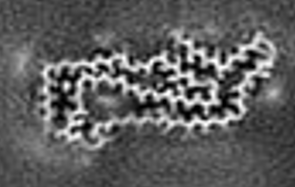
• In 1990, the first high-resolution image of a single protein molecule was produced using cryogenic electron microscope (cryo-EM). Here’s an image of a mis-folded tau protein molecule from someone with PSP (from Shi et al. Nature 2021).

Each little bump Is an amino acid. As far as we know, the folding pattern is the same in every tau molecule in every brain cell in every part of the brain in every patient with PSP. It’s a very different folding pattern for CBD despite its frequent outward resemblance to PSP. Each little nook and cranny is a potential spot for a drug to attach to prevent this toxic form of tau from interacting with other molecules, aggregating with other, identically folded tau molecules, or templating its abnormality onto normal copies of tau. Whichever, mechanism is chose, the disease could theoretically be halted in its tracks. If given the order of amino acids in the tau molecule (which is well known), and the amino acids at each little nook and cranny (also well known), AI could design a molecule to fit. It would be a monkey wrench in the PSP works.

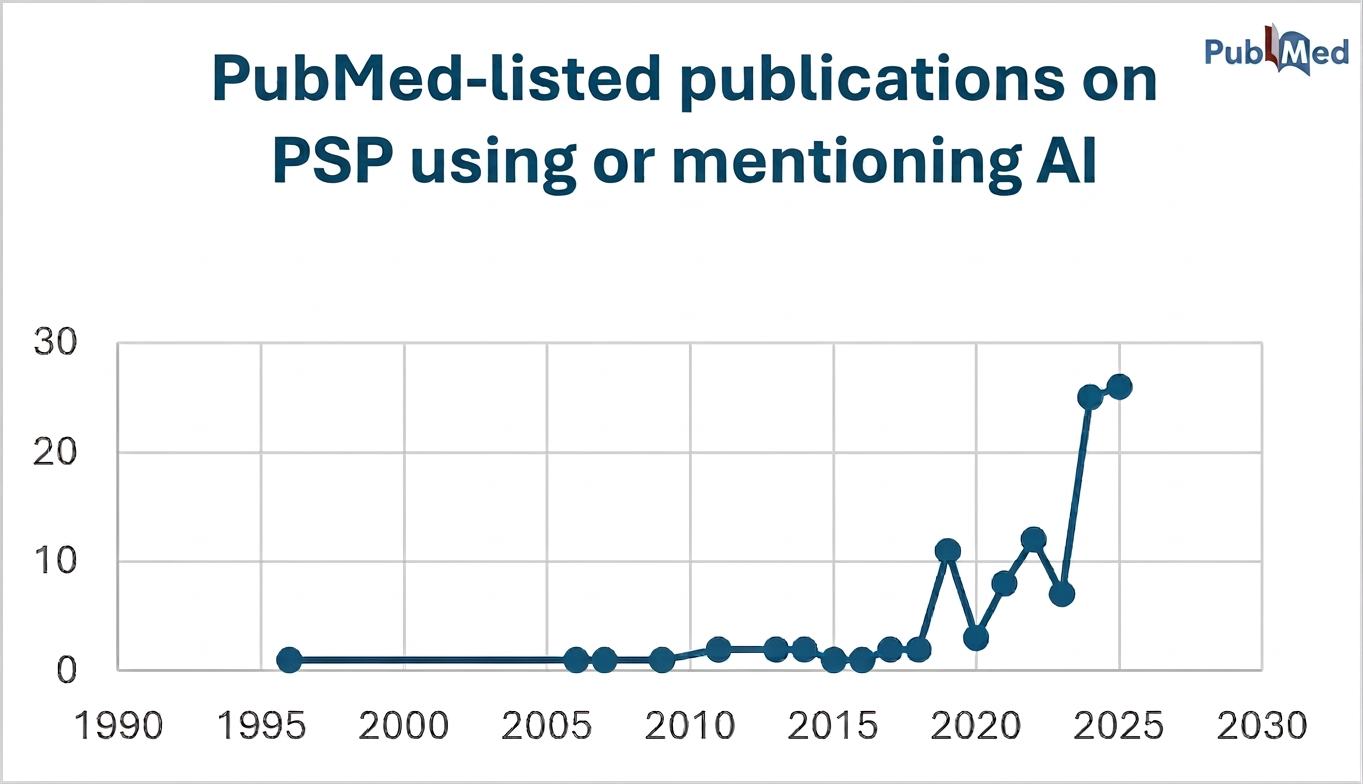
One thing is for sure – this graph is not going to trend down any time soon: