Good old MRI comes through

We still don’t have a great diagnostic test for PSP.  The best we can do is about 80%-90% sensitivity, specificity and positive predictive value.  In English:

  • Sensitivity is the fraction of people with PSP who give a positive result on the test.
  • Specificity is the fraction of people without PSP who give a negative result on the test.
  • Positive predictive value is the fraction of people with a positive test who actually have PSP.
  • A single number combining these into something useful in evaluating a single individual — rather than in comparing groups — is the “area under the receiver operating curve” (AUC; see this post for an explanation).  The AUC ranges from 0.50, which is no better than a coin toss, to 1.00, which is perfect accuracy.  An acceptable diagnostic test typically has an AUC of at least 0.85.

Most of the studies of PSP diagnostic markers have important weaknesses such as:

  • The studies frequently set up artificial situations such as distinguishing PSP only from PD or normal aging rather than from the long list of other possibilities that must be considered in the real world.  
  • The patients’ “true diagnoses” are usually defined by history and examination alone rather than by autopsy.
  • The patients included in the study were already known to have PSP by history and exam (or sometimes by autopsy), while the purpose of the marker would be to identify PSP in its much earlier, equivocal stages or in borderline or atypical cases.
  • The patients with PSP in most such studies are only those with PSP-Richardson’s syndrome, who account for only about half of all PSP in the real world.

The best type of marker so far is ordinary MRI.  Recently, a group of neurologists in Athens, Greece led by first author Dr. Vasilios C. Constantinides and senior author Dr. Leonidas Stefanis evaluated the specificity of various MRI-based measurements of brain atrophy.  One strength of their study was that their 441 subjects included people not only with PSP and Parkinson’s disease, but also with a long list of other conditions with which PSP is sometimes confused as well as a group of healthy age-matched controls. 

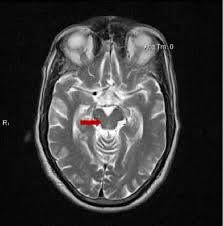
The single best MRI marker per this study was the area of the midbrain, the fat, V-shaped structure indicated below:
They found that MRI markers provided:

  • High diagnostic value (AUC >0.950 and/or sensitivity and specificity ∼90 %) to distinguish PSP from multiple system atrophy, Parkinson’s disease, and control groups.
  • Intermediate diagnostic value (AUC 0.900 to 0.950 and/or sensitivity and specificity 80 % to 90 %) to distinguish PSP from Alzheimer’s disease, frontotemporal dementia, dementia with Lewy bodies, and mild cognitive impairment (an early stage usually of AD).  
  • Insufficient diagnostic value (AUC < 0.900 or sensitivity/specificity ∼80 %) to distinguish PSP from corticobasal degeneration, normal-pressure hydrocephalus, and primary progressive aphasia (a language abnormality that can be caused by multiple specific diseases).
  • Insufficient value to distinguish the non-Richardson PSP subtypes from corticobasal degeneration and primary progressive aphasia, but good performance in the other comparators.

The researchers also concluded that:

  • One MRI measurement isn’t best for all the possible PSP comparators. 
  • Sometimes a combination of two or three measurements performed better than any single measurement.

One weakness of their method was the use of subjects diagnosed by standard history/exam (i.e., “clinical”) criteria, rather than by autopsy. Another is that their patients with PSP had had symptoms for an average of three years, so these were not subtle or early-stage cases. A letter to the journal’s editor from Dr. Bing Chen of Qingdao City, China further pointed out that the study of Constantinides and colleagues failed to account for the subtle effects of neurological medications on brain atrophy.  As PSP and the comparator disorders may be treated with different sets of drugs, taking this factor into account might enhance or reduce the apparent diagnostic value of MRI atrophy measurements.  

So, bottom line?  Drs. Constantinides and colleagues have given us the first study of MRI markers in PSP to include meaningful numbers of subjects with non-Richardson subtypes.  It’s also one of the few studies of any kind of PSP marker to include comparison of PSP a wide range of diagnostic “competitors” beyond just Parkinson’s and healthy aged persons.  Another plus is that the test, routine MRI, is nearly universally available, relatively inexpensive, and non-invasive.

The hope is that Pharma companies or others with candidate drugs will now have fewer or lower hurdles in the way of initiating clinical trials.

Wired

With a nice handful of medications for PSP approaching clinical trials, it would be great to be able to assess the participants’ movement ability not just every few weeks to months at the research center, but also much more frequently at home.  The reduced need for clinic visits would ease participation for patients who for whatever reason have difficulty tolerating or obtaining travel.  It could also provide a more “real-world” picture of how the patient is doing in their home environment.

One relatively easy step in that direction arose from a project published last year (in which I, full disclosure, was senior author).   It modified the 28-item PSP Rating Scale, omitting the exam items that might not work well by video and used existing databases of PSPRS scores over time to assess the correlation between the modified and unmodified scores.  In short, the correlation was excellent.

But a PSP Rating Scale modified for video still requires a video connection, and that can be tough for the PSP age group and their caregivers, especially those where cell service is spotty.  Besides, video visits can’t happen every day or even close to it.  So, some other gadget would be nice.

Now, a group led by Dr. Alexander Pantelyat of Johns Hopkins and Dr. Anne-Marie Wills of Mass General (the co-senior authors) with Dr. Mansi Sharma of Mass General (the first author) have published a first-blush look at a simple gait monitoring system in PSP and Parkinson’s. 

Other versions of the same idea for PSP have had to be used in a lab at a research facility and required a complex array of sensors pasted to various parts of the body.  But this one is used in the patient’s home and requires only three sensors: one strapped to the lower back with a belt and one fastened to each shin by what looks like an old-fashioned garter strap like my father used to wear.  For reasons of safety, only patients with histories of very few falls and ability to walk unassisted qualified for this early trial.  Patients with PSP and Parkinson’s were compared on their performance of four standard gait tasks.  They received instructional videos and the three sensors communicated with an app on a tablet provided.

Of the 22 patients who qualified and consented, only two (both with Parkinson’s) couldn’t manage the technical requirements.  For the others (10 with PD and 10 with PSP), the device proved able to quantify and time the movements well and to differentiate PSP from Parkinson’s. Most important was that managing the experimental hardware and software while avoiding falls or other complications was perfect.

The next step will be to assess the device over a period of several months for its ability to track PSP progression.  This should be successful because the Spearman correlation coefficients of the three gait measures with the modified PSP Rating Scale, were pretty good: 0.62, 0.64 and 0.84; and we know that the PSPRS tracks PSP progression well.  (Correlation of 1.0 is perfect and 0 is random.) 

Another reason to be optimistic about the device to track progression is that it’s already been accomplished, although with a more complex, six-electrode device implemented in a research lab.

A reason for caution is that not every patient in a drug study walks unassisted at home as safely as these 20 hand-picked participants, especially toward the end of a one-year trial period.  Furthermore, using this device at home in routine clinical practice would involve patients at all levels of gait instability.  But for people in remote areas or whose caregiver can’t afford to take time off from work for a clinic visit, this could be the ticket to research trial participation.

The hindbrain steps forward

The cerebellum is gradually being understood as a contributor to cognitive and behavioral function in both in health and disease.  A new publication has teased out MRI changes in the cerebellum that differentiate PSP from other dementing disorders early in the disease.  This pattern could be developed into a diagnostic test and as a marker of disease progression and even as a guide to rehabilitation measures.

The cerebellum is classically thought of as a regulator of movement.  In its most simplistic essence, its job is to put a brake on voluntary movement instructions from the cerebrum.  The cerebellum is guided in this task by perception of the position and motion of the trunk, head and limbs, by the effect of gravity, all complemented by visual input.

More recently, the cerebellum has demonstrated a memory function when it comes to movement regulation (making “muscle memory” more than just a metaphorical expression), and damage to certain parts of the cerebellum can cause a behavior disinhibition and cognitive impulsivity similar to the frontal lobe damage seen in PSP. In that sense, the cerebellum still functions as a “brake,” but on behavior and cognition rather than just on movement.

Now, researchers from the University of California San Francisco have carefully analyzed routine MRI scans from people with dementia arising from a variety of neurodegenerative conditions including PSP.  They specifically quantified gray matter damage.  (Gray matter is brain tissue composed mostly of cell bodies — as opposed to white matter, which is mostly axons.  In the cerebellum, unlike the cerebrum, the gray matter is the deeper layer and the white matter is superficial.)

The figure below shows the principal results. Illustration from Chen Y, et al. Alzheimer’s & Dementia, 2023. The senior author is Dr. Katherine Rankin. Each MRI image has been reconstructed by computer from routine scans to show the cerebellum splayed out flat.  The randomly assigned colored areas represent a loss of gray matter relative to non-demented people of similar age (“Controls”).  Note that the pattern for PSP differs in obvious ways from the other diseases, though at present the differences are only between the averages for groups, not individual differences useful for diagnosis in routine care. 

Notes: The small type abbreviations are the sub-areas of the cerebellum.  AD=Alzheimer’s disease; CBD=corticobasal degeneration; LBD=Lewy body dementia; TDP=frontotemporal dementia with TDP-43 protein aggregation.  It comes in 3 types. “Pick’s” is a form of frontotemporal dementia.  LBD is combined with AD because at autopsy, the former is always accompanied by some of the latter.  This paper did not include Parkinson’s disease or multiple system atrophy, as those diseases rarely include dementia early in the course, the focus of the present study.

The authors conclude, “These findings suggest the potential for cerebellar neuroimaging as a non-invasive biomarker for differential diagnosis and monitoring.”  They hasten to add that to understand the reasons for these different patterns of cerebellar loss, future studies will have to image the areas of the cerebrum where brain cell activity has been lost and to correlate that with corresponding loss of activity in the cerebellum.  That’s called “functional neuroimaging” as opposed to the “structural neuroimaging” of the current study.   

These insights, aside from their qualitative and quantitative diagnostic value, could provide guidance for electrical or magnetic transcranial stimulation (i.e., delivered across the scalp and skull rather than by inserting hardware onto or into the brain) as symptomatic treatment for PSP and the other dementing disorders. 

A new PSP genetic risk factor screener

Genetic screening is emerging as a routine and necessary step in clinical research in the neurodegenerative diseases. If you’re looking for the cause of a family cluster, for example, you have to rule out the genetic variants already known to be associated with that disease. If you’re working up a geographical cluster of PSP, as my colleagues in France and I are, you have to look for a genetic founder effect before embarking on a difficult search for environmental causes, and the place to start is with gene variants already known to increase disease risk.
Pathological overlap among the various neurodegenerative diseases is another major current theme. For example, LRRK2 mutations can cause any of a number of pathologies, including PSP, and the tau H1 haplotype is associated with PSP, CBD and PD. It would therefore be convenient to have a single genetic screening device would allow different labs studying different diseases to compare or merge results.
Such a gizmo is now here. It’s a superset of Illumina’s Infinium HumanExome BeadChip called NeuroX. It tests for not only the standard 242,901 gene variants usable in studying any condition but also an additional 24,706 variants focusing on Alzheimer’s, Parkinson’s, MSA, ALS, FTD, multiple sclerosis, Charcot-Marie-Tooth disease, myasthenia gravis — and PSP. The chip is designed to allow easy substitution of subsequent versions of both the basic Illumina chip and easy addition of new neurological variants.
The first author of the report in Neurobiology of Aging is Mike Nalls and the senior author is Andrew Singleton, both of the NIH. The genetic variants included in the chip were derived from multiple genome-wide analyses over the past 20 years. Disclosure: I’m listed way down on the list of “authors” because I was a leader of “GenePD,” one of the consortia whose findings were used in constructing the new chip.  But I have no financial interest in the invention.
At a cost of $57 per sample plus the cost of the basic machine and technician time, you won’t have to be a drug company or the NIH to afford a statistically meaningful series; genetics core labs will be able to offer this as a routine procedure.

PSP markers in CSF? Not yet

As a PSP-ologist, it takes a lot to discourage me, but the excellent review of CSF markers in the diagnosis of PSP did it. Nadia Magdalinou, Andrew Lees and Henrik Zetterberg of University College London, writing in the JNNP, point out that no CSF measure has been consistently or reproducibly found to differentiate PSP from all of the relevant competing diagnostic considerations.
An excellent study cited in the review found low levels of CSF α-synuclein in Parkinson’s, DLB and MSA relative to PSP and other brain disorders. A value less than 1.6 pg/μl had good (91%) positive predictive value for any synucleinopathy but higher concentrations had poor (20%) negative predictive value.  So that measure is of some small value.
Neurofilament light chain in CSF is elevated in PSP, MSA and CBD, according to another study, with an area under the ROC curve of 0.93. This has been confirmed by others since. This is useful in distinguishing PSP from PD, but when your patient has a poor levodopa response and downgaze problems, PD isn’t really the issue; PSP, MSA and CBD are.
One study of neurofilament heavy chain found that it can differentiate PSP from CBD but not from MSA. That study was published in 2006 and we’re still awaiting confirmation.
You’d think that tau would be the object of intense scrutiny in the differential diagnosis of PSP by CSF, but there’s been relatively little on that. One good study found that the ratio of phospho-tau to total tau is lower in PSP and MSA than in PD. The other studies of phospho-tau in PSP have been negative.
So the winner so far for PSP, limping across the finish line, seems to be neurofilament light chain. It’s not available commercially as far as I can tell; nor should it be, without further study.
Adding to this discouraging picture is the fact that most or all of the studies of CSF markers in PSP have sampled patients in a stage of PSP that allowed clinical diagnosis. By that time, the CSF picture may be more diagnostic than in the earlier stages, when a state marker would be most useful. In other words, the studies were retrospective rather than prospective.
For now, I’m putting my money on imaging.