Orphans, this could be your chance

Back in 2023, I posted an explanation of the ten PSP subtypes.  The archetypal subtype, PSP-Richardson syndrome accounts for about half of all PSP and, in contrast to most of the other subtypes, has a rapid progression rate, a validated rating scale, and highly accurate diagnostic criteria.  All of these features have led clinical trial sponsors to maximize their trials’ sensitivity and minimize their costs by restricting admission to people with PSP-Richardson.  But developing better outcome measures for non-Richardson forms of PSP could change that practice.

A big step toward realizing this goal was published last week in the journal Neurology by a group at the Mayo Clinic in Rochester, MN.  Led by first author Dr. Mahesh Kumar and senior authors Drs. Jennifer Whitwell and Keith Josephs, the study found that a good outcome measure for clinical neuroprotection trials in all PSP subtypes was to combine a measure of atrophy by MRI with a measure of clinical disability.  This is a major advance.

The researchers performed brain MRIs at the start and end of a one-year period in 88 people with PSP and 32 age-matched controls.  Of those with PSP, 50 had PSP-Richardson, 18 had “PSP-cortical” (three of the other nine subtypes) and 20 had “PSP-subcortical” (the other 6 of the subtypes).  They had to lump the non-Richardson subjects using their subtypes’ general anatomical predilections because most of the subtypes were too rare to analyze on their own.

Calculating how much each of ten important PSP-involved brain regions had atrophied over the one-year interval allowed the researchers to identify which region(s) might best serve as markers of progression for each of the three groups when coupled with standard clinical measures.  Those measures include such familiar instruments as the PSP Rating Scale and the Unified Parkinson’s Disability Rating Scale’s motor section as well as less familiar scales specific for cognition, gait, eye movement and speech.  All the scales were administered concurrently with each of the two MRIs. 

They expressed the sensitivity to one-year progression not by some abstract statistic, but by the number of patients needed in a double-blind trial to demonstrate with at least 80% certainty that patients on active drug enjoyed a 20% slowing of progression relative to the placebo group. (These specifications are typical for PSP clinical trials.)  The better the measure’s performance, the fewer patients are needed.

And the award for Best Performance by an Outcome Measure in a PSP Neuroprotection Trial goes to . . . a combination of the rate of atrophy of whatever brain region shrinks fastest in the patient’s specific subtype and the PSP Rating Scale score.

The real significance of this study’s result is that using an outcome measure customized to each participant’s PSP subtype could allow trials to enroll not just people with PSP-Richardson, but also those with any of the other subtypes.  That’s because the trial’s measure of success could be to compare each patient’s rate of progression during the trial to that of patients in the placebo group with the same PSP subtype. 

This could double the number of people eligible to enroll in PSP trials, which means cutting the enrollment period in half, with commensurate reduction in costs for the sponsor.  The hybrid measure is more sensitive to progression than the PSP Rating Scale alone, thereby reducing the number of patients required even more. 

Both factors could lower the financial barrier confronting a company hoping to mount a trial for a promising PSP drug.  That may be the most important bottleneck right now in the development of a treatment to prevent or slow the progression of PSP.s

That’s why this news is huge for PSP in general and for the “orphans” in particular.

For once

Some excellent news for you today.  The orally administered drug AZP-2006 has shown early signs of slowing the progression of PSP. (Yes, you heard right!)

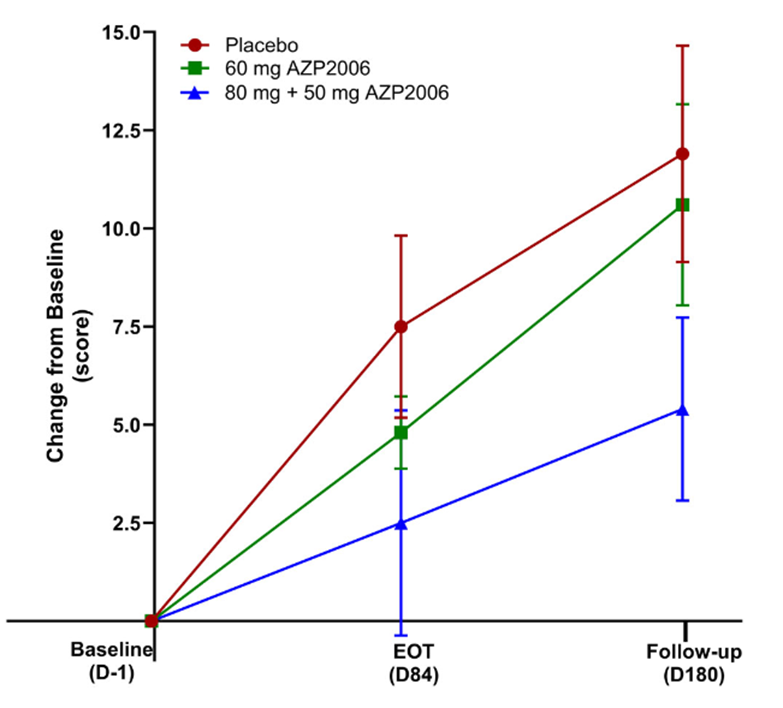
My blog post from May 9 of this year brought news that a small, open-label, Phase 1 study of AZP-2006 seemed to have slowed the progression of PSP by 31 percent.  Now, the drug has completed a small, double-blind, Phase 2a trial with even better results: In the 11 patients receiving 60 mg per day, the worsening in the PSP Rating Scale score over the 3 months of the double-blind phase was a third slower than in the placebo group (identical to the result of the uncontrolled Phase 1) and in the 13 patients receiving a loading dose of 80 mg on the first day and then 50 mg per day, the apparent worsening was two-thirds slower.  

It’s important for you to understand, and the authors repeatedly emphasize, that these results were not statistically significant, meaning that they could be the result of a random fluke.  There were also some minor differences among the three patient groups (placebo, 60 mg, and 80 mg then 50 mg) at the study’s baseline that theoretically could have explained the results.  A larger, Phase 2b study could confirm the result while having the statistical power needed to compensate for any “baseline bias” among the treatment groups. 

The trial included a 3-month open-label extension. That’s where the participants on placebo for the first 3 months were offered the opportunity to convert to the active drug at 60 mg per day, while those initially on the active drug could opt to continue it.  Over months 4, 5 and 6, the rate of decline of the formerly-placebo group slowed down noticeably.  The other important result is that the drug showed itself to be safe and well-tolerated over the entire 6 months.

The publication’s first author is Jean-Christophe Corvol, MD, PhD, a very well-regarded, senior neurologist I know at the legendary Hôpital Pitié-Salpêtrière in Paris.  The senior (i.e., last-named) author is Luc Defebvre, MD, PhD, at Lille University. Six of the other 16 authors are staff researchers at the sponsoring drug company, AlzProtect, of Lille, France.

In this graph, the vertical axis is the worsening in terms of the 100-point PSP Rating Scale.  EOT is end of the double-blind part of the trial at Day 84.  Thereafter, all participants received active AZP-2006.  Note that both active-drug groups progressed more slowly than the placebo group over the first 3 months; and on active drug, the participants formerly on placebo may have slowed their progression rate. The vertical line segments represent standard deviations of the mean. (From:  Corvol JC, Obadia MA, Moreau C, et al. AZP2006 in progressive supranuclear palsy: outcomes from a Phase 2a multicenter, randomized trial, and open-label extension on safety, biomarkers, and disease progression. Movement  Disorders. 2025 Sep 27. doi: 10.1002/mds.70049. PMID: 41014124)

So, when will the Phase 2b study start?  My May 5, 2025 post reported on the “PSP Platform,” (PSPP) an NIH-supported collaboration among dozens of U.S. academic centers to perform Phase 2b trials on up to three drugs simultaneously using one placebo group.  One of the first three drugs, in fact, is AZP-2006.  Last I knew, the PSPP was expected to start late this year, but it’s now almost October and I’ve heard nothing further other than that some details remained to be ironed out with the FDA. That trial would take about 6-12 months to recruit and then another 12 months for the last patient to finish, then at least a couple of months to analyze the data. 

So, how does AZP-2006 work?  I’ll plagiarize my own May 9 blog post, along with its “Nerd Alert!” warning that this gets technical:

The main mechanism of action of AZP-2006 is at the lysosomes, one of the cell’s garbage disposal mechanisms, where it acts specifically at the lysosome’s prosaposin and progranulin pathways. Prosaposin is the metabolic precursor (a “parent molecule” cleaved by enzymes to produce the active molecule) of the saposins, a group of proteins required for the normal breakdown of various types of lipids that are worn out or over-produced or defective from the start. Progranulin is the precursor, as you’d guess, of granulin, which, like saposin, is involved in function of the lysosomes. But progranulin addresses disposal of proteins, not lipids. In mouse experiments, the drug also enhances the production of progranulin, mitigates the abnormal inflammatory activity in tauopathy, reduces tau aggregation, and stimulates the growth or maintenance brain cell connections.

Bottom line: This very small, Phase 2a trial was designed to show safety, not efficacy, and its slowing of PSP progression did not nearly achieve statistical significance nor exclude potential sources of random bias.  But the magnitude of the (apparent) effect make this excellent news for those with PSP, present and future.

I’ve spent my summer in futility

If you’ve been disappointed with the long intervals between my posts over the past few months (and I hope you are), there’s a reason.  I’ve been using much of my discretionary sitting-at-the-computer time writing a long review article on clinical trial design in PSP.

The editor of the journal Alzheimer’s and Dementia: Translational Research and Clinical Interventions invited me to write something on PSP for a special issue on a trial outcome measure called “minimum clinically important difference.”  The MCID is the smallest change in an existing, validated, accepted clinical rating scale that can be perceived by the patient as making a difference to their everyday level of disability or quality of life.  An alternative definition I’ve seen is the smallest difference that would prompt the clinician to recommend a change in treatment. The MCID has never to my knowledge been used in PSP trials, though for over a decade it has served at least as a secondary measure in trials in other conditions, including Parkinson’s disease. 

The most widely accepted outcome measure for PSP clinical trials is still the original, 28-item version of the PSP Rating Scale, which uses a point scale of 0 (best) to 100 (worst). But the original PSPRS been criticized, most prominently by the FDA, as too dependent on the neurological examination, with insufficient attention to the patient’s daily life. The European Union’s equivalent of the FDA, the European Medicines Agency (EMA), still prefers the original PSPRS. (Disclosure: I developed the PSPRS and receive a share of its licensing fees from Rutgers University, the scale’s official owner.)

I collaborated in this writing project with Ronald G. Thomas, PhD, a biostatistician at UC San Diego.  We calculated an MCID for PSP using data from the placebo groups of five published, 12-month double-blind clinical trials.  I won’t get into more details lest I plagiarize myself or invite scoops, as the manuscript was submitted only a couple of weeks ago and has not yet cleared peer review.  But I can tell you that the MCID is only a small part of our paper, which discusses many aspects of PSP trial design with an eye toward allowing trials to enroll participants faster and to become smaller, cheaper, shorter, and easier for the patient and caregiver.

Aside from obvious the patient/caregiver consideration, why is all this so important?  Because we need to lower the bar for small pharma or biotech companies to try their new drugs in PSP. One obstacle is the cost – fewer patients and shorter trial durations are simply cheaper.  Another is that during a trial, the clock is ticking on the drug’s patent protection.

A very interesting outcome of the calculations Dr. Thomas performed for our paper (again, provisional pending peer review) relates to the number of participants required for a PSP “futility trial.”  That kind of trial typically uses controls from previously published sources, thereby reducing recruitment time and costs.  It is designed to determine relatively cheaply if a drug should be abandoned or it’s worth testing in a formal, expensive, traditional trial meeting government requirements for potential approval.  A small company whose futility trial “rules out futility” (to use the formal, statistical term for success in this context) could find it easy to license or sell that drug to a larger company or to attract venture capital for a large trial of its own.

Dr. Thomas found that a futility trial needs only 100 participants on the active drug, assuming it uses placebo data from 200 people from previous trials, and has 80% power to detect a 35% slowing of progression with a statistical significance of .05. That’s not really huge news, as futility trials have been performed in PSP before, albeit using different statistical parameters than these. 

The take-home is that the unsuccessful double-blind PSP trials of the past have provided a valuable resource in the form of their placebo groups’ data, which can allow futility trials and permit many other improvement to our current clinical trial designs in PSP. That could make the clinical trial pipeline easier, faster, cheaper and less of an obstacle to small, start-up pharma companies.

Don’t try this at home

CurePSP recently received an inquiry from a PSP caregiver who had evaluated the individual with PSP twice over a 6-month period using the PSP Rating Scale and needed some guidance in interpreting the results.  We had to tell them that the PSPRS is designed for use only by neurologists experienced in evaluating people with movement disorders and eye movement disorders, so the scores they generated cannot be relied on.  Besides, the second score was about 30 points (on the 100-point scale) worse than the first, and no one with PSP progresses that quickly.  So, they must have administered the PSPRS incorrectly.

People with PSP and their caregivers who ask about the PSPRS are advised to pass it along to their neurologists, who can decide if they want to use it.  The PSPRS is still the world-wide standard “outcome measure” for PSP treatment trials and the rating standard for observational research.  But it has reached only limited acceptance in ordinary neurological practice outside of academic settings because it takes 10-15 minutes to apply, and most neurologists don’t have that kind of time in a visit to devote to it.

But don’t despair, you neurological do-it-yourself-ers.  There’s a newer scale called the Cortico-Basal Functional Scale (CBFS), which is designed to be completed by the patient and caregiver and works just as well for PSP as for CBS.  It’s not quite as precise as the PSPRS because it relies only on subjective symptoms and experiences, but it’s still quite reliable in assessing the severity of PSP and tracking its progression.  It has more potential to be adopted by neurologists for routine care because it can be completed at home the day before the visit or even in the office waiting room. You can download it via the link above, complete the 31 multiple-choice questions and bring the completed form to your next neurology visit.

Now for something you can use today: the PSPRS

I’m in awe of the scientific creativity and astuteness of the researchers whose work I feature in this blog. My own original work is more modest — but has its uses. In fact, hardly a week goes by without a publication of a research project using the PSP Rating Scale. This post is a shameless attempt to evangelize for it. Click here to download the PSPRS form.

Since my statistician colleague Pam Ohman-Strickland and I published it in 2007, the PSPRS has gradually become the standard way to quantify overall symptomatology and disability in clinical research in PSP. It is equally useful in routine clinical care and requires only 10 minutes to perform. It’s not copyrighted.

Yes, the Unified Parkinsonism Disability Rating Scale, the standard scale for PD, has been validated in PSP, but has nothing about frontal behavioral signs, eye movements, sleep and some other things that are important in PSP. The PSPRS has a nice, round 100 possible points divided into six sections and 28 items. Rather than attempting to rate every possible feature of PSP with equal emphasis, the items’ relative importance in the PSPRS mirrors that in the most common form of PSP itself. This design feature results in the PSPRS progressing about 11 points per year regardless of the magnitude of the score or disease duration.  The score is useful as a prognostic indicator and I’m presently working on refining that.

The PSPRS requires some skill in the neurological exam, so cannot be applied by patients or caregivers. But they can bring it to the attention of their neurologists. Click here for the original paper in Brain that explains the details of how to administer the PSPRS.

Like everyone, I’m hoping for a more objective, reproducible test to quantify the state of neural degeneration in PSP – maybe something with spinal fluid or MRI. But until then, the PSPRS is the best we’ve got and it’s dirt cheap.