Road test for a Roadmap

This is a request for your suggestions to improve/amend CurePSP’s research plan, which is now two years old.

Here’s a link to the first and current version of our Research Roadmap:  Roadmap for Symposium 2013. You can also find it here.

It was designed as a guide to grant applicants and donors who want to know what CurePSP is interested in funding.  That’s not to say that we wouldn’t fund other things, but proposals that fit into the Roadmap’s model are viewed more favorably in our grant review process.

The elevator explanation of the model is that it uses unbiased gene searches to identify new risk genes, then finds drug targets among the proteins in the related gene products or cellular pathways, then tests those drugs in lab models, then turns to Pharma to develop those drugs clinically.  Along the way, it calls for new models and new clinical markers to assist in the process.

Clearly, The Roadmap ignores important things such as symptomatic treatments, toxic etiologies, clinical characterization, epidemiology and neurophysiologic analysis, not to mention serendipitous neuroprotective treatments with unclear mechanism.  But it provides a focus and an orientation.

So please use the Comments function to leave me your suggestions for improvement.  Keep in mind that the Roadmap should remain relatively simple and generic.  We don’t want to direct research from the top down.  On the other hand, we don’t want the document to be so generic as to be useless.

Obviously, feel free to respond to others’ comments; and have fun!
 

Just a residue full of sugar . . .

I’ve been jolted out of my non-posting torpor by CurePSP’s annual International Research Symposium, held on November 6 in La Jolla. The lecture hall was smack dab on the beach and despite the quality of the presentations, it was easy for the eye to wander from the lectern to the doorway framing a view of swaying palms and the blue Pacific. Thanks to Jeff Friedman for arranging the venue. Anyway, I’ll be describing some of the goings-on in this post and the next few.
Two of the presentations, both from pharma scientists, described drugs in development for PSP that reduce tau aggregation by inhibiting OGA (O-GlcNAcase; pronounced “oh-GLY-na-kaze”). That enzyme removes the sugar N-acetyl-beta-D-glucosamine from either serine or threonine residues of proteins. The opposing reaction, catalyzed by O-GlcNAc transferase, like other post-translational modifications, is a common way for cells to regulate proteins. In the case of tau, having that sugar in place reduces aggregation.
All of the OGA inhibitors being developed are small molecules suitable for oral administration. The smaller company with an OGA inhibitor program is Asceneuron, based in Lausanne, Switzerland. They expect to start a Phase I human trial in 2016 although they are still in an early stage of mouse model trials and they haven’t settled on one lead compound for further development. The larger company, Merck, is at a more advanced stage. Their drug, MK-8719, has shown that it can slow brain degeneration in mice transgenic for one of the FTD MAPT mutations. The drug also inhibits tau aggregation in a human iPSC line and in an early Phase I human trial in healthy volunteers was found to be well-tolerated and to increase O-GlcNAcylation in blood mononuclear cells.
Let’s hope that both companies move their OGA inhibitors to Phase II trials in the next couple of years.

A welcome formality

I see my patients with PSP on special clinic days when I have arranged for specialized professional help and have allotted extra time for the visits. The downside is that that it can be a dispiriting few hours, with little to offer anyone that day beyond symptomatic treatment, information and a pep talk. So I use this blog to accentuate the positive.

In that vein, I’m happy to report the drug/biotech industry’s efforts to develop a therapeutic antibody are proceeding apace. The latest tidbit is that the FDA has granted orphan drug status to the anti-tau antibody designated C2N-8E12 being developed by a joint venture of C2N Diagnostics and Abbvie. A 32-patient Phase I trial headed by Adam Boxer at UCSF will begin sometime soon. Achieving orphan status allows the company certain financial advantages and a longer patent life. Both are critically important for any new treatment for a rare disease, as the potential profits wouldn’t otherwise justify the development cost and risk.
Several other companies are working on anti-tau therapeutic antibodies, many of them aiming initially at PSP. Their ultimate Holy Grail is a treatment for Alzheimer’s, but it’s easier to conduct a clinical trial in PSP, as its progression is more readily predicted and measured. Furthermore, tau is the only protein known to aggregate in PSP, which makes that disease a simpler “model system” than AD, where both tau and beta-amyloid aggregate. The company furthest along this road is Bristol-Myers Squibb, whose tau antibody trial seeks 48 patients with PSP at 12 centers across the US and will start enrolling in a few weeks.
So I’m hoping for sunnier PSP clinic days soon!

Speech therapy in PSP?

The Lee Silverman Voice Training (LSVT) “Loud” program is a popular method used by speech/language clinicians to improve vocal volume and clarity in people with Parkinson’s disease.  I’ve never been all that enthusiastic about it because there is no literature demonstrating superiority to traditional forms of speech therapy for PD.  For another thing, I’m a little suspicious of its proprietary financial model, where a clinician pays anywhere from $300 (for a student) to $990 (for a professional) for a two-day course that yields a certificate permitting them to advertise that they offer LSVT.   The courses and certificates are available only from LSVT Global, Inc.

Potential evils of capitalism aside, it’s good to see someone finally trying to help the dysarthria of PSP.  Our heroes are a group in Rome headed by the well-regarded movement disorders authority Fabrizio Stocchi, MD PhD.  The paper‘s first author is Patrizio Sale, MD PhD. a neuro-rehabilitation specialist.  The work appeared in the European Journal of Physical and Rehabilitation Medicine.

The study compared the benefit of LSVT Loud in 16 patients with PSP to the same four-week course of treatment in 23 patients with PD.  Both groups did improve in most of the measures applied.  Probably the most positive result was in the reading task, where the maximum volume for the patients with PSP improved from an average of 82.5 dB to an average of 87.5 dB. Somewhat more modest benefits accrued for nonverbal phonation and for non-reading speech.

Unfortunately, there were no control patients receiving sham treatment, traditional treatment or no treatment.  We don’t know if the improvement will long persist, but the literature suggests that it does so in PD.  Equally important is that the study did not evaluate articulation — only volume.  Furthermore, the study was quite small, inviting flukey results.  Clearly, more work is needed, but for now, I’ll try sending some of my patients with PSP and hypophonia (low vocal volume) for LSVT.  I’ll let you know what happens.

A new PSP genetic risk factor screener

Genetic screening is emerging as a routine and necessary step in clinical research in the neurodegenerative diseases. If you’re looking for the cause of a family cluster, for example, you have to rule out the genetic variants already known to be associated with that disease. If you’re working up a geographical cluster of PSP, as my colleagues in France and I are, you have to look for a genetic founder effect before embarking on a difficult search for environmental causes, and the place to start is with gene variants already known to increase disease risk.
Pathological overlap among the various neurodegenerative diseases is another major current theme. For example, LRRK2 mutations can cause any of a number of pathologies, including PSP, and the tau H1 haplotype is associated with PSP, CBD and PD. It would therefore be convenient to have a single genetic screening device would allow different labs studying different diseases to compare or merge results.
Such a gizmo is now here. It’s a superset of Illumina’s Infinium HumanExome BeadChip called NeuroX. It tests for not only the standard 242,901 gene variants usable in studying any condition but also an additional 24,706 variants focusing on Alzheimer’s, Parkinson’s, MSA, ALS, FTD, multiple sclerosis, Charcot-Marie-Tooth disease, myasthenia gravis — and PSP. The chip is designed to allow easy substitution of subsequent versions of both the basic Illumina chip and easy addition of new neurological variants.
The first author of the report in Neurobiology of Aging is Mike Nalls and the senior author is Andrew Singleton, both of the NIH. The genetic variants included in the chip were derived from multiple genome-wide analyses over the past 20 years. Disclosure: I’m listed way down on the list of “authors” because I was a leader of “GenePD,” one of the consortia whose findings were used in constructing the new chip.  But I have no financial interest in the invention.
At a cost of $57 per sample plus the cost of the basic machine and technician time, you won’t have to be a drug company or the NIH to afford a statistically meaningful series; genetics core labs will be able to offer this as a routine procedure.

My lecture on the treatment of PSP, MSA and CBD

I’m at the annual meeting of the Movement Disorders Society, now officially the International Parkinson and Movement Disorders Society (why the redundancy?).  I just gave a lecture on the treatment of PSP, MSA and CBD.  My bad – I didn’t get the PowerPoint file to the organizers in time for it to be included as a hard copy in the handout, so here it is: Treatment of PSP and CBD – L Golbe  You can download it even if you didn’t attend the conference.  You’re welcome.

A new drug target from an epidemiologic observation

I think what jolted me out of my multi-month posting torpor is next week’s annual meeting of the Movement Disorders Society. I’ve been preparing a lecture on the treatment of PSP, CBD and MSA, and that got my juices flowing.

Speaking of treatment, an interesting paper that appeared in Plos One during my writer’s block came out of Günter Höglinger’s lab in Munich. Julius Bruch was first author. It builds on the observation that people with Guadeloupean tauopathy are far more likely than local controls to have consumed the fruits sweetsop and soursop, which contain annonacin, a mitochondrial Complex I inhibitor. Subsequent work with annonacin has suggested that it can cause a tauopathy in rats.
The new paper found that annonacin upregulates the production of 4R tau, the predominant form in PSP and some other tauopathies, by favoring the inclusion of the exon 10 peptide product into the finished tau molecule. Further experiments described in the same paper showed that annonacin upregulates the splicing factor SRSF2, which is one of a handful of factors known to regulate splicing of exon 10. So they used silencing RNA to knock down SRSF2. The result was a dramatic reduction in 4R tau.

They then took the next step and analyzed human PSP brain tissue for SRSF2, finding it markedly elevated compared to controls with no neurological disease.

To examine the possibility that the elevation of 4R tau and SRSF2 by annonacin was the result of mitochondrial Complex I inhibition rather than of nonspecific cellular stress or nutrient deprivation, they treated neuronal cultures with MPP+, a well-studied Complex I inhibitor, but not with 6-hydroxydopamine, a toxin that works independent of Complex I, or with nonspecific nutritional deprivation.

So it looks like a drug that inhibits SRSF2 could correct the abnormal 4R/3R ratio in PSP and potentially prevent cell loss. But a lot of work remains to determine how important this particular pathway is in causing the cell loss. The highly variable 4R/3R concentration across different brain areas in PSP and the existence of tauopathies with normal or low 4R/3R ratios show that the story isn’t so simple. But with the recent explosion of interest from drug companies in PSP as a route to Alzheimer’s disease, any new approach could attract interest, and this one deserves a place on the list.  I don’t know if any existing or approved drugs inhibit SRSF2, but that could be a good job for a lab that’s tooled up for high-throughput screening.

Not your father’s PSP

As it turns out, PSP comes in many clinical flavors. Back in the 80s I remember some patients whose illness looked like Parkinson’s until I realized that they weren’t responding to my levodopa prescriptions, at which point I repeated a careful ocular motor exam and found square wave jerks and slow downward saccades. I also remember one member of my first series of 41 patients with PSP from 1988 with severe gait apraxia and freezing as his most disabling feature.
Then, in 2005, David Williams and colleagues, mentored by Andrew Lees at Queen Square, published what is probably the most important clinical paper on PSP in the half-century since Steele, Richardson and Olszewski. That work delineated and named PSP-Richardson syndrome (PSP-RS ) and PSP-parkinsonism (PSP-P). This wasn’t just a new way to slice a clinical spectrum sharing the same basic pathology; the two variants actually had statistical differences by cluster analysis. This suggests that they differ at the pathoanatomic level. They even differed in the ratio of 4R/3R tau. (It turns out that the predilection of PSP’s tangles for 4R tau is driven by RS.)

Since then, a cornucopia of low-frequency clinical variants meeting pathoanatomic criteria for PSP has been described. In approximate descending order of prevalence after RS and PSP-P are corticobasal syndrome, postural Instability, pure akinesia with gait freezing, frontotemporal dementia, ocular motor predominance, progressive non-fluent aphasia, semantic dementia, and a cerebellar variant.
The clinicopathologic studies are only starting to appear, but it’s likely that they will all turn out to emphasize different cells, nuclei and brain regions. We will also probably see some subtle molecular differences among them (presaged by the 4R/3R difference between RS and PSP-P).

That sounds like different diseases to me. Different diseases shouldn’t be combined in treatment trials, genetic analyses or descriptive studies. What a mess.

Or is it? Maybe we don’t need to find causes and cures for each PSP variant individually. As they’re all tau aggregation disorders, maybe they will all yield to the same prevention. Maybe the mechanism of prion-like spread, by now pretty much a textbook verity, will apply not only to all of the “pure tauopathies” (and it’s not yet clear that all of the PSP variants are in fact pure tauopathies) but to all of the protein-aggregation-based neurodegenerative disorders. If it does, then poisoning that process could be the grand unified answer to Alzheimer’s, Parkinson’s, ALS, and PSP in all its malign variety.

The Gathering

Now’s the time to arrange your October schedule around CurePSP‘s annual International Scientific Symposium.  The proceedings will be dawn to dusk on Saturday, October 18, 2014 in Baltimore at Johns Hopkins’ Mt. Washington Conference Center.  As usual, I’m privileged to be its scientific director and master of ceremonies.

As always for this shindig, the technical level will be very high, with scientists talking to scientists.  No lay-language summaries. There’s always time for everyone to contribute ad libitum during the ample discussion periods.  A lot of the meeting’s material is unpublished and it’s a great place to form new ideas and collaborations.

The agenda has two categories of speakers: recent CurePSP grantees presenting the results of their funded work completed within the past year; and internationally-known authorities describing the state of the art in their own areas.  This year, the grantees are Diana Apetauerova, Nilufer Ertekin-Taner, Stuart Feinstein, Pau Pastor, Michael Wolfe and Benjamin Wolozin .  The invited speakers are Adam Boxer, Günter Höglinger, Virginia Lee and John Trojanowski.  As always, Dennis Dickson will update the group on the operations of CurePSP’s brain bank, which he directs, and on the projects of his arising from that collection.  There will also be a few posters, with brief, live presentations by those PIs.

But perhaps the star attraction will be Jerry Schellenberg presenting the preliminary results of his much-anticipated whole-exome sequencing project in PSP.  We have reserved a large chunk of the schedule for his talk and for talks by a number of experts in the most promising genes identified by the WES.

Registration is free!  (but required) If you’re a student (medical or grad or other), fellow (clinical or research) or resident (neurology or other), CurePSP offers travel scholarships  Breakfast and lunch will be provided to all registrants.  I’ll post the exact schedule as soon as I can, but you can assume that the first speaker will start at about 7:45 AM and that we’ll all head for the nearest bar at about 5:00.

Poster submissions are welcome.  Please submit them by September 5 to abantum@curepsp.org with a copy to me (golbe@rutgers.edu).  I’ll have a decision for you by Sept. 10.

For more information, go to http://www.psp.org/research/researchers/symposium.html


Is PSP a disease?

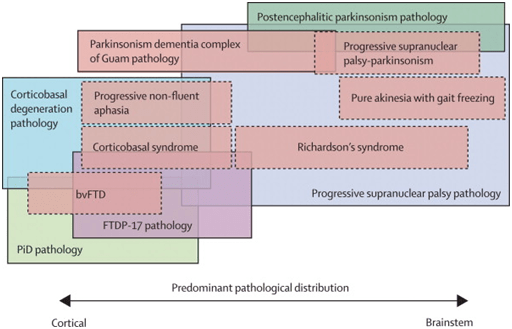
The neurodegenerative diseases are starting to merge. The most obvious level of commonality lies at the cellular level of pathogenesis, where each disease is now hypothesized to include protein misfolding, templating, intercellular spread and damage by oligomers. Within the tauopathies, there is major overlap among “diseases,” as shown in this superb diagram from David Williams and Andrew Lees (Lancet 2009).

The blue, green and purple areas are pathological syndromes and the reddish ones are clinical syndromes. Note that all of the patients with Richardson’s syndrome and PSP-parkinsonism have classic PSP pathology, but the reverse is not true. Corticobasal syndrome is only about half explained by corticobasal degeneration pathology (though the diagram suggests about 85%), most of the rest being PSP and frontotemporal dementia pathology. Similar shortfalls in clinicopathological correlation underlying our traditional definition of a “disease” plague the rest of the tauopathy diagram. A similar diagram can be made for the α-synucleinopathies.

How to explain this to our patients? Our students? Ourselves? I like to think of neurodegenerative diseases as a set of spectrums. As there are only a limited number of neural systems available to damage, inevitably some parts of some of the spectrums will overlap in their anatomical, therefore clinical, phenotypes. This idea may seem unsatisfying to our traditional, neat system of clinicopathological pigeonholes. It’s not as easy to digest as, for example, the “autism spectrum,” where we don’t yet have the messy variable of pathological correlates to contend with. But this state of neo-nosologic confusion is only temporary. Before too long, we will have a long list of genomic, epigenetic, toxic, proteomic variants along with just plain stochastic events that in combination produce neurodegenerative disease. We will then have an understanding of such diseases that is more sophisticated and rational than the current combination of microscopical, biochemical and clinical abnormalities. These insights will render our present concept of “a disease” obsolete and make it much easier to devise prevention for most of these conditions.