Neuroprotective tangles

Prompted by a reader’s comment a few days ago, I thought I should write about the difference between “neuroprotective” and “symptomatic” treatment.  The distinction is relevant to the PSP treatment trials about to start and to one’s decisions about whether to volunteer for them.

Neurodegenerative diseases, by definition, progress over time and neuroprotective treatments attempt to slow that process, not to provide relief from existing symptoms.  In theory, such treatments could be so miraculously effective as to halt the process in its tracks, but a realistic best-case target given our current understanding of these diseases is a 40%-50% slowing of the rate of future progression. Most PSP trials are designed to detect about a 25%-30% slowing.  A trial large enough to detect more subtle degrees of slowing would be prohibitively expensive.

For a drug to improve the existing PSP symptoms or disabilities, as levodopa improves those of Parkinson’s, for example, would require replacing a molecule deficient in the brain cells that still survive and function, or stimulating the surviving cells to work harder, or modulating the activity of other, healthy, brain cells to partly compensate for the effects of the damaged cells.  Such drugs do exist for PSP, but their benefits are modest and temporary, and the underlying neurodegenerative process continues.  In Parkinson’s, levodopa gives dramatic and long-lasting symptomatic benefit, but even there, the degenerative process continues unabated.

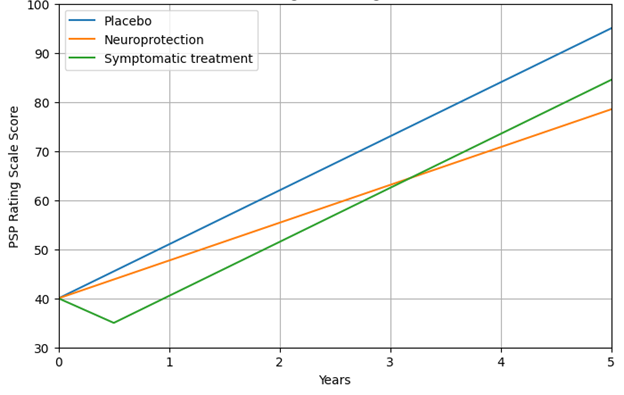
The graph below illustrates all this:

  • The vertical axis is the PSP Rating Scale, where 100 is the worse possible score and the average rate of worsening is about 11 points per year.  At a score of about 80, fatal complications such as pneumonia or severe urinary tract infections become very common.  Note that to avoid displaying blank space, the axis starts at 30 points, not zero.
  • The horizontal axis is years since the start of the treatment (the “baseline”).  You can see that for purposes of this illustration, I’ve chosen a baseline PSPRS score of 40, which conforms to experience with previous trials and to the observation that the average person with PSP doesn’t receive that diagnosis until about three years after symptom onset.
  • The blue line represents the course of the disease untreated.  In a drug trial, there’s usually a placebo effect, but to keep things simple, the graph ignores that.  Besides, that effect would dissipate over a couple of months at most.
  • The orange line represents the course 30% slower than that of the placebo group.  Note its shallower slope.  Again, for simplicity I show the effect as starting immediately upon receiving the drug even though some neuroprotective effects may take a few months to get going.
  • The green line shows a symptomatic effect, which in this example starts immediately and lasts years.  I’ve semi-arbitrarily chosen its magnitude to be five PSPRS points and the time to maximum benefit as six months.  At that point the rate of progression of the underlying disease continues unabated, but the five-point symptomatic benefit persists.  Note that the participants on such a drug are doing better than those on the successful neuroprotective drug until a bit after the three-year point, when the lines cross, and the advantage of the neuroprotection continues to widen.

HYPOTHETICAL COMPARISON OF EFFECTS OF PLACEBO,

NEUROPROTECTIVE AND SYMPTOMATIC TREATMENTS OF PSP

I’ll emphasize that while the 11 points per year rate of progression is based on real data, the 30% slowing of the rate of progression is only an illustrative example for the purpose of this instructional exercise. The five-point symptomatic improvement is analogous to the magnitude of improvement of Alzheimer’s disease treated with cholinesterase inhibitors such as donepezil, galantamine and rivastigmine.

The death of a brain cell isn’t like an incandescent light bulb suddenly burning out – it’s more like a slowly fading LED bulb.  During that “ill” phase, it might be possible for a candidate neuroprotective treatment to instead (or in addition) have a symptomatic effect. 

With all that as background, here are some conclusions:

As you’d imagine, it could be difficult to tell neuroprotective from symptomatic (or placebo) effects, as they’re both being measured by the same PSP Rating Scale.  But clinical trials in PSP try to anticipate this by testing for more objective evidence of slowing of brain cell loss, for example by assessing atrophy on MRI or spinal fluid levels of a protein called neurofilament light chain (NfL), which increases steadily in PSP and some other disorders. Placebo and symptomatic improvement would not be reflected in those diagnostic markers.

    Neuroprotection trials also perform their first repeat exams in the first few weeks and months to look for a rapidly-appearing difference in PSPRS scores between the active drug group and the placebo group. (MRI and NfL would not be useful so soon after baseline.)  However, it would be difficult to decide whether such a PSPRS improvement is placebo effect or symptomatic effect.

    There’s another way to distinguish a placebo effect from a physiologic effect (we avoid the term “real” because placebo effects are also real in their own way).  That’s to assess the participants for worsening couple of months after the trial’s end, when any symptomatic effect would have dissipated.  I haven’t seen the PRESERVE (Novartis’ NIO752 trial) protocol and its clinicaltrials.gov entry doesn’t address the matter, but I expect that it plans to do this, if only to monitor any adverse effects of the drug. 

    Bottom line: In a Phase 3 trial in a neurodegenerative disease, separating true neuroprotection from symptomatic and placebo effects is tricky. In future blog posts, I’ll try to sort out that tangle for you if I can.

    PS #1: For an excellent, very recent review of the placebo effect, see this paper, which is written in language easily comprehensible to educated laypersons.

    PS #2: Disclosure: I consulted for Novartis from 2018 to 2020, but not since. I have never held stock or any other financial interest in the company. But I do hold a major emotional interest in seeing their drug work, so there’s that.

    A good problem to have

    Now, this is progress.  Novartis just yesterday announced in clinicaltrials.gov that its Phase 3 trial of NIO752 is ready to accept volunteers for screening. The name of the trial is PRESERVE.  Good name.  No, it’s not an acronym for anything.

    So far, the company has only announced three trial sites (Rochester, MN; Englewood, CO; and Ulm, Germany) but dozens more will follow, with a total recruitment goal of 300.  Here are some details of probable interest to potential volunteers:

    • The drug is an antisense oligonucleotide, which as you’ve learned from this blog, interferes with the brain cells’ ability to translate the RNA from a specific gene into its protein.  In this case, the protein is tau, which lies at the heart of PSP.
    • As a very large molecule, NIO752 cannot pass the blood-brain barrier, so it has to be injected directly into the cerebrospinal fluid in the lower spine, using the same procedure as a diagnostic spinal tap (lumbar puncture).  This will be given every three months, assuming it follows the plan of the Phase 1 study.
    • A trial of the drug for safety in 45 people with PSP showed no important or permanent adverse effects from the procedure – just harmless and transient headaches or back pain in some.  Some transient confusion or lethargy occurred in three of the 45 – an effect of the drug, not the injection procedure.
    • The trial will enroll 300 participants overall, of whom 100 will be randomly chosen to receive a placebo injection.  That treatment assignment will be double-blind — not revealed to participant or neurological staff until the whole trial is over.
    • The duration of the double-blind period will be 72 weeks – about a year and a half.  After that, all the patients will be offered the opportunity to continue receiving the drug at no cost, as long as it has not been found to be harmful, and as long as Novartis is still manufacturing it.  That “open-label extension” program may end if and when the drug works and is on the market (let us pray).

    Your big question right now should be this: Should I volunteer for the PSP Trial Platform (PTP) or PRESERVE?  The scheduled start for PTP is next month (June 2026), and those sites will roll out gradually, just like the PRESERVE sites.  So, in theory, there’s no overall difference in the timing, though a site near you might open for one study well before the other, or there may be an accessible site for one and not the other.  All the PTP drugs and NIO752 are similarly and acceptably safe, in my view.

    Right now, I’d say volunteer for PRESERVE, though by a slim margin.  Two reasons, each minor:

    • Like any large, complicated project requiring approvals from government, private companies and academic institutions, the PSP Trial Platform has been subject to unforeseen delays.  (All major drug trials require collaboration among these three, but the PTP is more complicated than most.) In fact, the company sponsoring one of the three drugs planned for the PTP has still not finalized the arrangements, according to clinicaltrials.org. If that can’t be accomplished soon, the trial will start with only two drugs.  So, a bird in the hand . . .
    • The PRESERVE trial will have an open-label extension (see the caveats above), while the PTP has not yet decided on that, and it may differ across the different drugs.  Without an open-label extension, someone completing the Phase 2 trial would have to wait until the Phase 3 is finished and the drug approved before gaining access to it.  On the other hand, the FDA has been known to approve drugs for general use after only a Phase 2 if the need is great, and for PSP, it surely is. The PTP double-blind trials are 12 months long and the PRESERVE double-blind is nearly 18 months, so assuming both offer open-label extensions, someone on placebo in PRESERVE would have to wait six months longer to receive their active drug than someone in the PTP.

    Yes, there are other drugs whose sponsors are optimistic that trials will start within the next year or so.  Those include bepranemab (a monoclonal anti-tau antibody), GV1001 (an anti-inflammatory), ARV-102 (an enhancer of abnormal tau degradation) and TPN-101 (an inhibitor of a toxic protein called LINE-1).  But the timelines there are just too uncertain for someone with PSP to consider right now.

    Maybe the most important consideration is which drug is mostly likely to work.  I honestly don’t know, and the Phase 1 data don’t answer that question.  So that simplifies things a bit.

    A difficult choice, I know, but a good problem to have. 

    ASOs: sci-fi takes a step closer to reality

    Great news from Biogen about an antisense oligonucleotide (ASO) designed to reduce production of the tau protein. 

    First, some background: Most of you have heard about ASOs, but for a refresher, see these posts of mine from 2022 and 2026.  Here’s a slightly more technical but cutely animated explanation of ASOs from Harvard Medical School:

    The elevator version is that an ASO is a short length of RNA that binds and inactivates the brain’s messenger RNA for a specific protein – or an abnormal version thereof – to prevent it from carrying the protein’s genetic code from the DNA to the protein-manufacturing machinery.  In theory, the production of any protein involved in the cause of a disease can be reduced by designing an appropriate ASO to bind to a segment of that protein’s messenger RNA.

    The FDA has approved only one ASO so far – for a childhood muscle disorder called spinal muscular atrophy – but dozens of other ASOs are in the development pipeline for other conditions, including tauopathies. Biogen is currently testing its anti-tau ASO, called diranersen (formerly BIIB-080) against Alzheimer’s, by far the most common tauopathy.  A few days ago, they announced the results of a Phase 2 study of its safety and tolerability.  Here’s Biogen’s press release and here’s the description of the trial (without results) in clinicaltrials.gov. 

    Diranersen was well-tolerated in people with Alzheimer’s, as expected based on the Phase 1 results.  The big news was that the rate of accumulation of abnormal tau protein aggregation actually did slow down, as measured by levels of tau in the spinal fluid and by positron emission tomographic (PET) images of the tau protein’s distribution in the brain. The press release didn’t say how much slowing occurred, but it was apparently enough to convince Biogen to proceed to a Phase 3 trial and to convince the FDA to let them do so. More details will be presented at the Alzheimer’s Association International Conference in London in July 2026.

    The trial was not primarily designed to assess slowing of progression of the participants’ actual cognitive loss, but it gathered that information anyway in various forms.  The primary such test, called the “Clinical Dementia Rating Scale Sum of Boxes,” measures memory, orientation, judgment/problem solving, community affairs, home/hobbies, and personal care. It did not show a statistically significant slowing of progression for diranersen in Alzheimer’s, but the press release hints that there was some slight, statistically non-significant, degree of slowing.  

    That’s all about Alzheimer’s. For PSP, a different company, Novartis, is testing a different anti-tau ASO (NIO-752).  It is also well tolerated, as demonstrated by a recently-completed Phase 1 trial.  If the brain’s accumulation of abnormal tau can be slowed down in Alzheimer’s disease, as the Biogen press release claims, then presumably PSP can achieve the same result.  Novartis says it’s still (as of May 15, 2026) analyzing its Phase 1 PSP efficacy results, but those would have to be spectacular to show statistical significance in so small a study.  That company will soon start testing NIO-752 in a Phase 2 PSP trial in the US and other countries, so keep an eye on clinicaltrials.gov for enrollment instructions.

    Given these new results of one anti-tau ASO in one tauopathy, what are the prospects for a different anti-tau ASO in a different tauopathy?  I’ll duck the issue and call them promising but far from a slam dunk. That will be the topic of a future post, but what I can say right now is even these modest, preliminary signs of success with ASOs in tauopathies would have been science fiction back when I was in med school 50 years ago.

    A report from the ASO front

    The Comments section just received a trial participant’s personal report and some good questions about the anti-sense oligonucleotide (AS0) trial sponsored by Novartis.  As explained in my last post, all the patients in that trial have completed their participation and the data are being analyzed.  First, here’s the comment unedited (except for correcting the location of the PSP conference and my bracketed clarification in the fourth line), followed by my response.

    IT WORKS! My husband was in the trial. No cure but a great year – his condition was improved in so many ways. I have been waiting for someone at Cure PSP to put out the word. I assumed they were going to present at the Toronto conference but they did not.

    We are so sad they [Novartis] refuse to continue to give it to us. Novartis has a published policy to keep giving people in a trial drugs that provide help but denied us with the excuse it was phase 1. Even if it is too expensive when administered through the spine it provides evidence that this horrible disease can be managed and greatly improves life. We would love to go to Novartis and show them how it works. Hopefully they are not just proceeding on using it for Alzheimers. We have been watching and waiting to see if they release results. They need to publish them. HOPE MATTERS! Kathy and Steve from San Diego, California.

    Kathy and Steve:

    I’m so glad that you, Steve, had symptomatic benefit from NIO752.  You raise several good points deserving separate responses:

    • The known molecular mechanism of the drug would merely slow down, or hopefully halt, the future worsening of the disease, not improve it in absolute terms.  People entering clinical trials may start paying new attention to their health and changing their habits regarding diet, hydration, exercise, physical and other types of therapy, compliance with concomitant medication, and discontinuation of unnecessary concomitant medication that might have been producing side effects.  There’s also the possibility of a placebo effect.  All this, of course, could make someone entering the trial feel better and is why establishing true drug efficacy requires a control group. 
    • The reason not to provide the drug post-trial to Phase 1 trial completers is that the purpose of Phase 1 is to establish safety, and until that trial is over and the data analyzed, the drug’s safety remains unknown in people with PSP.  Even if the trial is over and the drug found to be safe, that applies only to the duration of the trial.  So, allowing a trial completer to continue to receive the drug for longer would be taking a safety risk, and there would no longer be a placebo group to use in assessing the magnitude of that risk.
    • That said, there’s a slight theoretical possibility that the reduction in tau production caused by NIO752 could actually allow recovery of normal function by some brain cells that were malfunctioning but still salvageable, producing an immediate symptomatic improvement.  But that might have no relationship to any long-term neuroprotective benefit.
    • I do have some good news in response to your hope that Novartis is still pursuing PSP rather than just Alzheimer’s.  I’ve heard that the company has been seeking information useful for the design of an efficacy PSP trial.  That suggests that such a trial is being at least provisionally planned. 
    • The results of Phase 1 trials are not always be published in journals, but they are often presented as posters at conferences and are announced by the company in the form of press releases.
    • Yes, HOPE DEFINITELY MATTERS!

    NIO752 update

    Today reader RW posted a comment asking about the status of the NIO752 trial. I thought my answer was so, SO well-crafted and informative that I just had to promote it from a comment response to a full blog post, and here it is:


    RW:

    First, for the benefit of your fellow readers, NIO752 is the anti-sense oligonucleotide from Novartis. An ASO is a short span of RNA injected into the spinal fluid space. In this case, the injections are given four times: every three months for a year. The drug reduces production of tau at its source — where its gene is transcribed into protein. In my opinion, it’s more likely to work against PSP than any other past or current experimental drug. However, the need for the spinal injections could limit its appeal, especially if one or more of the oral (i.e., more convenient) drugs currently in more advanced stages of clinical testing reach the market first.
    The Phase 1 NIO752 trial ended a month or so ago and Novartis, apparently, is still crunching the numbers. It’s typical for that to take 2 or 3 months, so I wouldn’t infer anything from it. Keep in mind that this was only a Phase 1 trial, powered to assess safety, not efficacy. I haven’t heard anything through the grapevine about major safety problems during the trial, but you never know what the actual data might show or how the company might react in terms of continuing to advance the drug into a Phase 2 trial.
    LG