We tauopathies have to stick together

A post from two months ago explained why some positive results from a trial of an antisense oligonucleotide (ASO) drug for amyotrophic lateral sclerosis (ALS) is good news for PSP. Now, there’s similar but even better news about an ASO drug for Alzheimer’s disease called “diranersen.” Why better? Because unlike ALS, Alzheimer’s disease is a tau-based disorder, like PSP.

Quickie review: ASO drugs interfere with the action of messenger RNA, which is produced by a gene in the cell’s nucleus and carries it out to the ribosomes, where it’s translated into that gene’s specific protein. Trials of “neuroprotective” treatments hope to demonstrate a decline in the rate of worsening relative to placebo, affording the participant more time at each disease stage. Neuroprotective treatments like ASOs are not designed to produce improvement relative to the study’s baseline.

Yesterday (July 14, 2026) the results of a Phase 2 trial were released at the Alzheimer’s Association’s annual research conference in London. The double-blind design included 406 people with either “mild cognitive impairment” (MCI) or mild dementia caused by Alzheimer’s. (MCI does not include difficulties in performing daily activities and dementia does. For the purposes of the trial, MCI is defined as a score of 21-27 on the 30-point Mini-Mental Status Exam and dementia as 20 or less.) The participants were randomly assigned to one of three dosage levels or placebo for the 76 weeks of the double-blind period. The improvement was calculated as the difference between the first and last visit scores divided by the the first visit score.

The testing included five standard cognitive tests, tau levels in the spinal fluid, and positron emission tomography (PET) scans to image brain tau deposits. The drug, like all ASOs to date, is administered by injection into the spinal fluid space at the base of the spine, as for a spinal tap. Of those seven tests, the “primary outcome measure” was the Clinical Dementia Rating Sum of Boxes (CDR-SB), presumably because it’s the one with the most experience behind it.

Officially, the trial was negative because the CDR-SB failed to show a statistically significant slowing of the rate of worsening. But for two of the other four cognitive measures, there were statistically significant degrees of slowing of 50% in one and 42% in the other. The benefits shown by the PET and spinal fluid look equally impressive to my eyeballs, but their degree of statistical significance was not provided.

Transient pain in the head, limbs and/or back from the spinal taps were by far the most common side effects, occurring in about half of all participants, but no worse on diranersen than on placebo. The only side effect clearly worse on diranersen was a temporary confusional state (about 25% vs 5% on placbo). In all cases, it was gone within a week.

You can see and download the company’s detailed announcement here. Keep in mind that the drug company sponsor, Biogen, wrote it for public relations purposes. It is not sufficiently detailed for a research journal and has not been peer-reviewed, but Biogen has announced plans for an expensive Phase 3 trial, proving that they’re willing to put their money where their mouth is.

Biogen hasn’t parted with further details on the Phase 3, but if it starts in 2027 and is similar in design to the Phase 2 (but larger), one might expect results in 2030 and if all goes well, FDA approval shortly thereafter. Too long, I know, and besides, that’s Alzheimer’s — not PSP.

Of course, the elephant in the room is the trial of NIO-752, the ASO from Novartis, currently in a Phase 3 trial for PSP and stated for completion in mid-2029. The success to date of diranersen in Alzheimer’s, is excellent news for the prospects of a similar anti-tau ASO for PSP. As far as I know, there’s no clinically relevant difference between the two ASOs.

On behalf of the PSP community, I’ll thank Novartis for its efforts behind NIO-752 and encourage Biogen to extend its so-far-favorable Alzheimer’s program to PSP. Any other Pharma companies interested? The opportunity is ripe!

—–

Disclosure: In the past, I have consulted for both Novartis and Biogen, but have never had a financial interest in either company. The only possible exception is that Rutgers University, which owns the rights to the PSP Rating Scale because I was a professor there when I developed it, shares a fraction of its licensing fees with me.
Neuroprotective tangles

Prompted by a reader’s comment a few days ago, I thought I should write about the difference between “neuroprotective” and “symptomatic” treatment.  The distinction is relevant to the PSP treatment trials about to start and to one’s decisions about whether to volunteer for them.

Neurodegenerative diseases, by definition, progress over time and neuroprotective treatments attempt to slow that process, not to provide relief from existing symptoms.  In theory, such treatments could be so miraculously effective as to halt the process in its tracks, but a realistic best-case target given our current understanding of these diseases is a 40%-50% slowing of the rate of future progression. Most PSP trials are designed to detect about a 25%-30% slowing.  A trial large enough to detect more subtle degrees of slowing would be prohibitively expensive.

For a drug to improve the existing PSP symptoms or disabilities, as levodopa improves those of Parkinson’s, for example, would require replacing a molecule deficient in the brain cells that still survive and function, or stimulating the surviving cells to work harder, or modulating the activity of other, healthy, brain cells to partly compensate for the effects of the damaged cells.  Such drugs do exist for PSP, but their benefits are modest and temporary, and the underlying neurodegenerative process continues.  In Parkinson’s, levodopa gives dramatic and long-lasting symptomatic benefit, but even there, the degenerative process continues unabated.

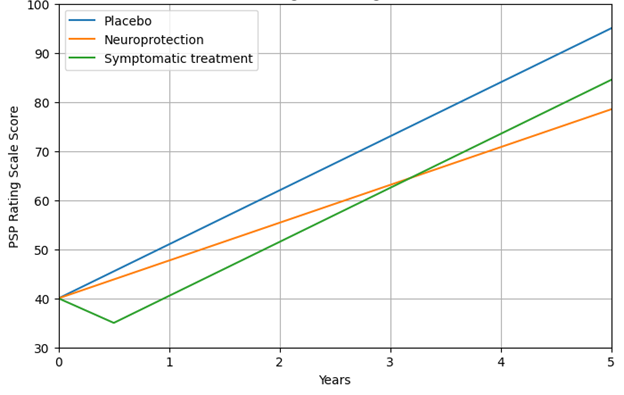
The graph below illustrates all this:

  • The vertical axis is the PSP Rating Scale, where 100 is the worse possible score and the average rate of worsening is about 11 points per year.  At a score of about 80, fatal complications such as pneumonia or severe urinary tract infections become very common.  Note that to avoid displaying blank space, the axis starts at 30 points, not zero.
  • The horizontal axis is years since the start of the treatment (the “baseline”).  You can see that for purposes of this illustration, I’ve chosen a baseline PSPRS score of 40, which conforms to experience with previous trials and to the observation that the average person with PSP doesn’t receive that diagnosis until about three years after symptom onset.
  • The blue line represents the course of the disease untreated.  In a drug trial, there’s usually a placebo effect, but to keep things simple, the graph ignores that.  Besides, that effect would dissipate over a couple of months at most.
  • The orange line represents the course 30% slower than that of the placebo group.  Note its shallower slope.  Again, for simplicity I show the effect as starting immediately upon receiving the drug even though some neuroprotective effects may take a few months to get going.
  • The green line shows a symptomatic effect, which in this example starts immediately and lasts years.  I’ve semi-arbitrarily chosen its magnitude to be five PSPRS points and the time to maximum benefit as six months.  At that point the rate of progression of the underlying disease continues unabated, but the five-point symptomatic benefit persists.  Note that the participants on such a drug are doing better than those on the successful neuroprotective drug until a bit after the three-year point, when the lines cross, and the advantage of the neuroprotection continues to widen.

HYPOTHETICAL COMPARISON OF EFFECTS OF PLACEBO,

NEUROPROTECTIVE AND SYMPTOMATIC TREATMENTS OF PSP

I’ll emphasize that while the 11 points per year rate of progression is based on real data, the 30% slowing of the rate of progression is only an illustrative example for the purpose of this instructional exercise. The five-point symptomatic improvement is analogous to the magnitude of improvement of Alzheimer’s disease treated with cholinesterase inhibitors such as donepezil, galantamine and rivastigmine.

The death of a brain cell isn’t like an incandescent light bulb suddenly burning out – it’s more like a slowly fading LED bulb.  During that “ill” phase, it might be possible for a candidate neuroprotective treatment to instead (or in addition) have a symptomatic effect. 

With all that as background, here are some conclusions:

As you’d imagine, it could be difficult to tell neuroprotective from symptomatic (or placebo) effects, as they’re both being measured by the same PSP Rating Scale.  But clinical trials in PSP try to anticipate this by testing for more objective evidence of slowing of brain cell loss, for example by assessing atrophy on MRI or spinal fluid levels of a protein called neurofilament light chain (NfL), which increases steadily in PSP and some other disorders. Placebo and symptomatic improvement would not be reflected in those diagnostic markers.

    Neuroprotection trials also perform their first repeat exams in the first few weeks and months to look for a rapidly-appearing difference in PSPRS scores between the active drug group and the placebo group. (MRI and NfL would not be useful so soon after baseline.)  However, it would be difficult to decide whether such a PSPRS improvement is placebo effect or symptomatic effect.

    There’s another way to distinguish a placebo effect from a physiologic effect (we avoid the term “real” because placebo effects are also real in their own way).  That’s to assess the participants for worsening couple of months after the trial’s end, when any symptomatic effect would have dissipated.  I haven’t seen the PRESERVE (Novartis’ NIO752 trial) protocol and its clinicaltrials.gov entry doesn’t address the matter, but I expect that it plans to do this, if only to monitor any adverse effects of the drug. 

    Bottom line: In a Phase 3 trial in a neurodegenerative disease, separating true neuroprotection from symptomatic and placebo effects is tricky. In future blog posts, I’ll try to sort out that tangle for you if I can.

    PS #1: For an excellent, very recent review of the placebo effect, see this paper, which is written in language easily comprehensible to educated laypersons.

    PS #2: Disclosure: I consulted for Novartis from 2018 to 2020, but not since. I have never held stock or any other financial interest in the company. But I do hold a major emotional interest in seeing their drug work, so there’s that.