Let’s pick up and dust off

Some not-so-good news, I’m afraid: ORION trial has been discontinued for lack of benefit.

A combination of two oral drugs collectively called AMX0035 has been in a double-blind trial since late 2023. One component, sodium phenylbutyrate (brand name Buphenyl), helps brain cells get rid of misfolded, worn out or defective proteins, including tau. The other, taurursodeoxycholic acid (brain name TUDCA), stabilizes dysfunctional mitochondria. Both drugs are known to be safe in non-PSP populations, as they have long been approved and marketed for other conditions.

A few days ago, with about half of the ORION subjects having completed their 12-month double-blind observation, the sponsoring company performed an interim analysis. Their statisticians, under strict secrecy rules, “peeked” at the active drug vs. placebo assignments, comparing the groups on their degree of worsening on the PSP Rating Scale since the first visit. They found no difference, which means that allowing the remaining patients to complete their double-blind observation could never show a statistically significant improvement for the trial as a whole. Nor was there any slowing of progression on any of the secondary efficacy measures such as brain atrophy on MRI. Fortunately for the study participants, the frequency and severity of adverse effects were very low in both the active drug and placebo groups.

Where does PSP go from here, trial-wise?  Lots of places:

  • The trial of FNP-223, an oral drug that reduces abnormal phosphorylation and misfolding of tau, is nearly complete.
  • A trial of NIO-752, an anti-sense oligonucleotide injected into the spinal fluid that reduces the manufacture of tau, will start in a few months.
  • The PSP Platform Trial, which has teed up two two drugs and expects a third soon, should start later this year if changes in its NIH funding don’t stand in the way. Those are an active anti-tau vaccine called AADvac1 and AZP-2006, an oral drug that reduces inflammation and helps brain cells dispose of garbage. They will be tested separately, but using a common control group.
  • The trial of GV-1001, a subcutaneous injection that works at the RNA level to reduce brain inflammation, will probably start in 2026 or late 2025 if all goes well.  

Two drugs a bit further behind in the pipeline, based on my reading of the tea leaves, are:

  • bepranemab, an anti-tau monoclonal antibody for intravenous infusion and
  • an oral reverse transcriptase inhibitor called censavudine, where the results of the Phase I trial are sparsely reported to date.

That makes five new drugs to start trials within the next year or so — plus another one or two slightly later.

I liked the ORION trial’s idea to give two drugs simultaneously to address two different parts of PSP’s pathogenesis. Many PSP experts feel that at least that many drugs will be needed to do much to slow the progression of this complex disease. That’s what has proven necessary for things like AIDS, severe hypertension and many kinds of cancer. Those are only a few examples of multi-pronged attacks turning life-threatening, progressive diseases into chronic, manageable, non-disabling conditions.

I’m bullish on the same kind of thing happening to PSP.
Four reasons to hope

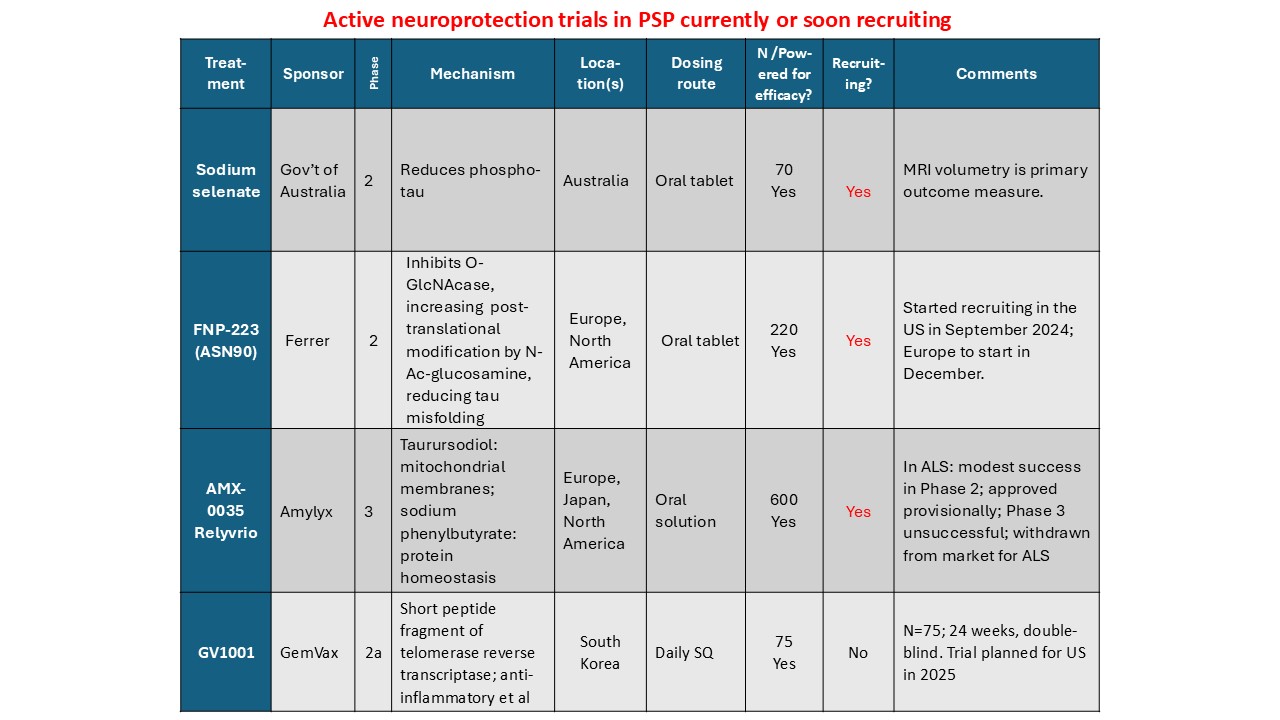
It’s high time I updated you on currently – or imminently – recruiting PSP clinical trials.

Here are the four in chronological order. All these are for “neuroprotection,” meaning slowing of the underlying disease process. They don’t attempt to improve the existing symptoms, however. That’s called “symptomatic” treatment and I’ll get around to that soon.

More details:

Sodium selenate provides supplemental selenium, which is critical for the function of 25 human enzymes with a wide range of functions. Two are relevant to PSP: glutathione peroxidase 4 and protein phosphatase 2A. The first regulates one type of programmed cell death and the second removes phosphate groups abnormally attached to the tau protein. The trial is happening only in Australia. See here for details, including contact information.

FNP-223 inhibits an enzyme called 0-GlcNAcase (pronounced “oh-GLIK-nuh-kaze”), which removes an unusual sugar molecule from its attachment to tau. The sugar is called N-acetyl-glucosamine and it prevents abnormal tau from attaching at the same spots on the tau molecule. It’s an oral tablet and the trial, which has just started, will be in both Europe and North America. Click here for details and contact info.

AMX-0035 is a mixture of two drugs in an oral solution. Both are currently marketed for conditions unrelated to neurodegeneration. The PSP trial has started in North America and will do so in Europe and probably Japan in the next few months. One of the two drugs, called sodium phenylbutyrate (marked as Buphenyl), addresses the brain cells’ management of abnormal proteins. The other, taurursodeoxycholic acid, marketed as TUDCA, helps maintain the mitochondria. Click here for details and contact info.

Finally, GV-1001 is an enzyme with anti-inflammatory action in the brain. But it’s not like a steroid or non-steroidal anti-inflammatory drug. It acts by an mechanism that the drug company is keeping close to its chest and has something to do with DNA transcription into proteins. The drug has to be injected subcutaneously every day, like insulin. A small trial is in progress in South Korea and in you live there, here’s enrollment info. There are plans to start a trial in the US in 2025, but that could depend on the current trial’s outcome.

Soon, I’ll post something on neuroprotection trials in which the double-blind recruitment is over but the results are pending. After that will be symptomatic trials.

With all these trials in progress, CurePSP’s “Hope Matters” tagline is truer than ever.

I’m glad you asked that . . .

Yesterday a reader left a comment regarding my 2/29/24 post on the ORION trial (of the drug AMX-0035) and I responded on the comments page. But I thought the comment was so well expressed and possibly so widely shared by my readers that it deserved more of a platform. So I turned the question and my response into this post.

Hello Dr. Golbe,

Thank you for the information and data on the AMX-0035 trial. I cannot help but share my thoughts.

The endpoint of this trial, if I understand correctly, is to slow the progression of the disease’s natural course. How is this to be assessed via the PSPRS? An absence of a rise in the score over time or an improvement in the score? If the goal is to prevent a rise in the score over time, is there a known rate at which the PSP-RS usually rises in the absence of any intervention in order to compare this to?

I hesitate to bring this next concern up, however I feel that I need to. In the absence of any known treatment for PSP, if this trial is successful then this is quite good news – anything that helps in any way is good news. However, is it really? The quality of life for a patient with PSP is terrible as you (or anyone who has ever cared for or evaluated a patient or loved one with PSP) know. Therefore is extending this poor quality of life by a year truly a success? The reason I bring this up is because I would like to know if perhaps by targeting these molecular and cellular processes within the mitochondria and endoplasmic reticulum, and thus reducing the stress and burden which is on these patients at the cellular level, is there any hope that perhaps there will also be some symptom improvement as a result of a lessening of burden/overload of the system and the brain’s own immune system and other processes being able to more efficiently function or discard of more abnormal proteins? And therefore some (even small) improvement in quality of life. This very well may be completely unknown. I may have asked you this in a prior post. I ask this not to be dismal or morbid but to see if there is even more hope. As you always say, hope is important.

AF

Dear Ms. F,

I think both of your questions are shared by many others.

The answer to you first question, regarding what the patients on the study drug are compared to, is the placebo group. At the time of enrollment, each patient is randomly assigned to receive either the real study drug or an identical-appearing placebo. Of course, this plan is made quite clear in the informed consent process but only the drug company knows the assignments. For the ORION study, 60% will get real drug and 40% placebo.  At the end of the study, the rates of progression of the PSPRS score for the two groups are compared. In this way, we don’t need to know in advance how rapidly PSP progresses. On completing their 12 months of placebo or real drug, each patient will be offered the chance to take the real drug (called the “open-label phase”).

The second question asks about the likelihood of symptomatic benefit, rather than just slowing the rate of worsening. The chance of that is low, but not zero. If the drugs do improve the function of cells affected by the PSP process, some of them may be able to recover but others (probably most) will be beyond saving. Either way, the treatment may allow cells that are still healthy to avoid becoming involved in the disease process at all, or with a major delay. What we don’t yet have is a way to restore the function of the cells already lost, though researchers are busily working on that.

Your second question implies that it may not be worthwhile merely to slow the progression of a disabling condition without curing it or improving its symptoms relative to the study baseline. That’s a legitimate philosophical and ethical question. My own interactions with patients in my decades of practice and my informal poll of this blog’s readers show that even a 25% slowing of progression (the benefit of AMX-0035 in ALS), which would provide one more year of life for people with PSP, would be worth the hassle and risk of side effects of a new drug. Keep in mind that in prolonging survival from three years to four, the drug would not merely prolong the most advanced, disabled stage for another year. Rather, it would prolong the condition in each of the three years by 33%.

I hope this clarifies things a bit.

Dr. Golbe

A clinical trial out of the gates

I hope you will forgive my 24-day posting hiatus.  To make it up to you, I bring good news: The trial of AMX-0035 in PSP is planning to expand its enrollment activities in the next few weeks, and this drug’s track record is unusually encouraging.

The trial, dubbed “ORION” for some reason, initiated enrollment over the past two months at eight sites in California, Florida, Massachusetts, Michigan, Tennessee and Texas.  32 other sites in the US and dozens in Europe and Japan will open in coming months, with a total enrollment target of 600 patients. Those interested can email clinicaltrials@amylyx.com, check clinicaltrials.gov or the company’s own site.   The trial will include a 12-month double-blind period with a 40% chance of assignment to the placebo group, followed by a 12-month open-label period. Trials like this usually take about a year or two to fully enroll, another year for the last enrolled participant to complete the double-blind and another few months to analyze the data.

The drug company is Amylyx Pharmaceuticals, based in Cambridge, Massachusetts.  They held a meeting a few days ago for their US sites’ neurologists and coordinators, where I gave a detailed lesson on proper administration of the PSP Rating Scale, which will be the study’s main outcome measure.  (Disclosure: Amylyx paid me for that presentation and for general advice on the trial’s design but I have no financial interest in the success of the company or the drug.)

The treatment in question is actually two drugs, taurursodiol and sodium phenylbutyrate, both administered orally as a powder stirred into water. The first addresses the dysfunction of the mitochondria in PSP.  The second reduces stress in the endoplasmic reticulum and enhances the unfolded protein response, both of which are also dysfunctional in PSP.  All of these cellular functions are related and lab experiments show that the two drugs combined work better than the sum of their individual effects.

Unlike any of the other new drugs currently or or soon to be tested for PSP, AMX-0035 has been found to help a related disease, amyotrophic lateral sclerosis (ALS or Lou Gehrig disease), where it appears to slow the progression by about 25% and prolongs survival accordingly. The drug, branded “Relyvrio,” won approval from the FDA for ALS last year and is gaining widespread acceptance among neurologists in treating that condition.

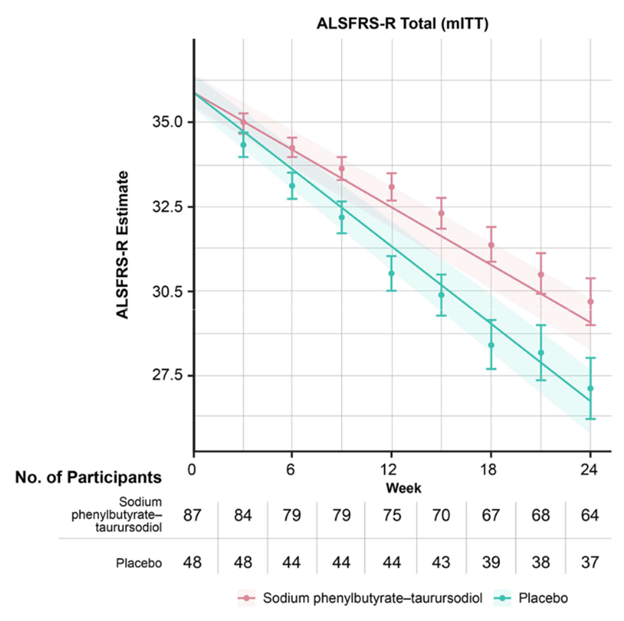
The graph below (from Paganoni et al, New England Journal of Medicine, 2020) shows the worsening of the main ALS disability measure (vertical axis; note that the bottom is not zero) over the 24 weeks of the trial (horizontal axis). The orange line/shaded areas and the means/standard error bars represent the patients on AMX-0035 using two different statistical techniques. The patients on placebo are shown in green.

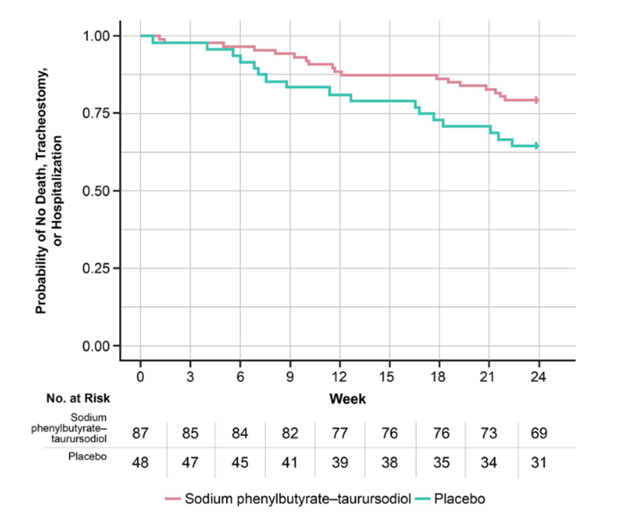
The graph below (also from Paganoni et al), called a Kaplan-Meier survival plot, shows the fraction of patients in the ALS trial remaining alive without tracheostomy or hospitalization (vertical axis) along the 24 weeks of the trial (horizontal axis).

This is great for people with ALS, but that’s not a tau-based disorder like PSP.  However, in a Phase 2 trial in Alzheimer’s disease, which is partly a tau disorder, AMX-0035 did reduce spinal fluid levels of both total tau and of a toxic form called p-tau 181.  That trial was too small and brief to reveal any efficacy of AMX-0035 to slow or halt AD progression but I assume a proper Phase 3 trial will follow. 

Side effects of AMX-0035 in the AD trial have not been published, but in the ALS trial, nausea, diarrhea, excess salivation, fatigue and dizziness occurred in 10% to 21% of patients on the drug and in slightly lesser percentages of those on placebo.

If AMX-0035 shows the same result in PSP as it did in ALS, that means about one additional year of survival for the average patient, and even more if the disease can be diagnosed earlier.  Potential game-changer.  I’ll keep you updated.

The mighty-chondria

When someone with PSP reports a feeling of “weak muscles” to their neurologist, the answer is typically, “yes, you’re weak, but the problem isn’t in your muscles – it’s in the messages to your muscles from your brain.”  But it turns out that in PSP, muscles can be a problem, too, and that opens up some treatment potential.

We’ve known for decades that the mitochondria aren’t working right in PSP and other neurodegenerative diseases.  You’ll recall that those are the tiny factories in almost all our cells devoted to the biochemical process of respiration – that where oxygen and sugar combine to produce energy for the cell’s many functions.  Besides that very important job, mitochondria are also involved in processes such as neural plasticity (the ability of brain cells to react to external influences), calcium regulation, electrical properties of the cell and synaptic transmission.

Here’s a electron microscope photo of a single mitochondrion (from this source).

What brain cells and muscle cells have in common is the need to maintain very different concentrations of potassium between themselves and the surrounding fluid (called a “gradient”), and that takes lots of energy.  So, any defect in mitochondria will tend to hurt brain cells and muscle cells first and worst.  In fact, childhood neurological dysfunction and muscle weakness are the two main features of a whole category of diseases caused by single-gene mutations affecting proteins used only by mitochondria.

In PSP, the mitochondrial problem is more subtle, but we don’t know exactly what it is or what causes it.  Here are some strands of evidence:

  • Brain cells growing in a dish that have had their own mitochondria destroyed and replaced by mitochondria isolated from blood cells of people with PSP don’t recover from various kinds of stress as well the same brain cells with replacement mitochondria from healthy people. 
  • Toxins damaging an important series of chemical reactions in the mitochondria called Complex I can cause a PSP-like condition in lab animals. 
  • Complex I and other components of mitochondria are also damaged by tau molecules with an abnormal number or location of attached phosphate molecules (“phospho-tau”), which we know occur in PSP.  The net effect is excessive levels of “free radicals,” which are toxic by-products of normal respiration.
  • While the most important gene mutation contributing to PSP risk is in MAPT, which encodes tau, the next-most important is PERK (protein kinase RNA-like endoplasmic reticulum kinase), which regulates the responses to stress in mitochondria.
  • Coenzyme Q-10, a nutritional supplement that assists Complex I, may help some of the immediate symptoms of PSP, as shown by at least one double-blind trial.

All the above is simply background justification to suspect that muscles and not just brain should be involved in PSP.  But there’s more direct evidence, too:

  • Muscle weakness and fatigue are more common in PSP than in others of the same age.
  • Weight loss is common in PSP and occurs early in the disease course.  The same is true for both in Parkinson’s, but not as markedly.
  • Grip strength is impaired in PSP.  That could be a result of changes in the brain, but the duration of the muscle fiber contractions is prolonged in PSP, a sign of muscle dysfunction.
  • Men (but, oddly, not women) with PSP have a reduced overall muscle mass relative to others of the same age. 
  • Muscle biopsy in people with PSP shows modest evidence of the same severe change in mitochondria (called “ragged red fibers”) that occur in the genetic mitochondrial diseases of childhood.

So, what’s the take-home for people with PSP? 

  • First, EXERCISE – including low-intensity muscle-building exercises.  Discuss the details first with your neurologist or physical therapist, and probably also with your primary care physician to make sure your heart and lungs are up to the task. 
  • Second, HAVE HOPE that insights into the mitochondrial role in PSP will bring new treatment or neuroprotection targeted at those cellular processes in the brain.  In fact, one such medication, called AMX-0035 (a combination of taurursodiol and sodium phenylbutyrate) will be entering a Phase 3 trial for PSP in the next few months.  The combination under the brand name “Relyvrio” was approved last year by the FDA for Lou Gehrig disease, where there’s a similar mitochondrial problem, so I have very high hopes that the same will happen for PSP.